The most successful door-to-door salespeople aren't necessarily the most outgoing or naturally persuasive. They consistently outperform others because they master a specific set of skills that help them build trust, handle rejection, navigate objections, and guide prospects toward a decision.
Door-to-door sales have always been one of the most demanding forms of selling. There are no scheduled appointments, no inbound leads waiting in a pipeline, and no guarantee that the person behind the door is interested in having a conversation.
The highest-performing reps know how to build rapport quickly, listen actively, manage rejection, handle objections with confidence, and recognize when it's time to ask for the sale.
The good news is that none of these skills is reserved for a select few. They can be learned, practiced, and improved over time. In this guide, we'll explore the seven essential skills that consistently separate top door-to-door salespeople from everyone else, why they matter, and how they impact success in the field.
Key Takeaways
- Consistent door-to-door sales success comes from a small set of trainable skills, not from natural-born talent or sheer effort.
- Resilience, active listening, and objection handling matter more to long-term results than product knowledge alone, especially for new sales reps.
- Most reps lose deals at the opening, not the close. Building rapport in the first thirty seconds shapes everything that follows.
- Strong time and territory management quietly drives more sales than any single pitch improvement, because it puts reps in front of more qualified potential customers.
- Closing is a skill of confidence and timing: top door-to-door salespeople ask for commitment clearly instead of hoping the prospect volunteers.
- Sales leaders who define, coach, and measure these skills create repeatable performance across an entire team rather than relying on a few stars.
Before You Master the Skills: Where to Keep Learning
Successful door-to-door sales organizations rely on more than spreadsheets and scattered notes to manage their operations. As teams grow, having a dedicated platform can make it easier to organize leads, manage territories, and maintain visibility across the sales process.
Knockbase is designed specifically for door-to-door sales teams, providing the tools needed to manage field operations, customer information, and sales activities from a single platform.
See how Knockbase helps teams stay organized and support long-term growth.
What Skills Do Successful Door-to-Door Salespeople Have in Common? 7 Traits That Drive Better Sales Results
There is a version of your field sales team where results stop being a guessing game. Reps start more conversations that actually go somewhere. Objections get handled instead of feared. Follow-up happens on schedule instead of slipping through the cracks. And the number that matters most- closed deals- climbs month after month because the people doing the work finally know which levers to pull.
That version is closer than most teams think, and it doesn't require hiring a roster of "naturals." Door-to-door selling rewards a learnable set of skills more than almost any other form of selling, because every interaction gives you immediate feedback.
The reps who win consistently aren't lucky. They've developed seven specific traits that turn a cold doorstep into a sale. Master those, and you build a field sales operation that grows on purpose instead of by accident.
Why Effort Alone Doesn't Guarantee Door-to-Door Sales Success?
Here's the uncomfortable truth most field sales managers eventually run into: effort and outcomes don't move together the way you'd expect. You can have a rep who knocks more doors than anyone, shows up early, stays late, and still posts a lower success rate than someone working half the hours. When that happens, the instinct is to push for more activity, more knocks, more pitches, more grind, but volume rarely fixes the real problem.
The real problem is that door-to-door selling stacks several hard challenges on top of each other, and weakness in any one of them quietly kills deals before they ever reach the close.
1. Rejection fatigue wears reps down
Door sales is one of the only jobs where hearing "no" dozens of times a day is normal. New sales representatives often start strong, then watch their confidence erode by the third hour.
The drop in energy is visible on the doorstep, and potential customers feel it. A rep who has internalized rejection stops projecting the warmth and certainty that make people want to listen.
2. Weak openings sink conversations instantly
Approaching a stranger at their home is awkward by default, and many reps never learn how to open naturally. They sound scripted, rushed, or salesy in the first five seconds, and the door closes literally and figuratively. The pitch never gets a chance because rapport was never established.
3. Poor objection handling turns interest into a dead end
"I'm not interested." "I already have a provider." "It's too expensive." These aren't rejections; they're the actual starting point of most real conversations.
Reps who panic at the first objection lose deals that a calmer, more skilled person would have navigated. The difference isn't the product. It's the response.
4. Inconsistent follow-up leaks revenue
A huge share of door-to-door deals close on the second or third touch, not the first. Reps who don't track their warm prospects or who let follow-up slip lose sales they already half-earned. This is why many teams adopt door-to-door sales software to ensure every opportunity is tracked and revisited at the right time.
The business consequences compound quickly. Every one of these gaps means more time, more territory burned, and more potential customers turned cold, driving up your cost per deal and dragging down sales performance across the team.
Worse, when you can't pinpoint which skill is failing, you can't coach it, so the same patterns repeat with every new hire. That's exactly why the strongest door-to-door salesperson focus on skill, not just hustle.
The Psychology of Rejection: How Top Door-to-Door Reps Stay Resilient
Rejection is a part of the job description. Even the highest-performing reps hear "not interested," "we're good," and "no thanks" dozens of times a week. What separates top performers isn't their ability to avoid rejection; it's their ability to recover from it without losing confidence, energy, or momentum.
The best reps understand that success in door-to-door sales is a numbers game. They don't measure themselves by the outcome of a single conversation. Instead, they focus on the behaviors that consistently produce results over time: showing up, starting conversations, handling objections, and following the process.
One important mindset shift: top performers don't spend less time facing rejection than everyone else; they simply spend less time dwelling on it. Here’s how they do it in practice:
1. They Don't Tie Their Self-Worth to a Sales Outcome
D2D expert reps understand that a homeowner's decision is influenced by timing, budget, priorities, and dozens of factors outside their control. A rejected offer doesn't mean they're a bad salesperson. By separating personal identity from sales outcomes, they maintain confidence even during difficult stretches.
2. They Treat Every Door as a Fresh Opportunity
Strong reps avoid carrying frustration from one interaction into the next. Whether it's taking a deep breath, resetting their posture, or mentally refocusing between houses, they create small routines that help them start each conversation with positive energy.
3. They Focus on What They Can Control
Top performers know they can't control whether someone answers the door or decides to buy. What they can control is their preparation, attitude, communication, professionalism, and follow-up. Focusing on controllable factors helps them stay motivated regardless of short-term results.
4. They Refuse to Let a Few Rejections Define the Day
One of the biggest mistakes new reps make is turning a handful of rejections into a negative story about their entire day. Successful reps don't assume that three "no's" mean the rest of the afternoon is doomed. They understand that every conversation is independent and deserves a fresh mindset.
5. They Turn Rejection Into Feedback
Rather than replaying unsuccessful conversations emotionally, high performers analyze them objectively. They ask questions such as: "Did I build rapport effectively?" Was my opening strong enough? Did I handle the objection correctly? This mindset transforms rejection from a confidence killer into a learning opportunity.
6. They Protect Their Energy Like a Business Asset
In D2D sales, energy is one of the most valuable resources a rep has. The best salespeople actively manage it through routines, breaks, positive habits, and realistic expectations. They understand that maintaining consistent energy throughout the day often has a bigger impact on results than any single script or closing technique.
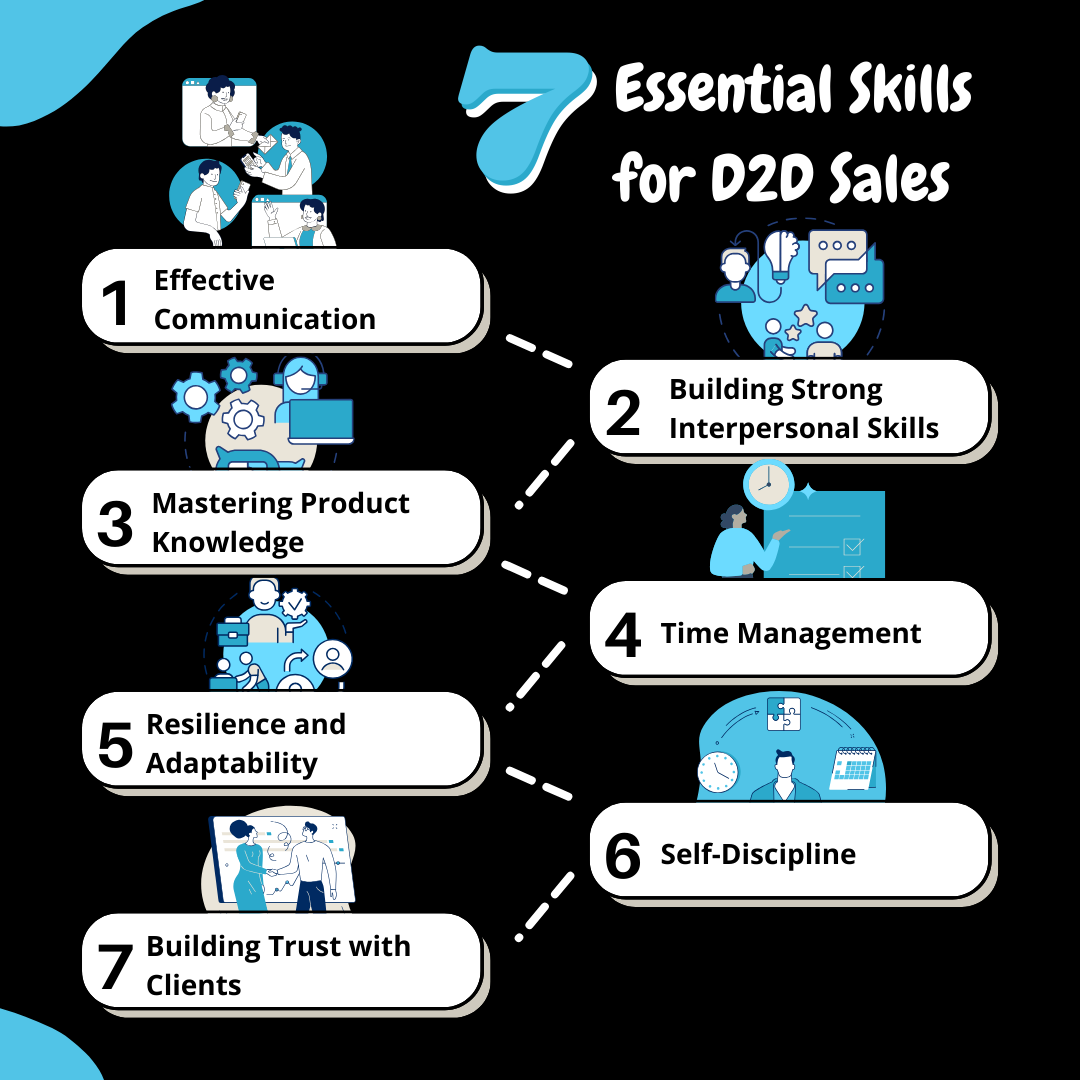
The 7 Skills That Separate Top Door-to-Door Sales Reps From Everyone Else
1. Active Listening
What it is: Genuinely hearing what a prospect says and what they don't say instead of waiting for your turn to talk.
Why it matters: Door-to-door selling lives or dies on understanding customer needs fast. A rep who listens picks up the small signals that reveal what a homeowner actually cares about: a comment about rising energy bills, frustration with a current provider, a renovation they mentioned in passing. Those signals are the whole game. They tell you which benefits to lead with and which to skip.
Common mistakes: Most struggling reps treat the conversation as a monologue. They launch into a fixed pitch regardless of what the person in front of them says, missing the exact information that would have closed the deal. Talking over objections instead of absorbing them is the most common version of this failure.
On the doorstep: A homeowner says, "We just had someone out last month." A weak rep hears a brush-off and retreats. A skilled listener hears an opening: "Oh, you're already looking into this. What did they quote you?"
Now there's a real conversation, built on something the prospect actually told them. Active listening is how you turn a polite deflection into a meaningful connection.
2. Communication and Rapport Building
What it is: The ability to make a stranger feel comfortable within seconds and earn the right to keep talking.
Why it matters: First impressions decide most door-to-door interactions before the pitch even begins. Tone, pace, body language, and warmth do more work than any clever line. People buy from reps they trust, and trust on a doorstep is built almost entirely through how you carry yourself in the opening moments. This is where the personal touch of face-to-face interaction becomes a genuine advantage over digital marketing; you can read the room and adjust in real time.
Common mistakes: Standing too close, talking too fast, leading with high pressure, or sounding rehearsed. Each one triggers the homeowner's guard. Reps who fail here usually don't realize the conversation was lost in the first ten seconds.
On the doorstep: Step back half a pace, smile, and open with something human before anything transactional. "Hey, I know I'm catching you out of nowhere- I'll be quick." That single line lowers defenses and signals respect for their time. From there, a relaxed, conversational tone keeps the door open long enough to establish rapport and earn a real hearing.
3. Resilience and Emotional Control
What it is: The capacity to absorb rejection, reset, and bring the same energy to the next door as you did to the first.
Why it matters: This is arguably the most important skill in all of door-to-door sales. No other selling environment delivers rejection at this volume and frequency.
A rep who can't manage the emotional toll won't just feel worse; they'll perform worse, because flat energy and visible discouragement are obvious to every potential customer they meet. Resilience is what protects sales performance across a long, hard day.
Common mistakes: Taking every "no" personally. Letting a bad stretch bleed into the next conversation. Equating rejection of the offer with rejection of the self. These mental habits quietly end more careers in field sales than any skill gap.
On the doorstep: Top performers build a simple reset ritual: a deep breath, a quick mental note of what to try differently, a deliberate shift in posture before the next knock. They treat each door as independent. The fortieth door gets the same focus as the first, which is exactly why their numbers hold steady when everyone else's collapses by mid-afternoon.
4. Objection Handling
What it is: Calmly and confidently navigating the natural resistance every prospect raises before they buy.
Why it matters: Objections aren't the end of the sales process; they're the middle of it. "I'm not interested," "I already have a provider," and "It's too expensive" are predictable, which means they're coachable. Reps who master objection handling convert conversations that everyone else walks away from.
Common mistakes: Arguing, getting defensive, or immediately discounting the price. Each response confirms the prospect's instinct to say no. The goal is never to "win" the objection; it's to understand it and reframe it.
The framework: Acknowledge, ask, then address. When a homeowner says it's too expensive, a skilled rep doesn't argue. They say, "Totally fair. Can I ask what you're comparing it to?" That single question reframes price as value and reopens the conversation.
"I already have a provider" becomes, "That makes sense; a lot of my best customers were with someone else before they saw the difference here." The mindset underneath it all: an objection is an interest in disguise. People who are truly uninterested simply close the door.
5. Product Knowledge
What it is: Deep, fluent understanding of what you sell and the problems it solves.
Why it matters: Confidence comes from competence. A rep who knows their product or service inside and out answers questions without hesitation, handles technical concerns from skeptical buyers, and projects the certainty that makes people comfortable saying yes.
Whether you're selling solar panels, a pest control plan, or a home services package, fluency lets you connect features to the specific customer needs you uncovered through listening.
Common mistakes: Two extremes. New reps either know too little and get exposed the moment a prospect asks a real question, or they overload the homeowner with every technical detail they've memorized, drowning the conversation in features nobody asked about. Product knowledge is a tool for building trust, not a script to recite.
On the doorstep: The skill isn't reciting specs; it's translating them. A homeowner doesn't care about panel efficiency ratings; they care about a lower bill. Strong reps use product knowledge to answer the question behind the question, connecting what they sell directly to the outcome the customer actually wants.
6. Time and Territory Management
What it is: Working your territory strategically so you spend the most time in front of the most promising potential customers.
Why it matters: This is the skill most articles ignore, and it may be the most underrated driver of door-to-door sales results. Two reps with identical pitching ability will post very different numbers if one plans routes intelligently and the other wanders. Smart territory management means more quality conversations per hour, which mathematically means more deals without any improvement to the pitch itself.
Common mistakes: Knocking randomly, doubling back across a neighborhood, working low-probability areas during peak hours, and failing to prioritize warm prospects. Wasted time is wasted revenue, and it's invisible on a daily basis until you look at the territory as a whole.
In practice: Top reps cluster their routes to minimize travel, time their canvassing to when people are actually home, and keep a running list of prospects who asked them to "come back later" then they actually come back.
Pairing route discipline with light market research about a neighborhood's fit for the product turns raw activity into a focused, high-yield effort. This is the quiet difference between busy and productive.
7. Closing and Asking for Commitment
What it is: Confidently guiding an interested prospect to a decision and clearly asking for the sale.
Why it matters: Plenty of reps generate genuine interest and then never ask for the commitment, hoping the customer will volunteer to buy. They rarely do. Closing isn't a high-pressure trick; it's the natural conclusion of a conversation where you've listened, built rapport, handled objections, and established value. Reps who can't close leave finished deals on the table.
Common mistakes: Hesitating, talking past the buying signals, or burying the ask in vague language. Fear of rejection at the finish line undoes all the work that came before it.
On the doorstep: Learn to read buying signals when a prospect starts asking about timing, pricing specifics, or how installation works; they're telling you they're ready. Use trial closes to test the water: "If we could get you started this week, would that work?" Then ask directly and stop talking.
"Let's get you set up; I just need a few details." Confidence in the ask, paired with comfortable silence afterward, closes far more deals than any clever pitch. Closing is where every other skill on this list finally pays off.
Which Skill Has the Biggest Impact on Door-to-Door Sales Success?
If you could only develop one skill first, which should it be? The honest answer is that it depends on where a rep is breaking down, but the patterns are clear enough to guide your priorities.
Beginners are almost always overweight with product knowledge. They assume that knowing more facts about the offer is what stands between them and better results. It isn't. Product knowledge is necessary, but it's table stakes, not a differentiator.
Top performers consistently point somewhere else. When you ask people with a proven track record what actually drives their sales results, they more often than not name resilience, communication, rapport, and objection handling in that order.
Those three skills determine whether you ever get to use your product knowledge in the first place. You can't pitch what you know if you can't survive the rejection, can't open the conversation, and can't navigate the first objection.
For most reps, the highest-leverage move is to shore up the opening (rapport) and the middle (objection handling), because those are where the largest share of deals quietly die.
Closing matters enormously, but a rep who fixes the front of the conversation gives themselves far more closing opportunities to begin with. Diagnose where each person actually loses deals, then train the matching skill. That targeted approach beats generic "get better at selling" advice every time.
How Sales Leaders Can Build These Skills Across a Whole Team?
For business owners and team leaders, the real opportunity isn't coaching one rep to greatness; it's making these seven skills repeatable across everyone you hire. That's how you turn door-to-door sales from a talent lottery into a system.
Start by defining what good looks like for each skill, in plain language that your reps can act on. "Be more persuasive" is useless. "Acknowledge every objection before responding to it" is coachable. Specificity is what makes a skill teachable.
1. Measure the right things
Most teams only track final outcomes: knocks and closes. But the seven skills break the sales process into stages you can actually observe: opening rate, conversation length, objection-recovery rate, follow-up completion, and close rate. When you measure each stage, you can see exactly where a rep is losing deals and coach the specific skill that fixes it, instead of guessing.
2. Use field ride-alongs as your primary training tool
Door-to-door selling is learned by doing and watching. Pair newer sales representatives with strong performers, debrief immediately after each interaction, and run objection-handling drills before reps ever hit the doors. Role-play the three or four objections your team hears most until the responses are automatic.
3. Build a follow-up system, not a follow-up habit
Individual willpower fails at scale. Give your team a simple, shared process for capturing warm prospects and scheduling return visits, so the deals that close on the second touch actually get the second touch. A repeatable system protects future sales that individual memory would lose.
Done consistently, this is how a field sales organization compounds. Each rep gets better, new hires ramp faster against a clear standard, and your overall sales performance stops depending on whether you happened to hire a natural this quarter. The skills become the asset, not any single person.
How Does Knockbase Help Door-to-Door Sales Teams Work Smarter?
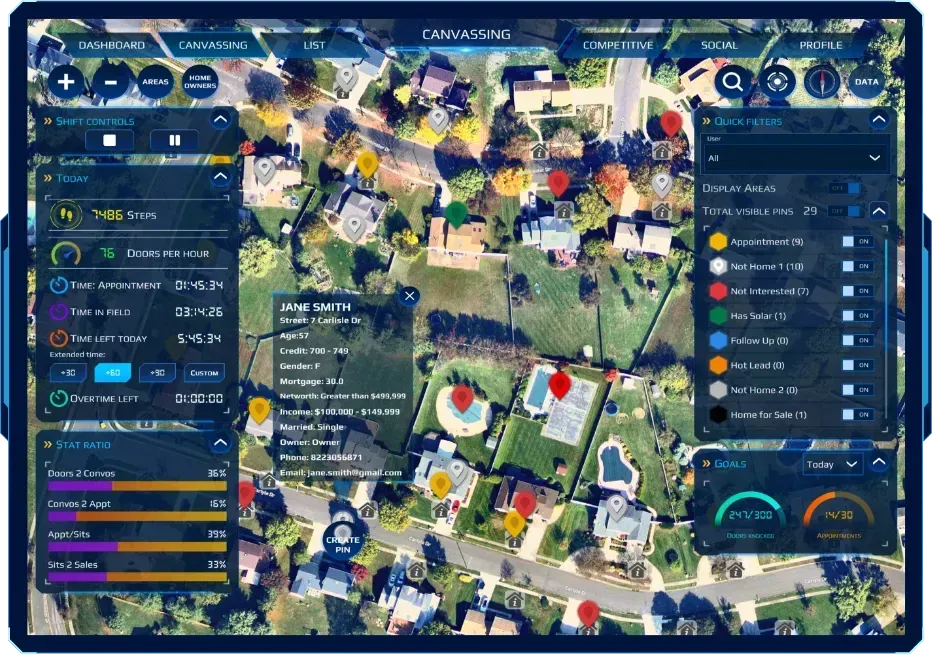
The best door-to-door sales reps know that success isn't just about what happens at the door; it's also about what happens before and after the conversation.
Managing territories, tracking leads, scheduling follow-ups, and monitoring performance can quickly become overwhelming when handled through spreadsheets, notebooks, or disconnected tools.
Knockbase is designed specifically for door-to-door sales teams, helping reps and managers stay organized throughout the entire sales process. Instead of relying on memory or manual tracking, teams can manage leads, assign territories, record customer interactions, and monitor sales activity from a single platform.
1. Territory Management Made Simple
Knockbase helps sales teams organize territories more effectively, reducing overlap between reps and ensuring coverage across target neighborhoods. This allows teams to spend more time engaging with prospects and less time planning routes.
2. Better Lead Tracking and Follow-Up
Every customer interaction can be logged and tracked, making it easier to follow up with interested prospects and prevent opportunities from slipping through the cracks. Reps gain a clear view of where each lead stands in the sales process.
3. Real-Time Visibility for Managers
Sales leaders can monitor team activity, territory performance, and pipeline progress without waiting for end-of-day updates. This visibility helps managers provide support where it's needed most and make more informed decisions.
4. Mobile Access for Field Teams
Because door-to-door sales happen in the field, Knockbase gives reps access to lead information, territory data, and customer records directly from their mobile devices. This helps keep information accurate and up to date throughout the day.
5. Performance Insights That Support Growth
Knockbase provides reporting and analytics that help teams understand what is working, identify areas for improvement, and make data-driven decisions. Instead of relying on assumptions, sales organizations can use real performance data to refine their approach and improve results over time.
For growing door-to-door sales teams, Knockbase provides the visibility, organization, and operational support needed to manage sales activities more efficiently and create a more scalable sales process.
Conclusion: Skills Are the Asset That Compounds
The gap between a top door-to-door salesperson and an average one was never about luck, territory, or even talent. It's about seven specific, learnable skills: active listening, communication and rapport building, resilience, objection handling, product knowledge, time and territory management, and closing. Each one strengthens the others.
Listening feeds rapport. Rapport earns you the objection. Resilience keeps you in the conversation long enough to handle it. And every skill ultimately exists to set up the close.
What makes this genuinely valuable for an individual rep or an entire team is that these skills are repeatable. They don't fade when one star leaves. They can be defined, measured, coached, and improved on a consistent basis.
If you take one thing away, make it this: stop measuring effort and start developing skill. Identify exactly where your conversations break down, train the matching trait, and watch your sales results climb on purpose instead of by accident.
Ready to Build a Higher-Performing Door-to-Door Sales Team?
Great sales skills are only part of the equation. The most successful door-to-door teams also have systems that help them manage territories, track leads, and stay on top of every opportunity.
See how Knockbase helps D2D sales organizations stay organized, improve visibility, and drive better results. Book a demo today and see Knockbase in action.
FAQs
What is the most important skill in door-to-door sales?
While all seven skills contribute to success, resilience and emotional control are often considered the most important. Door-to-door sales involve frequent rejection, and reps who can maintain their confidence, energy, and consistency after hearing "no" are more likely to succeed over the long term.
Can door-to-door sales skills be learned, or are great salespeople naturally talented?
Most successful door-to-door salespeople develop their skills through training, practice, coaching, and experience. Skills such as active listening, objection handling, rapport building, and closing can all be improved with deliberate practice and feedback.
Why do many door-to-door sales reps struggle even when they work hard?
Effort alone doesn't guarantee results. Many reps struggle because they have gaps in critical skills such as communication, objection handling, follow-up, or territory management. Identifying and improving these weaknesses often has a bigger impact than simply increasing activity.
How can I become more confident in door-to-door sales?
Confidence usually comes from preparation and repetition. Learning your product, practicing common objections, refining your opening conversation, and gaining experience in the field all help build confidence over time. Most top performers focus on improving their process rather than worrying about individual outcomes.
How do successful reps handle rejection?
Top-performing reps view rejection as part of the sales process rather than a personal failure. They focus on what they can control, learn from each interaction, and quickly reset before moving to the next opportunity.
Is product knowledge more important than communication skills?
Both matter, but communication skills often have a greater impact early in the sales process. If a rep cannot build rapport, ask good questions, or handle objections, they may never have the opportunity to demonstrate their product knowledge.
What are the most common objections in door-to-door sales?
Some of the most common objections include:
- "I'm not interested."
- "I already have a provider."
- "It's too expensive."
- "I need to think about it."
- "I'm too busy right now."
Learning how to respond calmly and confidently to these objections is an important part of improving sales performance.
How can sales managers improve the performance of a door-to-door sales team?
Sales managers should focus on coaching specific skills rather than only tracking outcomes. Measuring metrics such as conversation rates, objection recovery rates, follow-up completion, and close rates can help identify where reps need support and training.
Why is follow-up important in door-to-door sales?
Many prospects are not ready to make a decision during the first conversation. Consistent follow-up helps keep opportunities moving forward and ensures that interested prospects don't fall through the cracks.
How does technology help modern door-to-door sales teams?
Technology helps teams manage territories, track leads, schedule follow-ups, monitor performance, and improve visibility across the sales process. Dedicated platforms like Knockbase make it easier for reps and managers to stay organized and manage sales activities more efficiently.
How long does it take to develop strong door-to-door sales skills?
The timeline varies by individual, but most reps see meaningful improvement after consistently practicing core skills such as communication, active listening, objection handling, and closing. The key is continuous learning and applying feedback from real customer interactions.
What should new door-to-door sales reps focus on first?
New reps should prioritize communication, rapport building, active listening, and resilience before worrying about advanced sales techniques. These foundational skills create better conversations and make it easier to develop the rest of the sales process.

Canvassing Software ROI: How Sales Managers Should Calculate Cost-Per-Knock vs Cost-Per-Lead in 2026