If you’ve ever sent a team out to knock doors and felt like half their time was spent just figuring out where to go next, you’re not alone.
Door-to-door canvassers face immense pressure to meet targets, gather accurate data, and engage meaningfully at doors. Random knocking is inefficient, wasting time, energy, and morale.
Now, with fewer people and tighter schedules, territory planning and data-driven routes are essential, forming the backbone of an effective ground game.
Why Modern Route Strategy Is Becoming Essential for Today’s Door-to-Door Canvassers
Traditional canvassing used paper maps, intuition, or knocking on every door without knowing which homes mattered most.
Today, outreach efforts are faster and require target areas and street-level insights for effective conversations. Data-driven planning reduces overlap, missed streets, and coordinates volunteers, especially during large canvass days.
When canvassers spend less time wandering and more time engaging with residents face-to-face, voter turnout rises, and community bonds strengthen.
Key Takeaways
- Data-driven territory planning helps canvassers reach the right homes faster and reduces wasted time.
- Route optimization supports higher turnout and better direct contact with targeted residents.
- Mapping tools reveal priority neighborhoods and prevent canvassers from repeating the same streets.
- Campaign managers gain visibility into progress, performance, and real-time updates from the field.
- Modern canvassing software improves accuracy, coordination, and results across entire outreach efforts.
Curious What Smarter Territory Planning Looks Like in Action?
Excited to observe how data-driven routes enable canvassers to spend less time navigating and more time engaging at doors.
See it in action and explore how better planning turns ground efforts into measurable results.
Why Door-to-Door Canvassing Matters Today?
Despite the rise of digital outreach, door-to-door canvassing remains one of the most effective forms of direct contact because it creates honest, person-to-person conversations at the doorstep.
Political scientists continue to find that face-to-face engagement is among the strongest ways to persuade individuals to trust volunteers more than ads or emails.
Yet modern canvassing presents new challenges: larger territories, more complex voter data, and greater demands for accurate reporting.
Without clear routes and organized lists, even experienced volunteers can struggle, making good planning essential for every canvassing day.
Efficiency Challenges for Door-to-Door Canvassers
Think about how effectively you reached local residents during your last major canvass day as you plan your next event.
How long did it take to choose a street side? When routes are unclear, canvassers improvise, causing backtracking, missed houses, and questions like, ‘Did we already hit this house?”
This can quickly frustrate volunteers, who are there to talk to people at each house, not to navigate. With limited daylight, traffic, and breaks, such inefficiencies become costly.
A good territory plan doesn’t just help the campaign; it optimizes resources and makes the canvassing experience feel smoother and less exhausting for everyone involved.
1. Traditional Door Canvassing Problems
The traditional method of paper lists, highlighters, and initial canvassing at polling stations remains common.
It might work short-term in small areas, but when scaling up it causes issues: streets are skipped, blocks re-canvassed, and notes are hard to read.
2. Why Precision Matters in Door Knocking
Knocking enough doors doesn't guarantee success; who you reach, when, and how often matter more. Precision in door knocking means focusing on the right blocks, identifying supportive or under-engaged areas, and tailoring your message to each street.
A more intentional ground game reduces guesswork, improves clarity for canvassers, and ensures time and resources are spent where they have the greatest impact.
What Data-Driven Door Canvassing Actually Means?
People see “data-driven’ as cold, but it’s human-first—reducing guesswork on where to send canvassers.
Instead of a generic map, it uses layers like turnout history, past interactions, and local issues. The software doesn’t replace workers; it helps focus on high-value areas.
A good example of this shift from analog to digital is shared in the blog titled "Is digital canvassing more effective than paper-based methods?"
How Data Improves Door-to-Door Canvassing Results?
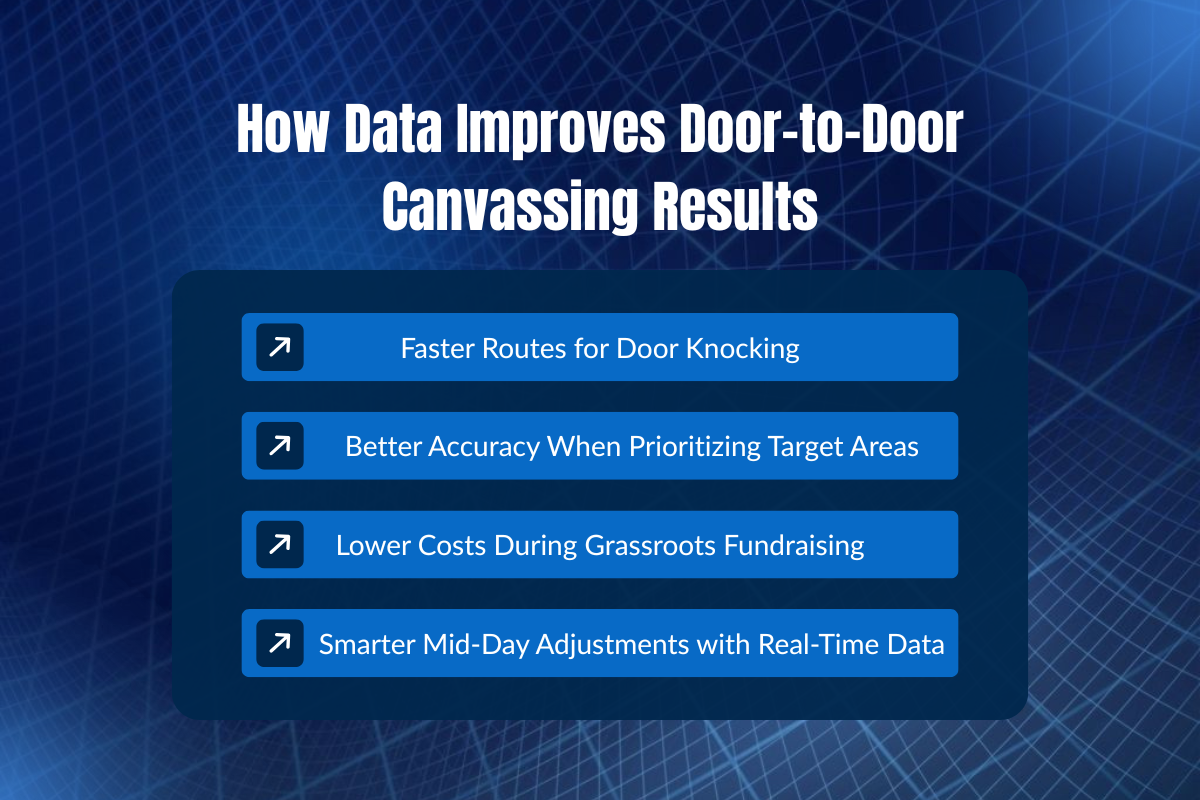
Door-to-door canvassing has always been about conversations, but the difference between effort and impact now comes down to data. When teams rely only on intuition or past experience, they risk knocking on the wrong doors, repeating outreach, or missing high-priority areas altogether.
Data changes that. It brings structure to canvassing by showing where to go, who to speak with, and what message is most likely to resonate.
1. Faster Routes for Door Knocking
Many canvassers feel exhausted at the end of the day despite having only a handful of meaningful conversations. This usually isn’t a motivation problem but a routing problem.
Data-driven routes eliminate these gaps, reduce backtracking, and guide canvassers through streets in the most efficient order. Better routing means more doors reached, more conversations per shift, and less physical burnout.
2. Better Accuracy When Prioritizing Target Areas
Not every street carries the same value for a given goal, whether it’s persuasion, turnout, or follow-up. Data highlights which blocks matter most right now.
By prioritizing high-impact areas, canvassers stay focused, and limited volunteer hours are used where they can make the biggest difference. This often leads to stronger engagement and, in fundraising efforts, higher donations.
3. Lower Costs During Grassroots Fundraising
For grassroots fundraising teams, inefficient canvassing wastes time, energy, and resources. Smart data-driven planning reduces unnecessary walking and idle time, allowing canvassers to spend more time having meaningful donor conversations.
When volunteers consistently engage receptive households and see real results, morale improves, and they are more likely to return for future shifts.
4. Smarter Mid-Day Adjustments with Real-Time Data
Canvass plans rarely stay static. Neighborhood availability, response rates, and on-the-ground conditions change throughout the day.
Real-time data gives organizers visibility into what’s happening as it unfolds. Teams can redeploy canvassers, shift focus to better-performing areas, or tighten coverage immediately without waiting until the day is over.
What are the Features That Modernize Door-to-Door Canvassing?
Once teams experience canvassing with digital tools, going back to paper maps and clipboards feels nearly impossible.
These features don’t replace human conversations; they remove friction from the process so canvassers can focus on what actually matters—connecting with people at the door.
1. Geo-Based Territory Tools for Door Canvassers
Geo-based territory tools allow organizers to create realistic, walkable turf based on streets, blocks, and natural neighborhood boundaries. Instead of vague zones or hand-drawn maps, canvassers receive clearly defined areas that make sense on the ground.
2. AI Route Optimization for Door-to-Door Teams
AI-powered routing builds efficient walking paths by considering distance, housing density, and past canvassing data. This helps canvassers spend less time navigating and more time talking to residents.
As more data is collected, routes continuously improve. The system learns from real canvass activity, making each future shift more efficient than the last.
3. Templates and Workflows for Door Knocking
Scripts and templates help new canvassers feel more confident at the door. Meanwhile, structured data collection ensures the campaign receives clean notes, consistent tags, and useful follow-up information that reflects the voter’s opinion.
4. Team Permissions for Volunteer Canvassers
Permissions help keep sensitive data secure while making sure volunteers see only what they need. This reduces confusion and makes onboarding far easier for new canvassers.
Old vs New Door-to-Door Canvassing Methods
Here’s a quick side-by-side comparison of traditional canvassing for a candidate and a modern, data-driven approach.
| Aspect | Old Door-to-Door Method | New Data-Driven Method |
|---|---|---|
| Route Planning | Canvassers decide routes on the fly, often backtracking or skipping areas. | Optimized, efficient walking routes reduce wasted steps and increase the number of doors. |
| Targeting | All doors are treated the same with little segmentation. | Prioritized target areas help focus on undecided or high-value candidates. |
| Coverage Accuracy | Easy to miss streets or double-knock homes; inconsistent records. | Real-time tracking ensures complete, non-overlapping coverage. |
| Volunteer Experience | Confusing routes lead to fatigue and lower morale. | Clear territories make canvassing smoother, easier, and more satisfying. |
| Manager Visibility | Hard to track progress until after shifts (if at all). | Live data shows who covered what, enabling mid-day adjustments. |
How To Choose the Right Door-to-Door Canvassing Software?
Finding the right canvassing software doesn’t mean choosing the tool with the longest feature list; it means choosing the one that feels natural for your team.
The tool should make canvassing for a candidate easier, not more complicated. So, let's explore:
1. Matching Tools to Door Knocking Styles
Your team’s canvassing style should guide your decision. If your campaign relies on rapid coverage, prioritize mapping and routing tools. If persuasion is your goal, choose a platform with strong note-taking and follow-up workflows.
2. Integrations for Target Areas and Recruit Volunteers Workflows
A good platform integrates with your volunteer tools and CRM. Integrations keep your lists clean, reduce administrative overhead, and enable access to additional information.
3. AI Features That Support Political Campaigns and Phone Banking
AI should support strategy, not complicate it. Modern canvassing tools can help determine whether a voter is best reached at the door, through phone banking, or with a follow-up touch.
These insights help campaigns prioritize outreach, reduce wasted effort, and focus resources where they matter most.
As election day approaches, this kind of intelligence becomes critical for improving efficiency under tight timelines.
4. Ease of Onboarding for Volunteer Canvassers
The best canvassing software can be explained in minutes during a pre-canvass briefing. If volunteers can open the app, understand their turf, log interactions, and move on without constant questions, you have chosen the right tool.
If it requires extensive training or troubleshooting, it will slow your operation down, no matter how powerful the features are.
If you are wondering what tools the pros use, then don't forget to check out this blog on Territory Planning for Growing Teams: The Tools Pros Use
Implementation Blueprint for Door-to-Door Canvassing
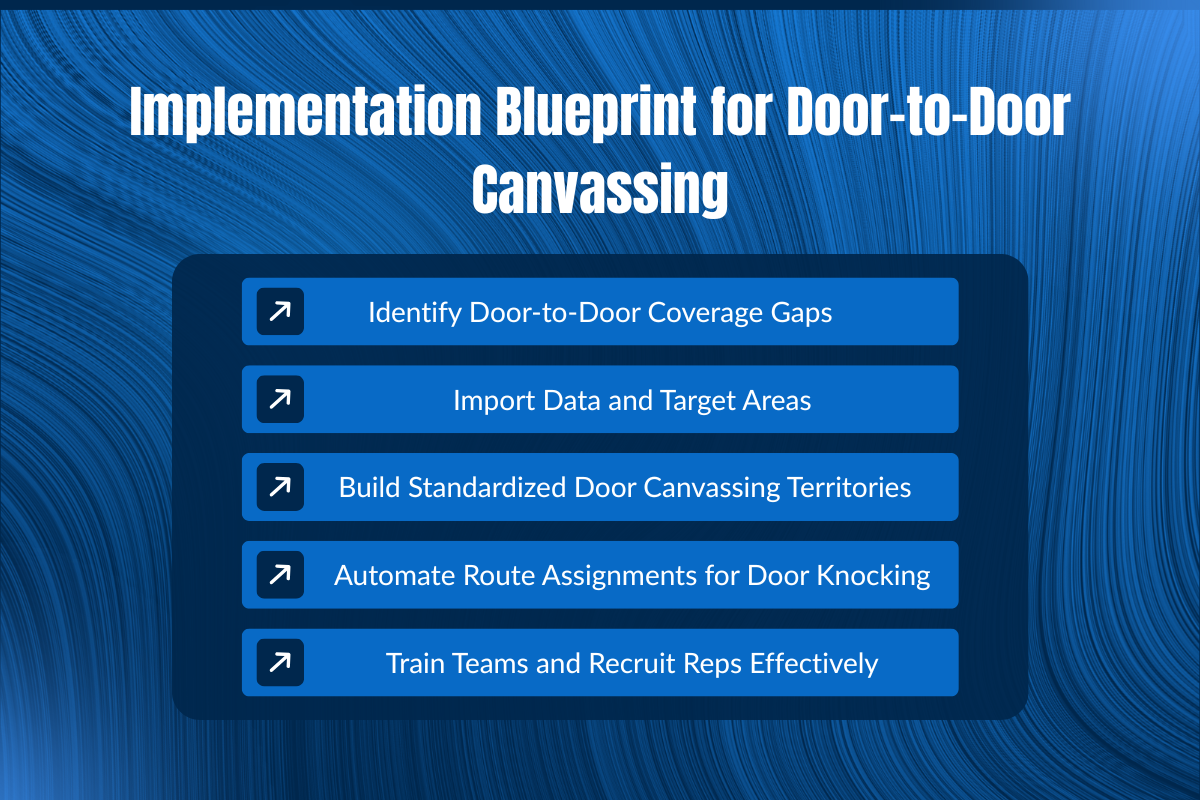
Rolling out new territory planning doesn’t have to be a big, dramatic switch.
You can phase it in, learn as you go, and bring your team along for the ride. The goal isn’t perfection on day one; it’s steady improvement until “data-driven” feels normal.
Step 1: Identify Door-to-Door Coverage Gaps
Start with a simple question: where are we guessing? Look at past canvass maps, notes, or team recollections to identify neighborhoods that feel consistently messy or unclear. Use this as a starting point to discuss strategies and services with your team.
Step 2: Import Data and Target Areas
Once you know your weak spots, bring your lists and target definitions into the system. Focus first on getting the key areas right, rather than trying to perfect every corner of the map at once.
Step 3: Build Standardized Door Canvassing Territories
Create a few sample territories and test them with trusted canvassers. Ask them how the routes felt, how long they took, and whether the turf felt realistic for a single shift.
Step 4: Automate Route Assignments for Door Knocking
Once territories feel right, let the software handle route creation and assignment. This is where efficiency gains become visible. Automated routing reduces gaps, minimizes overlap, and ensures canvassers spend more time talking to residents and less time navigating streets.
Step 5: Train Teams and Recruit Volunteers Effectively
Finally, roll it out more widely. Keep the training light but practical: show people the route, walk through one example door, and let them try it. As they provide feedback, make minor tweaks to make the system feel increasingly “built for us.”
Advanced Strategies for Door-to-Door Canvassers
Once the fundamentals are running smoothly, teams can move beyond basic execution and start optimizing for impact. At this stage, you are no longer just managing canvass days; you are shaping outcomes.
1. Early-Day Door Knocking Advantage
If you’ve ever noticed that certain times of day feel better at the door, you’re not imagining it. Early shifts, especially on weekends, often catch people when they’re less rushed.
Designing routes around these high-response periods can improve contact rates without increasing volunteer hours or headcount.
2. Using Alerts for Skipped Target Areas
Even the best routes face real-world interruptions: locked gates, dogs, noise, or weather. Alerts that flag skipped or partially covered addresses make it easy to revisit those doors later instead of losing them entirely. This turns small misses into recoverable opportunities.
3. Improving Documentation for Grassroots Fundraising
When you’re gathering donations or sign-ups, how you log those interactions matters. In cases like these, consistent notes let you follow up thoughtfully instead of starting from scratch.
Over time, you’ll see which neighborhoods respond best to certain kinds of asks, and you can lean into those patterns intentionally throughout the process.
4. Tracking Door Canvassing Results Over Time
Instead of treating each canvas as a one-off, start treating them like episodes in a longer series. What changed week to week? Which turf warmed up after conversations? Tracking trends means you’re building a more innovative field program, not just "doing as many doors."
The Future of Door-to-Door Canvassing
Door-to-door canvassing isn’t fading; it’s becoming smarter. Teams that combine human connection with data-driven planning gain a clear advantage over those relying on instinct alone.
As tools improve, less time is spent managing logistics and more time is spent on strategy, conversations, and community trust, the very reasons most people enter canvassing work in the first place.
1. AI Forecasting
Rather than treating every door equally, AI will help teams identify where a conversation is most likely to make an impact.
This does not replace human judgment or override community rights; it simply helps organizers and canvassers invest their limited, high-quality time where it can genuinely move outcomes forward.
2. Automated Routing Pipelines for Door Canvassers
Soon, you might spend almost no time building routes manually. Teams will define goals, target areas, and availability, and systems will automatically generate and assign walkable routes in real time.
This reduces setup work, prevents overlap, and keeps canvassers focused on conversations instead of navigation.
3. Predictive Insights for Political Campaigns
For political campaigns in particular, predictive insights will clarify where support is solid, where it is undecided, and where outreach is actively shifting opinion.
This transforms canvassing from a “we hope this helps” activity into a measurable, strategic lever that shows how ground efforts directly influence outcomes over time.
Knockbase is already heading in this direction to Enhance Your Sales Workflow with Knockbase: Utilizing Essential Tools for Sales.
How Knockbase Supports Efficient Door-to-Door Canvassing?
Knockbase streamlines door-to-door canvassing by unifying territory planning, routing, and field data into one platform.
- Data-Driven Territory Planning: Define target areas clearly so canvassers avoid covering the same streets, knock on the right doors, and use time and resources more efficiently.
- Optimized Routes for Door Knocking: Smarter route planning reduces backtracking and unnecessary walking, allowing canvassers to reach more doors and engage more residents in each shift.
- Real-Time Field Visibility: Teams gain live updates on progress, coverage, and field data, making it easier to adjust routes and coordinate volunteers throughout the day.
- Simplified Workflows for Volunteers: Clear routes, structured workflows, and easy data collection reduce confusion, improve efficiency, and create a smoother experience for volunteer canvassers.
In a Nutshell
Door-to-door canvassing remains one of the most effective ways to engage people through direct, face-to-face conversations.
When supported by data-driven territory planning and smarter routes, canvassers work more efficiently, volunteers stay motivated, and campaigns achieve stronger, more measurable results on the ground.
Why Knockbase?
Knockbase is purpose-built for door-to-door canvassing teams that rely on clear territories, efficient routes, and real-time field visibility.
It brings together territory planning, optimized routing, and live progress tracking in one platform—so canvassers know exactly where to go, and managers always know what’s happening on the ground.
By eliminating guesswork and manual coordination, Knockbase helps campaigns and outreach teams run more organized, effective, and scalable ground operations.
Explore how a unified platform improves door-to-door canvassing with Knockbase - built to support smarter routes, better coordination, and more effective ground efforts.
FAQs
1. What is door-to-door canvassing, and why is it still effective?
Door-to-door canvassing involves canvassers knocking on doors to engage voters through face-to-face discussions. It remains effective because direct contact builds trust, helps persuade undecided voters, and increases voter turnout more reliably than digital outreach alone.
2. Why is territory planning important for door canvassing?
Territory planning helps canvassers focus on target areas, avoid knocking on the same doors repeatedly, and reach as many voters as possible. Data-driven routes save resources, improve efficiency, and strengthen the overall ground game.
3. How do campaigns use data in door-to-door canvassing?
Campaign managers use voter databases, polling data, and voter opinions to determine priority neighborhoods, guide conversations, and tailor messages that resonate with community members during door-knocking efforts.
4. How does canvassing support grassroots fundraising and volunteer recruitment?
Door-to-door canvassing enables campaigns to recruit volunteers, gather grassroots fundraising support, and identify motivated supporters through personal conversations that phone banking and online outreach often miss.
5. What role does canvassing play alongside phone banking and other outreach?
Canvassing complements phone banking and digital efforts by providing direct, in-person conversations. Together, these methods help campaigns engage voters, coordinate volunteers, and strengthen outreach efforts across the constituency.

Canvassing Software ROI: How Sales Managers Should Calculate Cost-Per-Knock vs Cost-Per-Lead in 2026