It’s 7:30 PM, and you’ve knocked for hours. One person was interested, another mentioned the cooling-off period. Someone else asked for a telephone number and said they’d “think about it.” You’re tired, your sales pitch feels flat, and tomorrow you’ll do it all again.
This isn’t a motivation issue. This is what burnout looks like in door-to-door sales when operations are weak.
Across Canada, door-to-door salespeople are leaving faster than companies can train them. Managers push hustle harder. Reps burn out faster. And businesses quietly lose money through poor routing, lost leads, missed follow-ups, and cancelled contracts.
Whereas high-performing D2D sales companies are doing something different. They’re not asking their sales representatives to work harder. They’re building a structure.
Why Hustle Is Failing in D2D Sales Canada, and What Structure Scales Instead?
D2D sales in Canada start to break down when hustle becomes the only strategy. As teams grow, effort without structure leads to burnout, missed follow-ups, unclear territories, and inconsistent results.
Door-to-door salespeople work harder but see diminishing returns, while managers struggle to scale without losing their best reps.
What scales instead is an ops-first approach to D2D sales in Canada. Clear territories, predictable workflows, and data-backed visibility help door sales teams focus their energy where it actually converts. Hustle doesn’t disappear; it becomes sustainable.
This guide is written for D2D sales managers, team leads, and service companies who feel stuck between pushing harder and burning out their teams. This article will walk you through it step by step, what’s really happening in D2D sales, Canada, why burnout is so common, and how an ops-first approach gives companies a real competitive edge.
Key Takeaways
- Burnout in D2D sales Canada is a structural issue, not a talent problem, caused by unclear territories, poor follow-ups, and low visibility.
- Hustle can drive early momentum, but it becomes unsustainable and unpredictable as door-to-door teams scale.
- Clear structure turns effort into outcomes by improving close rates, stabilizing earnings, and reducing rep churn.
- Data-driven routing, real-time visibility, and consistent workflows outperform pressure-based management every time.
- D2D-specific software like Knockbase enables teams to scale across regions with control, consistency, and far less operational friction.
Hustle gets attention. Structure gets results.
If burnout, missed follow-ups, or unclear territories are already showing up in your D2D operation, that’s not a people problem-it’s an operational signal. The fastest-growing D2D teams in Canada are fixing this early by putting structure in place before scale breaks them.
See how ops-first D2D teams run territories, follow-ups, and performance in one system.
Book a Knockbase demo
and evaluate the workflow for yourself.
What Is D2D Sales Really Like in Canada Today?
Door-to-door sales in Canada are still very real, despite what people assume. It’s widely used by companies selling energy contracts and home heating, water heaters, and cooling equipment, windows, maintenance services, home upgrades, telecom, and internet services
But Canada adds unique pressure:
- Short selling seasons due to the weather
- Strict consumer rights and cancellation rules
- Permit requirements in many cities
- Increasing homeowner awareness and skepticism
A door salesperson today needs more than charm. They need knowledge, timing, compliance, and trust.
Door to Door Salespeople Are Not Failing But Systems Are
Most door-to-door salespeople don’t quit because they can’t sell. They quit because the job becomes chaotic.
Common problems they usually face:
- Standing at the doors that were already knocked on yesterday
- Losing prospective customers’ details
- No clarity on total price, payment steps, or cancellation forms
- Guessing which neighbourhoods convert better
- Managers chasing updates instead of coaching
- Failing to solve compliance and legal issues proactively, leading to operational disruptions
They aren’t failing because they lack skill. They fail when there’s no system to manage territories, follow-ups, accountability, or performance visibility. When reps don’t know where to go next, who owns which door, or how their activity is tracked, performance becomes guesswork rather than progress.
This is exactly where structured sales rep management systems start to matter, not to control reps, but to give them clarity, ownership, and consistency in the field.
What’s Actually Causing Burnout in Door-to-Door Sales?
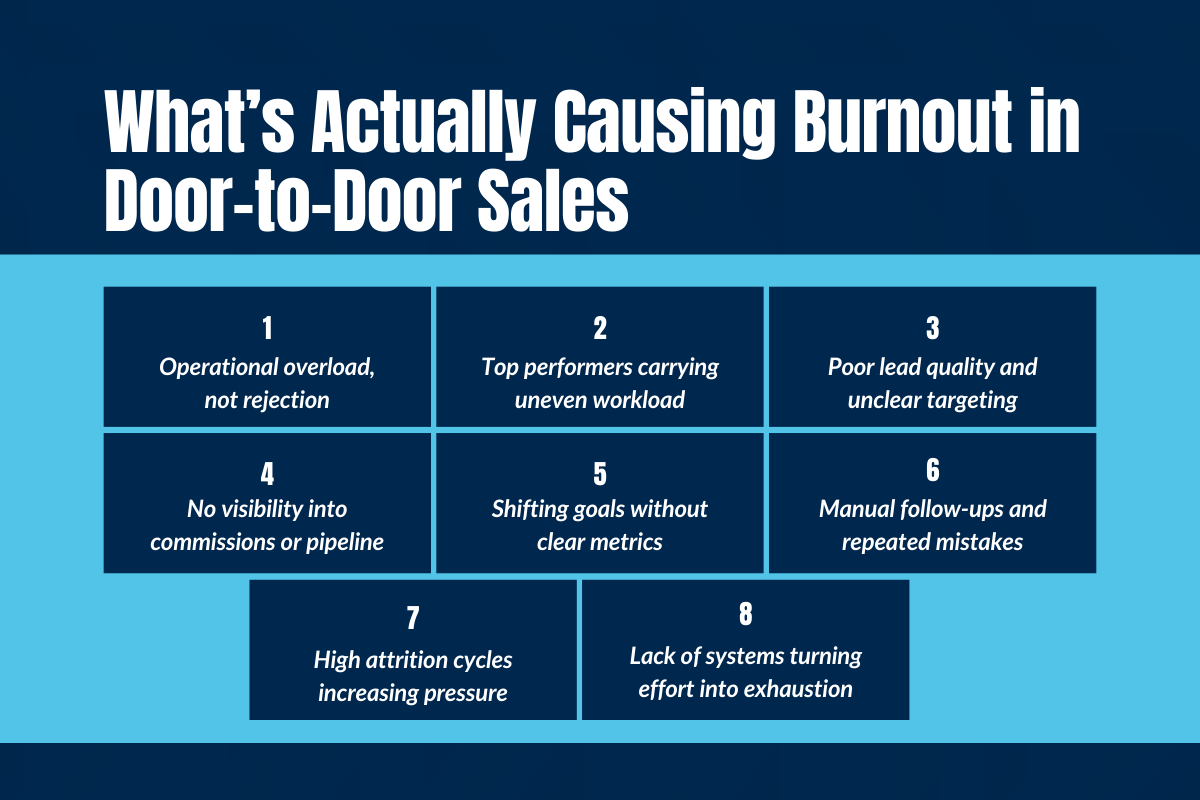
Burnout in door-to-door sales isn’t loud or dramatic. It creeps in quietly, missed follow-ups, declining energy, and shorter conversations. Until one day, your top performer hands in their badge. Most managers assume it’s rejection fatigue or weak motivation. In reality, burnout is usually a symptom of broken operations.
1. Why Top Door Salespeople Quit First
Ironically, the reps you rely on the most are often the first to burn out. Not because they can’t handle the job, but because they’re carrying more weight than anyone else.
Your best door salespeople usually:
- Knock more doors than the rest of the team
- Handle a higher volume of rejection daily
- Carry unspoken pressure to “save the numbers.”
At the same time, they’re often dealing with operational gaps that make the work heavier than it needs to be:
- Inconsistent or poorly qualified leads
- Unclear performance metrics and shifting targets
- No real visibility into commissions, cancellations, or pipeline status
- Repeating the same mistakes because nothing is tracked or reviewed
Mental fatigue sets in long before physical exhaustion. When effort isn’t matched with clarity or progress, even strong performers disengage.
2. Data Point: Burnout and Attrition in Direct Selling
Across North America, direct selling and D2D sales show some of the highest attrition rates in sales. Industry reports consistently indicate that:
- Average door-to-door salesperson tenure often falls under 6 months
- Replacing a trained D2D rep costs across $100,000 in lost revenue, onboarding time, and missed opportunities.
- For example, for a 20-person sales team, that means constantly recruiting, onboarding, and training 6-7 new reps annually. The direct costs alone - recruiting, hiring, training, and lost productivity - often exceed $100,000 per departed rep.
- Burnout directly impacts close rates, follow-up quality, and customer experience
In most cases, companies don’t lose deals because of bad sales pitches. They lose them because their reps quit.
Why Hustle Alone Doesn’t Scale D2D Sales Operations?
Hustle is powerful, but it has a short shelf life. What feels effective in the early days of a D2D operation becomes fragile as teams grow. The same habits that once drove momentum eventually create chaos.
1. Hustle Works at 5 Reps, Breaks at 25
With a small team, hustle hides inefficiencies. Managers can manually intervene, reps cover for each other, and problems stay manageable. As teams scale, those cracks widen fast.
As D2D teams grow, common issues start surfacing:
- Territory overlap increases, leading to wasted effort and internal friction
- Accountability drops because no single system owns the truth
- Managers lose real visibility into daily activity
- Training becomes inconsistent and personality-driven
WhatsApp groups, spreadsheets, and memory-based management stop working almost overnight.
2. The Truth: The Competitive Edge Comes From Structure, Not Pressure
Pressure can squeeze short bursts of performance, but it never produces stability. It runs on adrenaline, not systems, and adrenaline always runs out when pressure increases. Whereas structure creates repeatable results, even on average days, with average energy, from average reps.
Here’s what actually holds up in door-to-door sales:
- Predictability beats motivation. Motivation shifts with weather, rejection, mood, and seasonality. Structure doesn’t.
- Consistency beats charisma. Charisma scales poorly. Systems scale quietly and reliably.
Strong operations do more than protect your top performers from burnout. They give newer and mid-level reps a fair, realistic chance to succeed.
When expectations are clear, territories are defined, and performance is visible, effort finally converts into outcomes. That’s where sustainable growth comes from, not louder pressure, but better foundations.
What Does an Ops-First D2D Sales Model Look Like?
An ops-first model doesn’t remove hustle, it channels it. Instead of asking reps to “try harder,” it removes friction so effort actually compounds.
1. Clear Territories and Smarter Routing for Door-to-Door Sales
Poor routing wastes both energy and money. When reps aren’t sure where to knock or why, motivation drains quickly.
Structured routing helps by:
- Eliminating overlapping doors and repeated knocks
- Reducing unnecessary walking and travel time
- Increasing the number of doors knocked per hour without extending workdays
When reps know exactly where they’re going and what success looks like in that area, morale improves almost instantly. Top D2D performers avoid these traps by using smarter territory strategy and tech stack approaches that help crush quotas in Canada.
2. Standardized Sales Playbooks for Door Sales Teams
Letting every rep “do their own thing” sounds empowering, until quality drops and customer complaints rise.
Standardized playbooks support:
- Consistent sales pitch delivery
- Clear objection handling around money, contracts, and cooling-off periods
- Accurate explanations of consumer rights and cancellation rules
This protects the company, the rep, and the customer, all at once.
How High-Performing D2D Teams Track Performance Without Micromanaging?
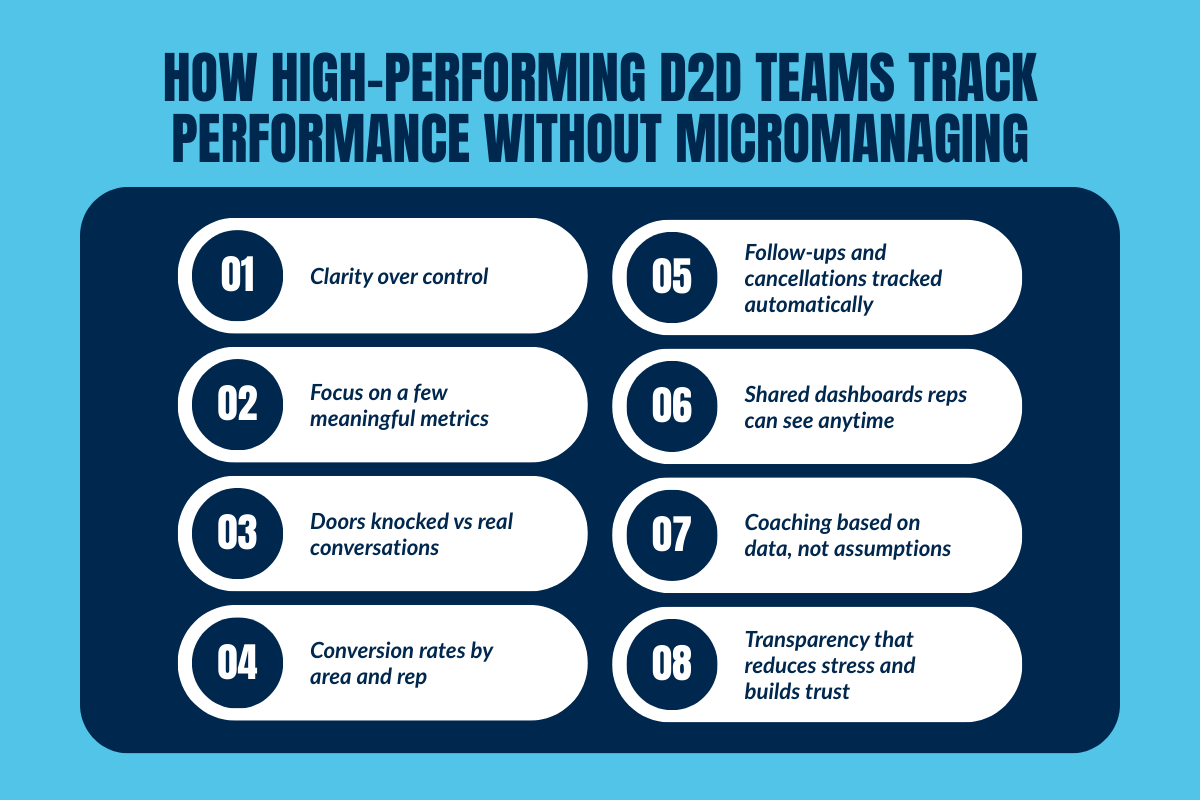
The goal of tracking isn’t control. It’s clarity. When done right, data reduces pressure instead of increasing it.
1. What Metrics Actually Matter in D2D Sales
Not everything needs to be tracked, just the right things. High-performing teams focus on:
- Doors knocked vs meaningful conversations
- Conversion rates by area, rep, or campaign
- Follow-ups completed and cancellations tracked
This data highlights what’s working, what’s broken, and where coaching will actually help.
2. Transparency Builds Trust in Direct Selling Teams
When reps can see their numbers clearly:
- Anxiety drops
- Ownership increases
- Managers coach instead of chasing updates
Confidence is key in sales, and confident salespeople have an advantage in this field because clarity replaces stress. Trust replaces tension.
High-performing teams focus on the right metrics and consistent tracking practices with tools like canvassing software that help teams coach smarter without micromanagement.
Why D2D Service Companies in Canada Are Moving to Software-Led Ops?
Canada’s regulations, climate, and seasonal sales cycles make operational discipline even more critical. As teams grow across cities and regions, manual systems simply can’t keep up. What feels manageable with a handful of reps becomes fragile and error-prone once activity spreads across neighbourhoods, managers, and regions.
1. The Limits of Spreadsheets and WhatsApp Groups
Spreadsheets and group chats are usually the first tools D2D teams adopt, and the first ones they outgrow. They fail because:
- Data gets lost, overwritten, or never logged in the first place
- There’s no historical context to guide territory, routing, or performance decisions
- Accountability fades when updates are optional and inconsistent
At scale, memory-based management creates blind spots. You can’t run a serious D2D business on scattered messages and best guesses.
2. What Modern D2D Sales Software Replaces
Purpose-built D2D software steps in where manual systems break down. Modern Canadian sales teams use software data to prioritize neighbourhoods based on demographics and market conditions. It replaces:
- Guess-based decisions with real activity and performance data
- Manual tracking with automatic, field-first logging
- Burnout-driven management with clarity and consistency
Good software doesn’t replace people or relationships. It removes friction so people can do their jobs without carrying unnecessary cognitive load. Moreover, the direct approach of door-to-door sales helps companies get immediate feedback from customers.
How Structure Reduces Burnout for Door-to-Door Salespeople?
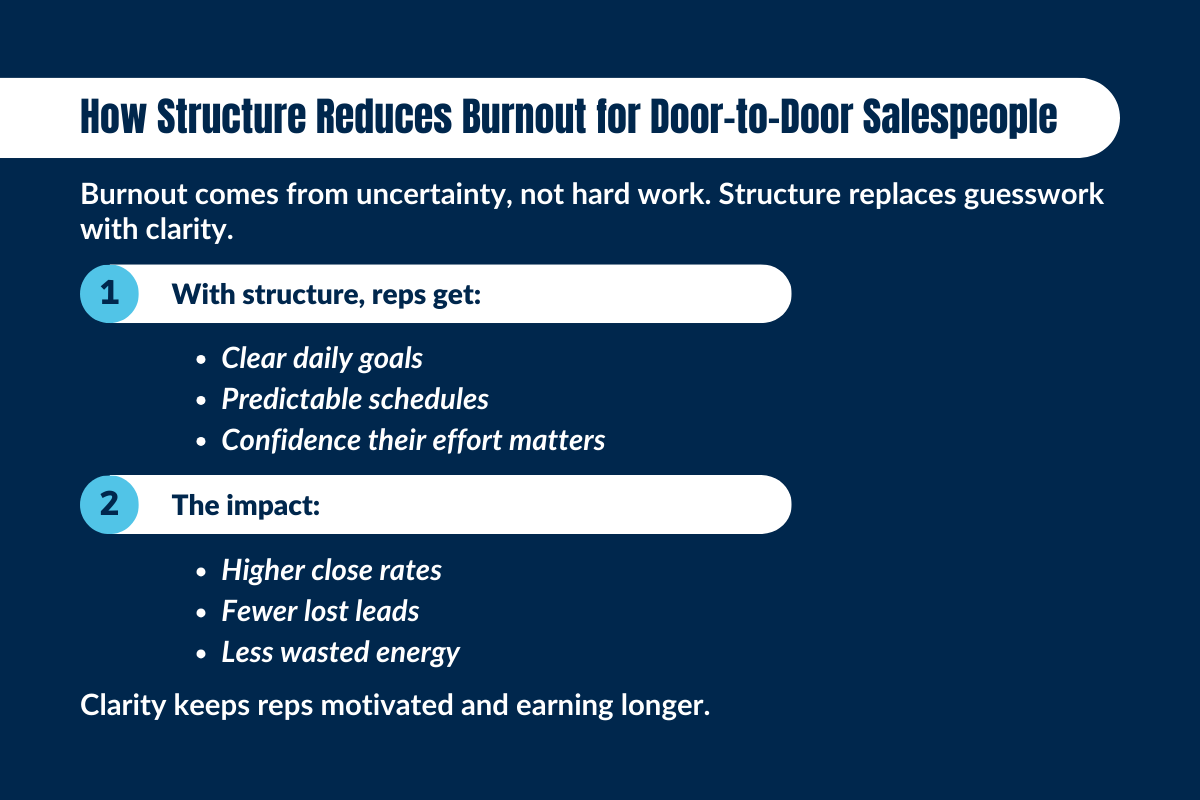
Burnout in door-to-door sales rarely comes from effort alone. It comes from uncertainty, not knowing where to go, what matters, or whether the work being done is actually paying off. In a high-rejection environment, structure creates psychological safety.
When reps understand the system around them, rejection becomes part of the process instead of a personal failure.
1. Predictable Days Create Sustainable Energy
The first stage of selling door-to-door is finding potential customers or prospects. With clear operations in place, reps gain something rare in D2D sales: predictability.
Structure gives them:
- Clear start and stop points to the day
- Defined goals that feel achievable, not arbitrary
- Confidence that effort is moving them forward
Managing time effectively helps salespeople reach more potential clients. Knowing when to stop is just as important as knowing when to push. That balance keeps energy sustainable over weeks and seasons.
2. Better Ops = Better Earnings for Door Sales Reps
Operational clarity doesn’t just reduce stress; it directly improves income. As salespeople build relationships on trust, they try to connect with clients emotionally.
When operations improve:
- Close rates increase through better timing and follow-ups
- Fewer leads fall through the cracks
- Less effort is wasted on dead ends or repeated mistakes
The result is more customers closed with fewer hours worked. That’s what keeps reps engaged long term.
How Platforms Like
Knockbase Support Ops-Led Growth Without Burning Out Teams?
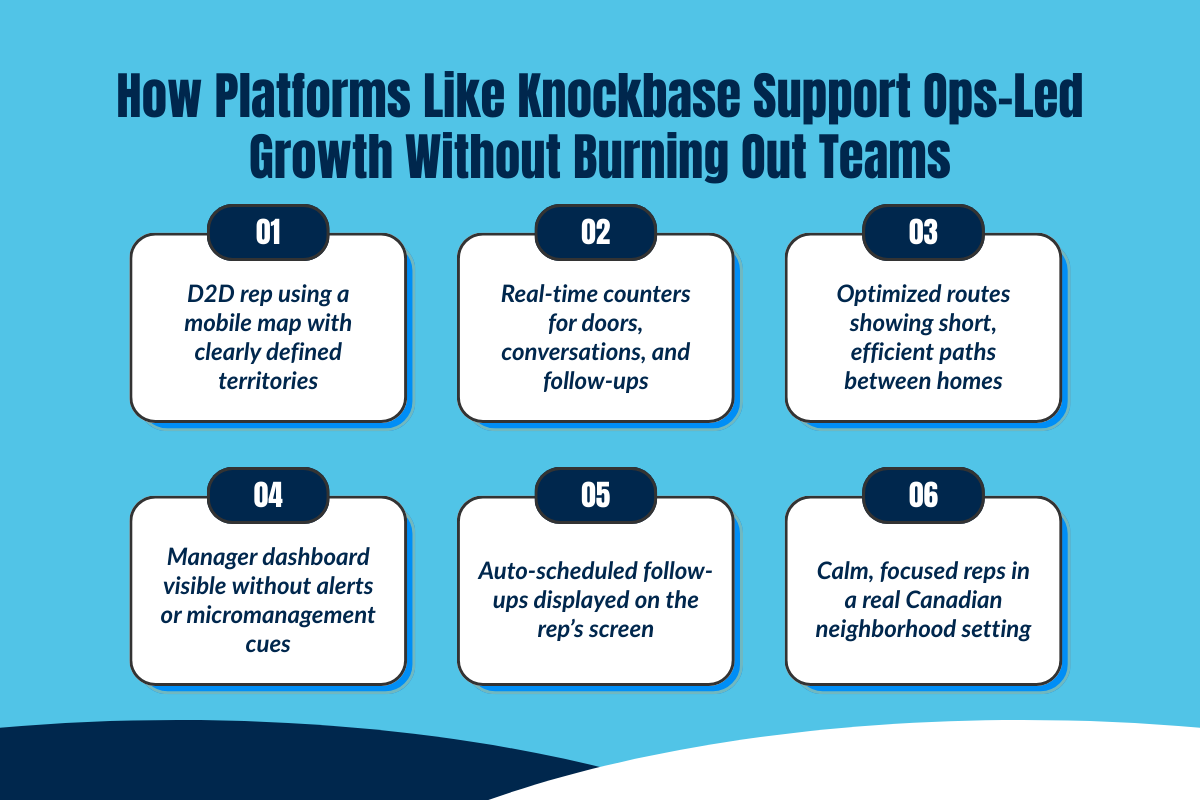
Ops-led growth only works when tools reflect reality. Most CRMs were built for desk sales, not people walking neighbourhoods, handling rejections, and working within tight time windows. Knockbase was designed for how door-to-door sales actually happen.
1. Designed Specifically for Door-to-Door Sales Operations
Knockbase is built around real D2D behaviour, not generic sales assumptions. It supports:
- Territory-based selling
- Field-first workflows
- The way door sales actually unfold, house by house
2. Smarter Territory Management That Respects Rep Energy
Territory confusion is one of the fastest ways to burn out a team. Clear territory management:
- Reduces overlap and internal conflict
- Optimizes routes to save time and energy
- Distributes workload fairly across reps
Removing this friction alone eliminates a major burnout trigger.
3. Real-Time Visibility Without Micromanagement
Visibility doesn’t have to mean pressure. With Knockbase:
- Managers see progress without constant check-ins
- Reps know where they stand every day
- Team leads catch issues early, before they escalate
Clarity builds trust. Trust reduces stress.
4. Performance Tracking That Focuses on Progress, Not Pressure
Knockbase tracks doors knocked, conversations, and conversions in one place. Instead of blaming outcomes, teams can spot patterns and coach smarter. Data becomes a guide, not a weapon.
5. Better Follow-Ups, Better Results in Direct Selling
Follow-ups are where many D2D deals are actually won or lost. Structured follow-ups lead to:
- Fewer missed opportunities
- Higher close rates
- A more professional customer experience
All without extending workdays or increasing pressure.
6. Faster Onboarding for New Door-to-Door Salespeople
As teams hire seasonally or expand rapidly, consistency becomes critical. With clear systems, new reps:
- Ramp faster
- Rely less on shadowing
- Follow the same workflows as experienced sellers
This keeps quality stable even as headcount grows.
7. Built for D2D Service Companies Operating in Canada
Knockbase is designed with Canadian realities in mind, supporting:
- Multi-city and multi-region operations
- Seasonal team scaling
- Long-term growth without operational chaos
How to Start Scaling D2D Sales Without Burning Out Your Team?
You don’t need to rebuild everything from scratch. Most teams don’t fail because they lack effort; they fail because the basics are fragmented. What you need first is a quick reset. Here's how:
1. The First 30 Days of an Ops Reset
Start small and focus on fundamentals:
- Audit how work actually flows today
- Identify where reps feel friction or confusion
- Centralize tracking and visibility
Fixing the basics often delivers immediate relief.
2. Choosing Tools Built for Door-to-Door Sales
When evaluating tools, prioritize systems that:
- Understand territory-based selling
- Track real D2D metrics, not vanity numbers
- Support coaching and clarity, not control
That’s where platforms like Knockbase fit naturally, not as an add-on, but as the operational backbone.
Conclusion:
Door-to-door sales in Canada aren’t slowing down, but hustle-only operations are. Teams still relying on pressure, manual tracking, and informal processes are already paying for it through burnout, churn, and inconsistent results.
The strongest D2D service companies are making a quiet shift toward ops-first systems that give reps clarity, protect their energy, and make performance predictable. They’re not asking people to work harder; they’re removing the chaos that drives good salespeople away.
Every delay widens the gap. Burnout compounds, data stays fragmented, and top reps move to teams with better structure. At that point, growth doesn’t just stall; it leaks. If the strain feels real right now, you’re not late, you’re right on time. Waiting longer is the real risk. Don’t let chaos slow your growth. Contact us today to see how Knockbase can transform your direct selling operations.
FAQs
1. What are D2D sales in Canada?
D2D sales in Canada are a form of direct sales where salespeople, including many students seeking summer or part-time work, approach potential clients at their homes to sell products or services. This method is common in home services, energy, and telecom, and helps participants develop valuable sales skills through face-to-face interactions.
2. Why do door-to-door salespeople burn out so fast?
Most burnout comes from poor systems, unclear targets, and wasted effort, not lack of motivation. Developing strong interpersonal and sales skills, such as effective communication, handling rejection, and building trust, is essential to handle the unique challenges of D2D sales and reduce burnout.
3. How can D2D service companies scale without losing reps?
Companies scale without losing reps by prioritizing structured workflows, clear territories, and visibility into who has sold door to door. Reps know which house to visit, how to connect with prospects, and stay aware of law, restrictions, and local police requirements, reducing burnout and confusion.
4. What gives a competitive edge in direct selling today?
The edge comes from clear territories, smart tracking of sales and purchases, and tools designed for door-to-door marketing. Reps can recognize potential clients, follow lawful practices, and talk effectively to build lasting relationships at every address.
5. What should consumers know about door-to-door sales in Canada?
Door-to-door salespeople may sometimes use high-pressure tactics to encourage immediate contract signing. Consumers have a cooling-off period during which they can cancel a door-to-door sales contract without penalty. It is advisable to ask for identification and permits from salespeople to verify their legitimacy, and to report any suspicious activities to local authorities or consumer protection agencies. Written contracts must include cancellation rights and terms of service.

Canvassing Software ROI: How Sales Managers Should Calculate Cost-Per-Knock vs Cost-Per-Lead in 2026