Door-to-door sales reward grit: knocking more doors, handling rejection, and staying composed lead to success. However, as D2D teams expand across EU countries, grit without structure weakens.
More doors no longer mean more deals; reps work hard but see slipping conversion rates and messy follow-ups.
Some leaders still rely on WhatsApp, memory-based updates, spreadsheets, and late summaries, while others use modern platforms for real-time field visibility.
The difference isn’t motivation or effort. It’s clarity, timing, and decision-making. If scaling door-to-door sales across Europe feels harder than it should be, you’re not imagining it. This blog is written for you.
How Modern Service Teams Use D2D Sales Platforms in Real Time?
This blog describes what happens when door-to-door (D2D) sales expand beyond a single market. It highlights where the sales process strains, what breaks first, and why success drops even with long hours.
It discusses how modern D2D organizations maintain personal connections, use technology to support sales, and what leaders must prioritize to scale smoothly across Europe.
D2D sales remain highly effective, converting at 2–5%, versus about 1% for digital channels, because face-to-face interactions build trust faster, especially in industries like solar, security, pest control, alarms, and home services.
But without the right structure, growth amplifies inefficiency instead of results. By the end of this blog, you’ll have a clear understanding of how scalable D2D sales actually work in the real world.
Key Takeaways
- Door-to-door sales still depend on effort, but scale exposes weak systems quickly.
- A structured sales process keeps sales reps focused from prospecting through follow-up.
- Teams grow faster than processes, and visibility often disappears first.
- Personal connection survives scale when supported by insight, not control.
- Modern D2D sales platforms turn daily selling activity into usable patterns.
Curious How Leading D2D Teams Coordinate Sales Across Europe Without Losing Momentum?
High-performing D2D sales teams don’t wait for end-of-day summaries. They share visibility into door sales activity, follow-ups, and outcomes so sales reps can focus on prospects most likely to buy.
Sales leaders gain insight into sales strategy execution, conversion rates, and territory performance without disrupting in-person sales or face-to-face interactions.
Real-time insights enable quick adjustments to door routes, follow-up timing, and sales pitch delivery, directly improving success rates across multiple EU markets. If you want to experience this right away, book a demo with us to see it in action!
Why D2D Sales Still Outperform Many Digital Channels in Europe?
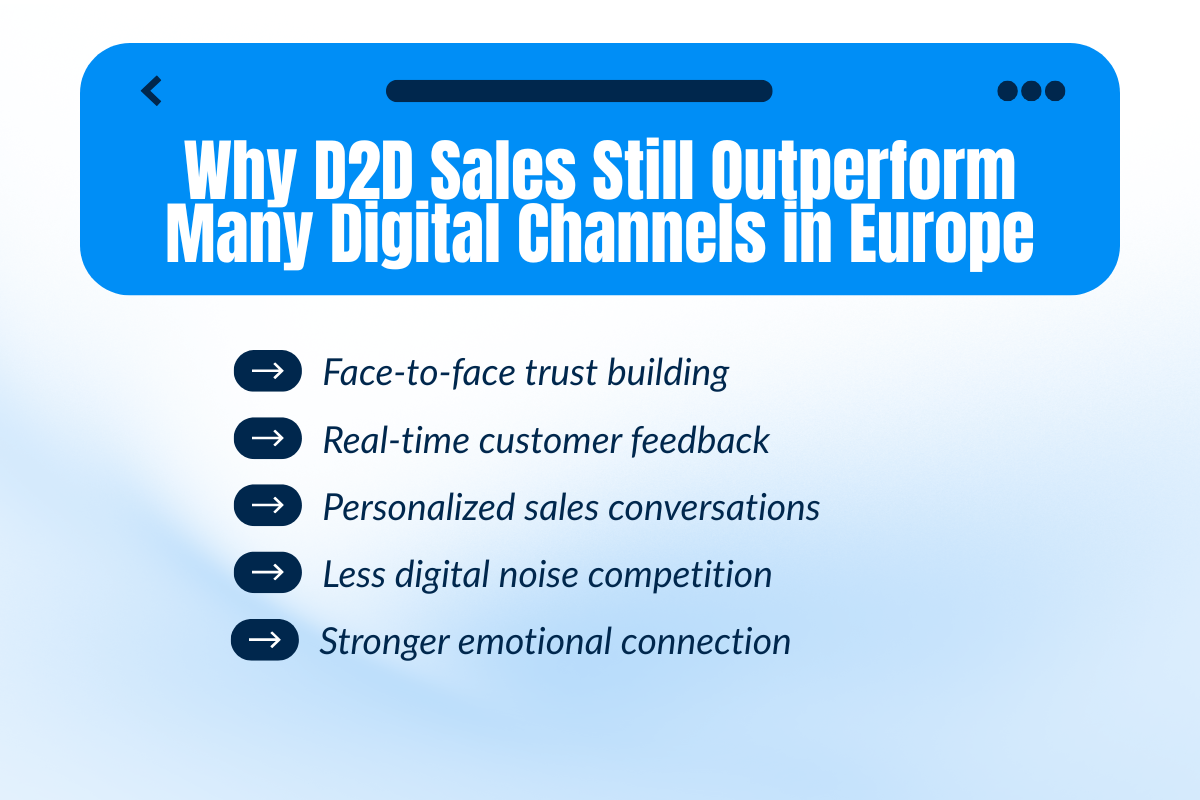
Door-to-door sales outperform many digital channels by enabling direct, face-to-face interactions. In-person sales foster personal connections, helping reps understand customer pain points and respond instantly.
Unlike online ads, door sales let reps gather real-time info, read body language, and adapt their pitch, boosting trust and making prospects feel understood.
D2D sales are viewed as less competitive than digital advertising, where customers are flooded with messages. Respectful, brief door-to-door sales often feel more personal and less transactional.
This is why direct selling remains effective across various industries, especially where building trust, explaining product benefits, and answering questions clearly are essential.
Why Is Scaling D2D Sales Across Europe More Complex Than It Looks?
At first glance, scaling door-to-door sales feels simple. Hire more sales reps, expand territories, and repeat what already works.
In reality, the European market adds layers of complexity driven by regulation, cultural expectations, and varying customer behavior.
Sales laws, solicitation licenses, and compliance rules vary widely, affecting how direct selling teams operate across countries.
Without shared systems, leaders often recognize problems only after conversion rates drop or sales rep turnover rises.
Differences in Door-to-Door Sales Culture Across EU Markets
Face-to-face interactions vary significantly across Europe, even when selling identical products or services. Trust levels, openness to door selling, and decision speed shape how a door-to-door salesperson approaches each prospect.
In some markets, buyers expect formal introductions and time to evaluate information, while others respond more openly to direct conversations and quick explanations.
Non-verbal cues such as body language, eye contact, and personal space play a major role in how messages are received during in-person interactions.
Sales teams that succeed across Europe adapt their approach to these cultural nuances rather than relying on a single script. Consistently tracking outcomes by market helps teams refine messaging, pacing, and follow-up strategies to match local expectations
How Do Fragmented Teams Affect Door-to-Door Sales Performance Across Borders?
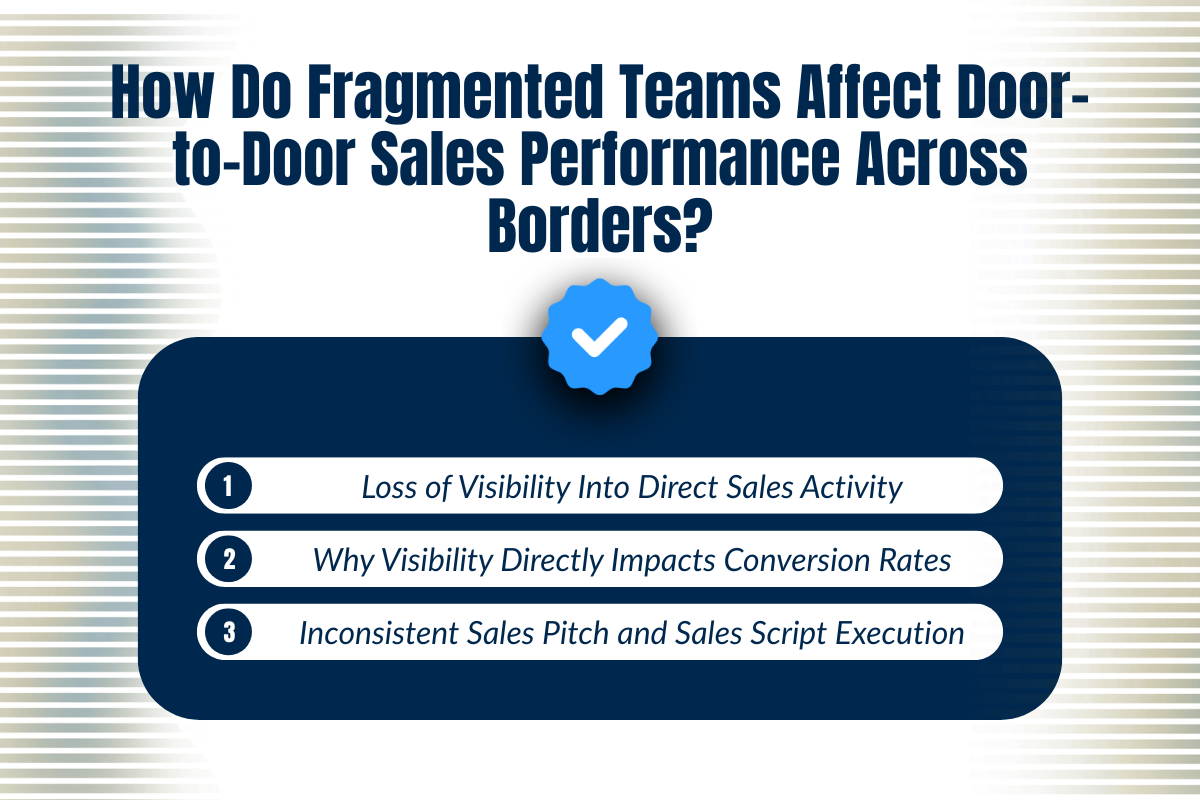
When D2D sales teams operate country by country, fragmentation quietly erodes performance. Sales leaders lose visibility into field sales teams, while sales representatives lack shared benchmarks.
Each region solves similar problems independently, weakening sales training, follow-up discipline, and consistency in sales pitch execution.
1. Loss of Visibility Into Direct Sales Activity
Without a shared system, door-to-door sales tracking depends on memory, handwritten notes, or delayed reporting. Leaders cannot see which doors were knocked, which potential customers were qualified, or where follow-ups stalled.
CRM integration restores visibility by syncing sales activities in real time, enabling coaching before prospects disengage.
2. Why Visibility Directly Impacts Conversion Rates
When leaders lack visibility into door-to-door activity, conversion rates suffer silently. Missed follow-ups, poorly timed revisits, and inconsistent prospect prioritization all reduce the likelihood that prospects buy.
Sales reps who can clearly see their follow-up list, past interactions, and next steps are more likely to close deals efficiently. Visibility protects valuable time and allows sales teams to focus energy where success rates are highest.
3. Inconsistent Sales Pitch and Sales Script Execution
As sales teams grow, messaging drifts across regions. One rep improvises too freely, while another relies rigidly on a sales script despite changing customer pain points.
Using a structured sales script ensures essential information is covered while allowing flexibility based on body language and prospect response.
For additional valuable insights on D2D sales performance, refer to the D2D Sales Playbook.
What Breaks First When Direct Selling Expands Into Multiple EU Markets?
When direct selling scales beyond a single EU country, the breakdown rarely starts with lead volume or sales talent. It usually begins with process gaps that were manageable at a local level but fail under cross-border complexity.
1. Consent Tracking and Documentation
The first major failure point is often consent management. Different EU countries enforce GDPR and consumer protection rules with varying intensity and interpretation.
When teams operate across borders without a unified system, consent records become fragmented, incomplete, or inconsistently stored.
2. Sales Messaging Consistency
Direct selling scripts rarely survive multi-market expansion unchanged.
Language nuances, cultural expectations, and legal disclosure requirements differ across EU states. Without structured controls, teams start improvising messaging, which leads to:
- Inconsistent pricing explanations
- Missing disclosures about cooling-off periods
- Conflicting information across regions
3. Follow-Up Execution Across Markets
Follow-ups are where cross-border selling often fails silently. Different countries have different expectations for contact timing, acceptable channels, and documentation.
Follow-ups also break down as prospective customers fall through the cracks due to unclear ownership and inconsistent sales-process tracking.
How Do Successful D2D Organizations Maintain Control Without Slowing Teams Down?
High-performing D2D organizations focus on alignment, not micromanagement. They analyze patterns across direct sales activity to understand why prospects buy.
Shared insight allows sales managers to coach effectively without interrupting the natural rhythm of door selling.
Balancing Local Door Sales Flexibility With Central Oversight
Top sales teams enable reps to adapt their sales pitch to local customer behavior while consistently tracking outcomes. Personal connection remains central to building trust and closing more deals.
At the same time, outcomes are tracked consistently across regions. Leadership monitors shared performance indicators such as:
- Conversion rates
- Follow-up completion
- Average deal size
This approach allows managers to compare regions, identify patterns, and support underperforming teams without flattening local nuance or slowing field execution.
How Does Technology Help Unify Door-to-Door Sales Across the EU?
Technology connects field sales teams and leadership through real-time data capture. Sales activity, follow-ups, and outcomes are recorded without disrupting face-to-face selling.
Route planning software, rep tracking tools, and sales automation reclaim valuable time and increase productivity by up to 46%.
1. Creating a Shared View of Sales Strategy and Outcomes
With unified systems, sales leaders can evaluate conversion rates and the effectiveness of sales strategy across markets. Performance insights guide coaching, territory planning, and lead prioritization.
Field force automation improves execution consistency and can increase sales output by up to 30%.
2. Standardizing Data Without Forcing Identical Sales Behavior
Technology allows organizations to standardize what is tracked without dictating how reps sell. While conversations vary by country and culture, core data points such as visit outcomes, objections, and follow-up actions remain consistent.
This creates reliable reporting across EU markets while preserving the flexibility reps need to succeed locally.
3. Improving Territory Management Across Borders
Advanced territory planning tools help sales leaders balance coverage across regions with very different population densities and housing patterns.
By visualizing activity and performance geographically, organizations can:
- Reduce territory overlap
- Identify underserved areas
- Allocate reps efficiently across urban and rural markets
This ensures growth happens evenly instead of overloading high-performing regions.
4. Maintaining Compliance Across Diverse EU Regulations
Different EU countries have varying rules around door-to-door selling, consent, and follow-ups. Therefore, centralized systems help organizations enforce compliance automatically.
Technology can help log consent and visit outcomes, control follow-up timing, and ensure messaging aligns with local regulations.
Why Are EU D2D Leaders Moving Away From Country-Specific Sales Tools?
Country-specific sales tools create operational silos that limit how door-to-door organizations learn and scale across Europe. When each market operates on its own system, performance data stays locked within borders, making it difficult to identify which sales techniques, routes, or follow-up strategies actually work best.
As teams expand into new EU markets, these fragmented systems force leaders to rebuild workflows from scratch. Sales managers must retrain teams, recreate reporting structures, and adapt tools repeatedly, slowing expansion and increasing operational overhead.
What Should D2D Leaders Prioritize When Scaling Across European Countries?
- Visibility into door-to-door sales activity must come first. Leaders need a clear understanding of how sales pitch execution affects success rates across regions.
- Sales training should be structured but flexible to accommodate local customer behavior and communication styles.
- Systems must support personal connection while helping sales teams gather information, follow up consistently, and close deals efficiently.
Manual Operations vs D2D Sales Platforms: A Practical Comparison
Both manual systems and D2D sales platforms can close deals. The difference becomes clear as sales teams scale and complexity increases.
| Area | Manual Operations | D2D Sales Platforms |
|---|---|---|
| Job Tracking | Relies on memory, notes, and spreadsheets | Tracks door activity with live updates |
| Scheduling | Requires manual coordination between sales reps | Automatically optimizes territories and routes |
| Follow Up | Often forgotten or delayed manually | Structured follow-up workflows trigger automatically |
| Visibility | End-of-day summaries with limited insight | Live performance data throughout the day |
| Training | Inconsistent and experience-driven learning | Repeatable, scalable sales training programs |
| Decision-Making | Reactive decisions based on delayed data | Proactive decisions using real-time insights |
Using sales software saves sales reps an average of eight hours per week, reduces burnout, and protects conversion rates over time.
If the debate between manual D2D sales processes and automation is still ongoing, find the detailed comparison in D2D Sales Automation vs. Manual Processes: Which One Wins?
How Small and Mid-Sized Sales Teams Benefit the Most?
- Smaller D2D sales teams feel structure benefits first. New sales reps ramp faster, avoid early mistakes, and maintain consistent sales process discipline.
- Sales managers spend less time fixing errors and more time coaching, allowing small teams to compete with larger organizations.
- Clear visibility into territories and follow-ups also reduces confusion among sales representatives, helping teams use valuable time efficiently.
- With structured tools in place, small teams experience lower burnout and more predictable performance, even as door-to-door sales activity increases.
How Customer Communication Improves Direct Sales Outcomes?
Clear follow-up strengthens trust after the door closes. Sales reps know exactly when and how to re-engage prospective customers.
Consistent communication increases satisfied customers, protects average deal size, and grows a long-term customer base.
Timely follow-ups also help sales professionals answer questions that arise after the first visit, improving confidence and reducing hesitation.
When customers feel informed and respected, they are more likely to move forward, recommend the service, and become repeat buyers.
How D2D Sales Software Supports Growth Across Industries?
Door-to-door selling remains highly effective across solar panels, security systems, pest control, alarm systems, and home services.
These industries benefit from in-person sales because product knowledge, demonstrations, and immediate answers build trust faster than digital channels.
How Knockbase Helps Solve the Challenges of Scaling D2D Sales?
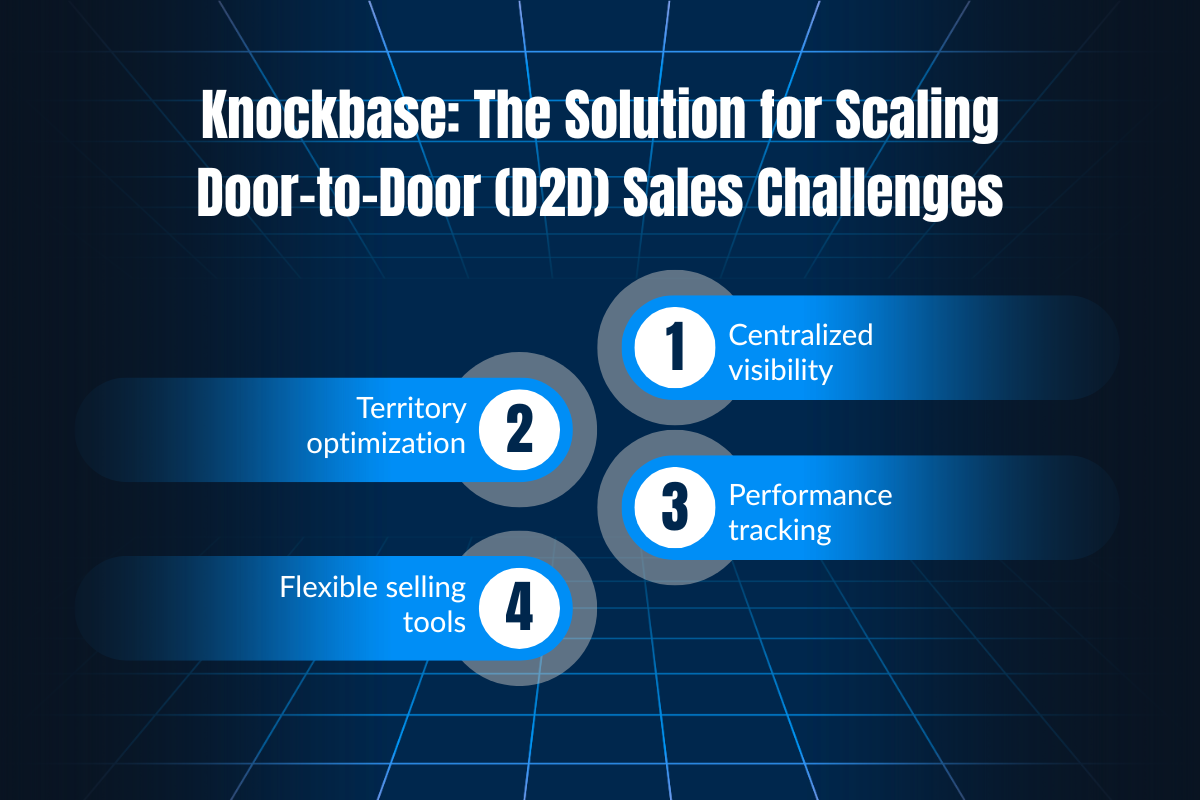
As D2D sales organizations expand across multiple EU countries, complexity increases across teams, territories, and performance tracking. Knockbase is designed to unify these moving parts without disrupting how sales reps sell at the door.
It provides structure for direct selling while preserving the personal connection that makes door-to-door sales effective.
Key capabilities include:
- Centralized visibility: See door-to-door sales activity, follow-ups, and rep progress in real time across all territories.
- Geo-Tagged Territory Management: Every knock, lead, and interaction is automatically tagged to a location so managers can assign zones, monitor coverage in real time, and avoid overlaps or missed areas.
- Flexible selling tools: Support natural sales conversations while preserving personal connection without forcing rigid scripts.
- Gamified Leaderboards & Performance Tracking: Transform goals into friendly competitions with real-time leaderboards that track knocks, appointments, and pipeline metrics.
- Custom Forms & Surveys: Build digital forms tailored to your sales process—capture details such as homeowner responses, survey answers, and follow-up prompts.
- Real-Time Canvass Management & Analytics: Live dashboards show key metrics like time spent in the field, pace of knocking, recent activity, and health tracking. Managers gain insights that guide real-time decisions and coaching.
- Appointment Booking & Automated Reminders: Reps can schedule, reschedule, and confirm appointments right from the field. SMS/email confirmations and automated reminders reduce no-shows and keep the pipeline moving.
- CRM Integration & Workflow Sync: Connect Knockbase seamlessly with your existing CRM and sales tools so lead data, appointment details, and outcomes flow automatically without manual entry or lost information.
- Reporting & Custom Dashboards: Create dashboards that show total knocks, lead conversions, appointments, and rep performance. Reports can be exported or filtered by rep and territory, so you always know what’s working.
For teams exploring scalable D2D sales, Knockbase demonstrates how clarity and flexibility can coexist.
What’s the Real Lesson About Scaling D2D Sales in the EU?
Scaling D2D sales fails when visibility fades, and alignment breaks down. Teams that succeed invest early in structure while preserving human selling.
D2D sales remain a people-first business, but long-term growth depends on processes, insights, and disciplined execution.
Why Knockbase?
Knockbase helps sales leaders solve fragmentation, visibility gaps, and follow-up breakdowns across EU markets. It supports financial predictability by improving conversion rates and protecting the average deal size.
By aligning sales representatives, territories, and insights in one platform, Knockbase enables sustainable D2D growth without adding operational friction. See how Knockbase works in real D2D environments.
Book a demo and explore the platform in action.
Frequently Asked Questions
1. What are D2D sales, and why are they effective in Europe?
D2D sales involve face-to-face direct selling at the customer’s door, which builds trust faster than digital channels. In Europe, personal connection, product transparency, and real-time interaction support higher conversion rates.
2. Why do door-to-door sales teams struggle when scaling across EU markets?
Teams struggle due to fragmented tools, inconsistent sales training, limited visibility, and high turnover. Without shared systems, leaders cannot monitor performance or coach sales reps effectively across regions.
3. How does technology improve conversion rates in direct selling?
Technology improves conversion rates by organizing follow-ups, optimizing routes, and delivering real-time insights. Sales reps spend more time selling and less time managing logistics or correcting errors.
4. Is door-to-door selling still relevant compared to digital sales?
Yes, door-to-door selling often converts at 2–5%, compared to roughly 1% for digital channels. Face-to-face interactions allow immediate objection handling and stronger relationship building.
5. How can sales leaders reduce burnout in D2D sales teams?
Burnout decreases when reps have clear territories, structured follow-ups, consistent sales training, and performance visibility. Removing guesswork protects morale and improves retention.

Canvassing Software ROI: How Sales Managers Should Calculate Cost-Per-Knock vs Cost-Per-Lead in 2026