Door-to-door selling feels brutal when you don’t know what to say in those first few seconds. Anyone who’s knocked enough doors knows that moment, the door opens, the homeowner gives you the “Who are you and why are you here?” stare, and suddenly your brain wipes itself clean.
You second-guess everything: “Do I introduce myself? Ask a question? What if they shut the door immediately?” It’s not that sales reps are bad; it’s that the brain freezes when pressure hits before the words do.
Top door-to-door reps fix this by removing guesswork. They rely on simple, proven opening lines that stop the panic, steady their voice, and make them sound calm and confident the second the door opens.
What Are Real-World Approaches That Actually Convert with D2D Sales Scripts?
In door-to-door selling, most reps don’t lose the sale because of the product. They lose it in the first ten seconds. The door opens, the homeowner is cautious, and if your opener doesn’t feel natural, relevant, and respectful of their time, the conversation ends before it begins.
Real-world D2D scripts that convert fix exactly that. They help you get quick permission to talk, lower defenses, and guide potential buyers into a simple next step without pressure.
This guide shows you how to do it with clear, field-tested D2D sales tips that work across solar, pest control services, and home security systems. You’ll see how top sales professionals use better openers, smarter objection handling, and small micro-commitments to keep the sales process moving.
Everything here is designed for new reps and teams who want consistent success, stronger relationships, and more deals, without sounding scripted or salesy.
By the end, you’ll know exactly what to say at the door, how to deliver it naturally face-to-face, how to stay organized, manage leads, and give only the most relevant information so prospects buy with confidence.
Let’s dive in.
Key Takeaways
- First impressions form in under a second, so a door-to-door salesperson needs a clear, calm opener that earns trust fast.
- Most reps freeze in the first 10 seconds because they lack a simple script, which hurts engagement with potential customers.
- Door-to-appointment rates average only 6–12%, showing how much the sales process depends on strong openers and better lead handling.
- Small script tweaks can boost appointments by 20%+, helping sales professionals close more deals and build a stronger customer base.
- Over half of face-to-face communication is body language, making tone, posture, and pacing just as important as the product’s features.
You don’t need better luck at the door—you need better defaults.
When pressure hits, your brain falls back on whatever you’ve practiced. Keep reading to see the exact openers, phrases, and delivery techniques real reps rely on when it counts most. Power up your field team, explore the D2D Sales suite now.
Why Most D2D Reps Struggle To Convert at the Door (Even Good Ones)?
Most people think D2D selling is hard because homeowners aren’t interested. But the truth is, even a good door-to-door salesperson faces some issues that lead to customer loss, and here are some:
1. They Freeze in the First 10 Seconds
- Even experienced sales representatives blank out because they don’t know what to say.
- No clear opener = over-talking, under-talking, or awkward silence.
- Potential customers check out before the sales process even starts.
2. First Impressions Are Brutal
- Homeowners judge you in 0.7 seconds, faster than a blink.
- They decide instantly: “Safe or not?” “Worth my valuable time?” “Do I keep listening?”
- Face-to-face selling lives or dies in that moment.
3. Industry Reality Check (Solar + Pest Control)
- Avg door-to-appointment rate: 6–12%
- Good reps: 18–25%
- Top 1%: 30%+
- Meaning: Most door-to-door salespeople leave half their potential buyers untouched simply because of weak openings.
4. Why Memorized Monologues Fail
- Homeowners instantly reject anything that sounds scripted or pushy.
- Successful door conversations come from scripts that are:
- Short
- Conversational
- Adaptable to different personalities
- This style helps build relationships and gives space for good open-ended questions.
5. Small Script Tweaks = Big Results
Sales professionals who updated just their first two lines saw:
- 22% more appointments
- Smoother conversations with potential customers
- Fewer instant “not interested” rejections
- Better momentum in their sales funnel
A great door opener is hugely beneficial before you ever talk about product features, leave a business card, or manage leads on digital channels.
What Makes a Door-to-Door Sales Script “High-Converting”?
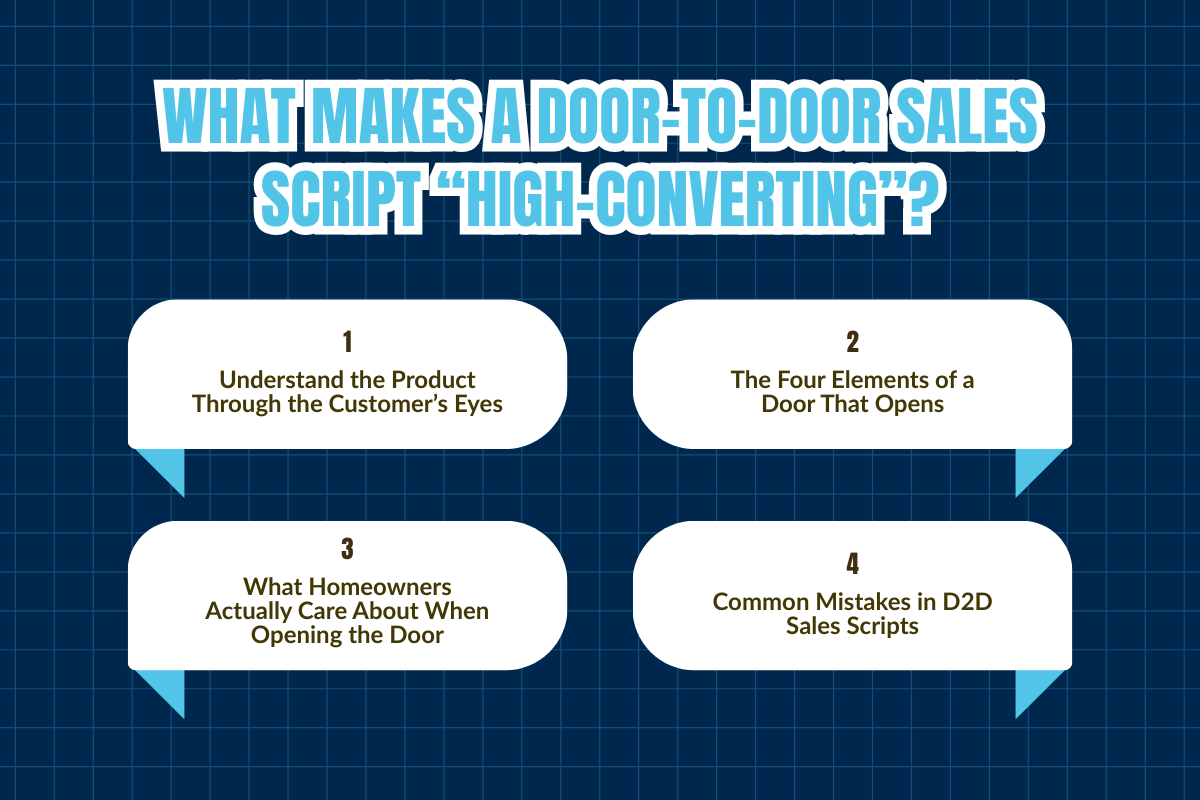
1. Understand the Product Through the Customer’s Eyes
A great D2D salesperson doesn’t just know the product; they understand how it fits into the everyday life of their target audience.
Before you start knocking, get a clear understanding of:
- What problems do your potential customers face
- How does your solution save their valuable time, money, or stress
- What objections might they have
This mindset shift is hugely beneficial for the entire sales process, from the first knock to the final follow-up.
2. The Four Elements of a Door That Opens
- Clarity: Homeowners must instantly understand why you’re at their door. A clear opener prevents confusion and sets up a smooth, successful door conversation.
- Confidence: Not loud, not pushy, just calm, steady confidence. This helps you come across as trustworthy and makes it easier for homeowners to answer questions or engage with you.
- Relevance: Your opening line should connect to something real happening in their area, a recent installation, a service update, or a neighborhood trend. This makes your visit feel timely, not random.
- Respect for Time: The first thought in every homeowner’s mind: “How long will this take?” A strong script answers that upfront, showing you respect their schedule while still offering a personal touch.
3. What Homeowners Actually Care About When Opening the Door
They are not thinking about:
- Your product
- Your pitch
- Your features
They are thinking:
- “Are you safe to talk to?”
- “Is this going to take long?”
If you fail these tests early, you lose even the most potential buyers, no matter how experienced you are in the sales industry. Passing these tests gives your sales representatives a better success rate, a smoother sales funnel, and more new leads.
4. Common Mistakes in D2D Sales Scripts
A lot of D2D salespeople unknowingly sabotage their own conversions. The most common mistakes include:
- Sounding robotic: homeowners instantly tune out scripted, unnatural lines
- Long introductions: people don’t have patience for a long setup
- Pitching too early: before building relationships or asking an open-ended question
- Ignoring: homeowner cues, especially body language or tone
- Not identifying pain points: which means you can’t tailor your message
- Skipping micro-commitments: small “yes” moments that lead to consistent success
- Poor body language: hands, posture, and eye contact matter
- Forgetting to earn trust first: the core of all field sales teams
Fixing these mistakes helps you:
- Manage leads better
- Convert potential customers into satisfied customers
- Improve future sales
- Generate more appointments on both digital channels and at the door
- Sell products more naturally
- Build a stronger sales career and company reputation
Ultimately, a great door opener is the difference between being ignored and making a new friend, starting a good conversation, offering good advice, or even handing over a business card that actually gets a call back.
If you want to turn first-time reps into confident closers, take a deeper look at: How to Train Your Team for Successful Door Knocking
How to Make Any Script Sound Natural: Body Language and Delivery?
1. Why Body Language Matters More Than the Words
Mehrabian’s communication study:
- 55% = body language
- 38% = tone
- 7% = words
Meaning: Even the best door sales script won’t work if your delivery is off.
2. Do’s and Don’ts for Door Sales
Dos:
- Step back 2–3 feet
- Keep hands visible
- Make light eye contact
- Smile like a normal person (not a salesman)
Don’t:
- Stand too close
- Point at the homeowner
- Look at your clipboard too often
- Over-smile
- Talk too fast
3. How to Practice Until It Sounds Natural
- Shadow top door-to-door sales reps
- Role-play daily
- “Record & review” your opener
- Rehearse with different personalities
- Use Knockbase to listen back to what actually works
The Soft-Skill Advantage: How Top Reps Personalize Scripts and Adapt to Any Homeowner (The Skill Most D2D Sellers Are Missing)
Most door-to-door reps think they need the perfect script. But top 1% reps know the real breakthrough comes from observation, adaptation, and emotional intelligence.
This is the soft-skill layer that turns an ordinary sales job into a career where you consistently sell door after door and make more money than average reps can imagine.
Here’s the skillset elite field sellers use, and why it changes everything:
1. Observe First, Speak Second (The 3-Second Advantage)
Top performers don’t start with lines; they start with reading the home. This instantly makes the conversation personal instead of scripted. What to look for:
- Cars: EV = value-driven; old SUV = budget-focused.
- Garden: Well-kept = they care about home value; neglected = lead with convenience or savings.
- Pest signs: Mud tubes, droppings → instant relevance.
- Solar panels: Introduce upgrades, rate changes, and efficiencies.
- Kids’ toys: Lead with safety, stable bills, or long-term value.
- Elderly ramps/rails: Go slower, clearer, softer.
- Shade patterns: For solar reps, this signals expertise, not selling.
Why this works: It doesn’t feel like a pitch; it feels like a real human paying attention. That alone increases your success rate before you say your first line.
2. Make Your Pitch Hyper-Local (The “Neighbor Relevance” Hack)
Generic statements kill trust. Hyper-local pain points make homeowners listen instantly.
1. Solar examples:
- Electricity rates rose 7.3% YoY in many states and up to 12–18% in several U.S. markets.
- “Most homes on this side of the block saw higher peak-hour charges.”
2. Pest examples:
- Activity spikes 30–40% in hotter or rainy months.
- “We’re checking homes closest to that problem patch down the street.”
Why this works: The homeowner feels like you’re informing them, not selling them. Relevance breaks resistance every time.
3. Use Soft Data, Not Hard Pressure (The Trust Trigger)
Numbers build credibility only when used lightly. Use phrases like:
- “What we’re seeing in this area is…”
- “Most homes on this block are getting…”
- “Your zone had a rate/activity update…”
- “Your neighborhood map shows…”
Why it works: Data feels neutral and safe. It bridges the initial trust gap, essential when you sell to complete strangers.
Give your team the tools to practice smarter, compete fairly, and improve results on every block. Experience Gamified Door-Knocking door-knocking systems that actually raise performance.
Adapt Your Script to the Person at the Door (The Top 1% Skill Most Reps Ignore)
Using one script for every buyer is the reason average reps stay average. Top earners adjust their opener based on who they’re talking to, which is why they book more appointments and make more money. Here are the core buyer types:
A. The Fast-Talker
Behavior: Quick, decisive, wants efficiency.
How to win:
- Match their pace.
- Use ultra-short openers.
- Skip fluff.
- Ask one sharp question.
Why: Fast buyers reward fast reps.
B. The Busy Parent
Behavior: Rushed, multitasking.
How to win:
- Acknowledge their time.
- Promise a 20-second check.
- Give an easy “out.”
- Focus on one benefit.
Why: Respect wins attention. Lack of respect gets the door shut.
C. The Suspicious Homeowner
Behavior: Guarded, cautious.
How to win:
- Slow down 30–40%.
- Keep hands visible.
- Avoid big claims.
- Validate their caution.
Why: They don’t hate salespeople; they hate feeling pressured.
D. The Analytical Buyer
Behavior: Logical, curious, cautious, but open.
How to win:
- Use soft data and neighborhood examples.
- Keep tone steady and factual.
- Ask permission before sharing numbers.
Why: Analytical buyers purchase logic, not hype.
E. The “Not Interested” Homeowner
Behavior: Reflex rejection.
How to win:
- Accept the “no.”
- Use a soft re-frame.
- Ask one micro-question to reopen the conversation.
Why: Most “Not interested” people aren’t rejecting you; they’re rejecting the pattern.
Why This Soft-Skill System Makes You Sell More Doors
Because it finally aligns your pitch with the person, not the script.
Most reps: Talk → React → Guess → Lose the door
Top reps: Observe → Adapt → Personalize → Convert
This is how the best of the best turn a simple door knock into:
- more appointments
- more trust
- more money
- and a faster-growing career in D2D selling
Real-World Objection Handling: Tested Phrases That Lower Defenses
These responses aren’t theory, they’re the exact phrases top D2D salespeople use every day to turn instant rejections into calm, open conversations. When you start knocking, these lines help you come across as confident, respectful, and professional, the kind of sales representative homeowners trust.
1. Objection: “Not Interested.”
High-Conversion Response: “No problem, most people say the same thing at first. Quick question though…”
Why it works: Homeowners often say “not interested” reflexively to end the interaction. This line:
- Lowers pressure
- Shows confidence
- Keeps the sales process alive
- Signals that you respect their space
- Creates space for a successful door conversation
It also shows the homeowner that you’re not there to force a sales pitch, but to understand whether they’re the right target audience.
2. Objection: “We Already Have Solar / Pest Control / Alarm Systems.”
High-Conversion Response: “Perfect, that makes this simple. I’m just checking whether your home falls under the new rate/activity bracket, so you don’t miss anything. Do you remember when you last updated your plan/service?”
Why it works:
- You position yourself as a helpful expert, not a competitor
- It adds a personal touch to the conversation
- It opens a dialogue about upgrades, gaps, or outdated benefits
- You immediately turn a wall into a window for future sales
This response is especially effective for reps who sell products like solar, pest control, or alarm systems because homeowners rarely track updates on their own.
3. Objection: “I Don’t Have Time.”
High-Conversion Response: “Totally understand, this takes literally 20 seconds. If it sounds irrelevant, I’ll step away. Fair?”
Why it works:
- Shows massive respect for their valuable time
- Gives them control
- Makes the conversation feel light, not pushy
- Reduces defensiveness
- Creates a micro-commitment that keeps the door open
Most potential customers appreciate a rep who isn’t trying to trap them in a long conversation. This line shows you’re a professional, not a nuisance.
4. Objection: “Send Me Information.”
High-Conversion Response: “Sure, before I send anything, I just need to ask the same two questions we ask everyone so the info is actually relevant. Sound good?”
Why it works:
- Stops the conversation from ending prematurely
- Helps you qualify the homeowner before any follow-up
- Ensures you’re not sending generic content that gets ignored
- Establishes your authority as someone who tailors information
This shifts you from being “just another door-to-door salesman” to a consultant who filters information based on the homeowner’s needs.
5. Objection: “Too Expensive.”
Anchoring Technique Response: “Totally fair, most people assume that. The funny part is that the check is free, and the actual cost depends entirely on your home’s numbers. Want me to show you the ranges quickly?”
Why it works:
- Lowers psychological resistance
- Reframes the conversation around facts, not assumptions
- Removes the fear of commitment
- Positions you as someone who provides clarity, not pressure
This technique is elite-level; it turns a price objection into curiosity. A great door opener followed by this tactic builds trust fast and leads to more new leads, more appointments, and more current customers becoming satisfied ones.
Why These Tactics Work So Well
These responses help you:
- Stay in control without sounding salesy
- Build credibility instantly
- Earn trust before the real sales technique begins
- Keep the sales funnel moving even after objections
- Show your company in a professional light
- Make homeowners feel safe and respected
They’re simple, but they transform how sales professionals handle objections, especially in fast-paced door-to-door selling jobs where every second counts.
If rejection slows you down, this breakdown is worth reading: Eliminating the Fear of Rejection in Door-to-door Sales
Advanced Door Selling Techniques: Only the Best Reps Use For Their Door Conversations
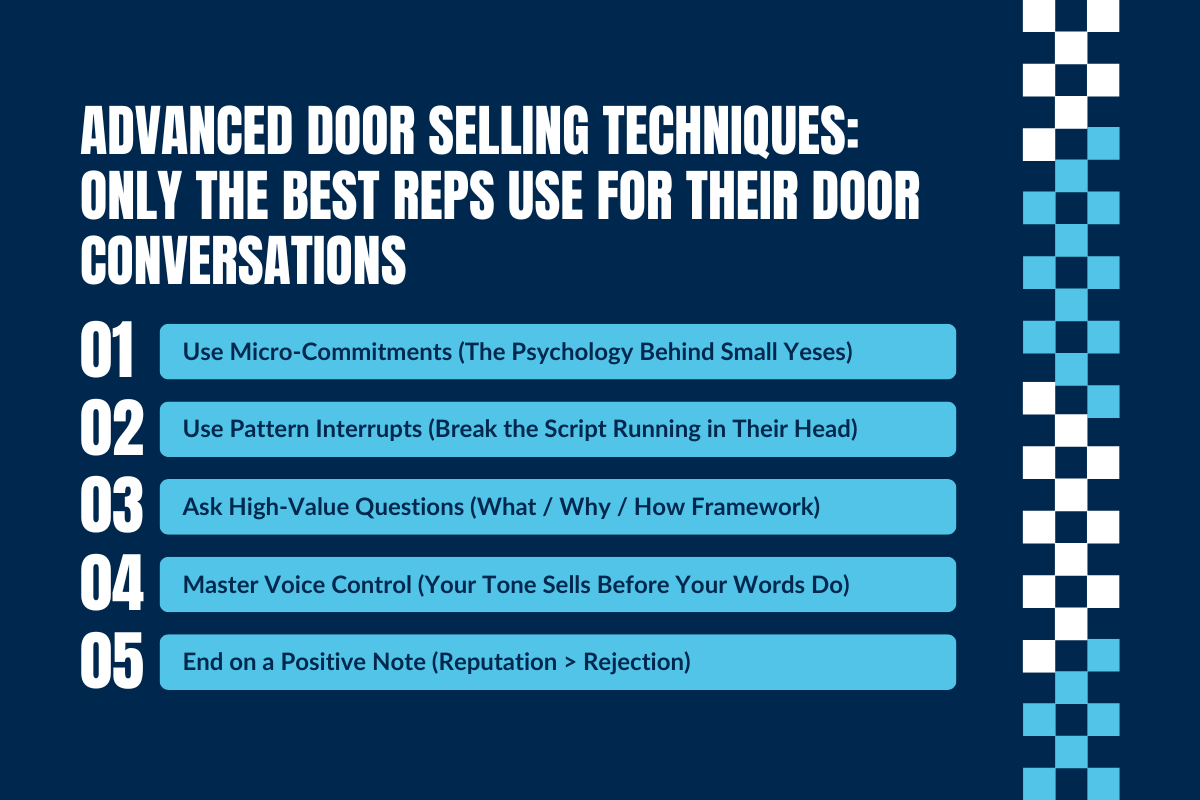
1. Use Micro-Commitments (The Psychology Behind Small Yeses)
Top 1% reps understand one truth: homeowners rarely agree to the big ask. But they almost always agree to a tiny one. Micro-commitments lower psychological resistance and make the interaction feel collaborative instead of salesy.
Example: “Totally fair if you say no. Mind if I show you the rate/activity shift first?”
This works because it:
- Acknowledges their right to decline
- Feels respectful
- Asks for a “yes” so small it’s frictionless
- Mentally prepares the homeowner to stay engaged for the next 10 seconds
It’s the difference between pushing a door open and gently nudging it.
2. Use Pattern Interrupts (Break the Script Running in Their Head)
When the homeowner opens the door, they already think: “Oh, great, another salesperson.” A pattern interrupt snaps them out of this autopilot and forces their brain to re-evaluate you.
Example: “I’ll be quick, I’m not selling anything right now.”
This jolts their expectations because it’s the opposite of what every other rep says. It buys attention, lowers defensiveness, and makes the conversation feel human, not transactional.
3. Ask High-Value Questions (What / Why / How Framework)
Top 1% reps ask questions that reveal motive, history, and emotional drivers, not just surface info. These open-ended questions make the homeowner talk, which naturally builds trust.
Examples:
- “What’s your average bill?” reveals pain points.
- “Why did you choose your current provider?” shows their priorities.
- “How long have you lived here?” gives context + rapport-building material.
When the homeowner talks, they begin to feel understood, and people buy from whoever understands them best.
4. Master Voice Control (Your Tone Sells Before Your Words Do)
Elite reps know that tone communicates more than the script itself. Voice control signals confidence, safety, and professionalism.
Top 1% traits:
- Lower tone creates calmness
- Slow down by 10–15%, shows confidence and authority
- Pause intentionally, makes you sound thoughtful, not pushy
A confident voice isn’t loud, it’s steady. That steadiness is what makes homeowners stay at the door instead of closing it.
5. End on a Positive Note (Reputation > Rejection)
If the homeowner says “no,” top reps don’t leave frustrated. They leave memorable, because today’s “no” often becomes tomorrow’s follow-up success.
A simple: “Totally fine, thanks for your time. Have a great day.”
Why this matters:
- Ends the conversation with respect
- Leaves your personal brand high
- Keeps the door open for future visits
- Makes the homeowner more receptive next time
Top reps think long-term. Every door is not just a pitch; it’s a reputation in the neighborhood.
How Knockbase Helps Teams Train, Track, and Improve Scripts?
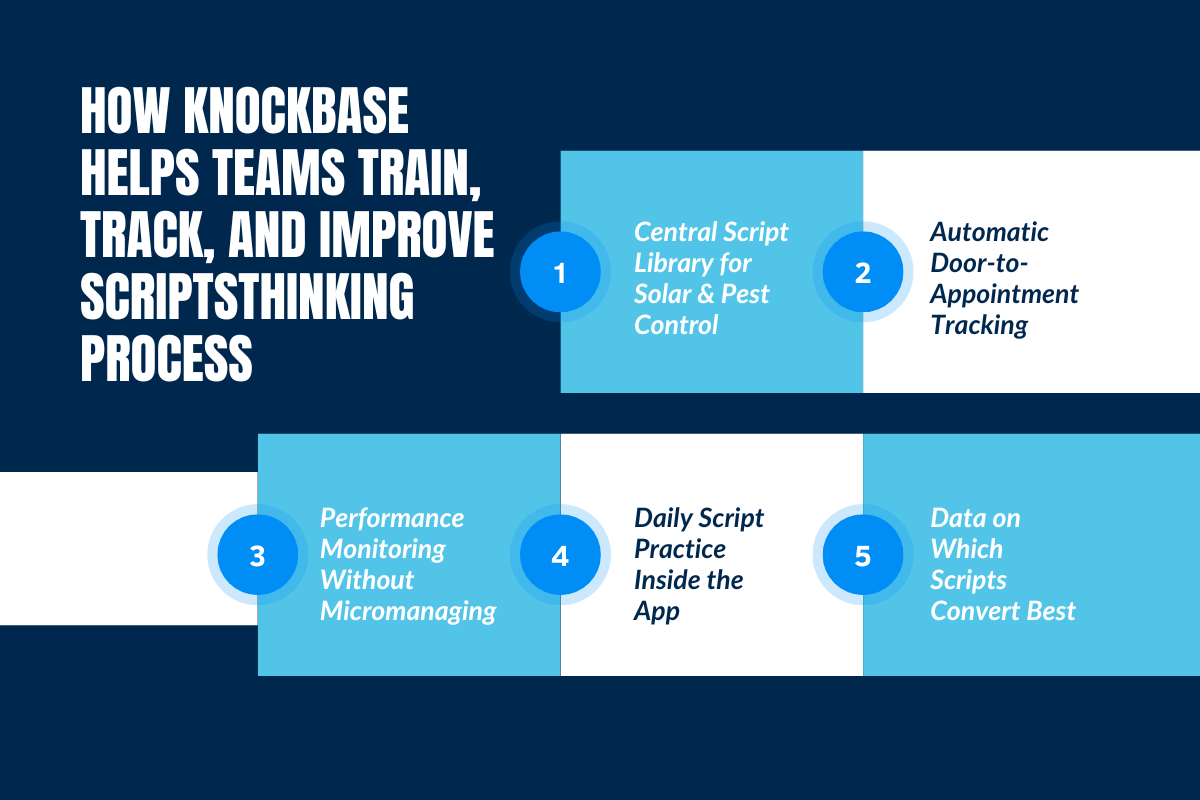
1. Central Script Library for Solar & Pest Control: Knockbase gives teams one place to store, share, update, and roll out scripts, so every rep uses the right version without confusion. Consistency = higher success rate.
2. Automatic Door-to-Appointment Tracking: The app tracks D2A metrics for every rep, every day. Teams instantly see where reps are dropping off in the sales funnel, no spreadsheets, no guessing.
3. Performance Monitoring Without Micromanaging: Managers get clear data on conversations, results, and patterns. Reps feel supported, not watched, which leads to better performance and more confident selling.
4. Daily Script Practice Inside the App: Reps can rehearse scripts in Knockbase just like athletes train. Short, consistent practice helps new hires ramp faster and makes experienced reps sharper.
5. Data on Which Scripts Convert Best: Knockbase shows which exact lines or openers turn into more appointments. Teams repeat what works, remove what doesn’t, and continuously improve future sales performance.
Final Checklist: What Every D2D Rep Should Master Before Knocking
- Know your 15-second opener
- Understand local pain points
- Use micro-commitments
- Have at least 3 objection handlers ready
- Keep product knowledge simple
- Practice body language
- Know when to walk away
- Log every door in Knockbase
Conclusion: The Right Words at the Door Change Everything
D2D selling is simple, but not easy. The reps who succeed aren’t the smooth talkers; they’re the ones who know exactly what to say in the first few seconds, stay calm, stay human, and follow a clear structure.
A great script doesn’t make you sound scripted. It makes you sound confident. Once you master these approaches, your conversion rates improve, appointments go up, and sales start to feel less like a grind and more like a skill you’ve finally unlocked.
About Knockbase
Knockbase gives D2D teams the unfair advantage, smarter scripts, real-time tracking, and data that shows exactly what’s working at the door. From script libraries to rep performance insights, everything your field team needs to book more appointments is finally in one place.
If you want higher conversion, stronger reps, and predictable results, Knockbase is built for you. Start using Knockbase today and turn every door into a real opportunity.
FAQs
1) Are D2D sales a good career?
Yes, door-to-door sales can be a strong career choice for people who like communication, persuasion, and performance-based income. Top reps earn well because commissions are uncapped, and the job builds valuable skills like confidence, objection handling, reading people, and maintaining discipline.
It’s demanding, but with good training, a solid product, and consistent practice, D2D becomes one of the fastest ways to grow both income and long-term sales skills.
2) What is the 3-3-3 rule in sales?
The 3-3-3 rule helps salespeople structure conversations simply:
- 3 seconds → Grab attention (tone, posture, quick opener)
- 3 minutes → Build trust (questions, relevance, diagnosis)
- 3 hours → Follow-up phase (walkthroughs, proposals, final decisions)
It reminds reps that sales moves in stages, spark interest fast, build trust quickly, and stay consistent through the follow-up cycle.
3) What are the best door-to-door scripts that actually work?
High-converting scripts are short, natural, and curiosity-based. They don’t sound robotic; they open doors by lowering resistance first.
Strong scripts include:
- Low-pressure opener: “I’ll be quick, just checking homes in this zone.”
- Pattern interrupt: “Not selling anything right now.”
- Simple question: “When did you last update your bill/service?”
- Relevance hook: “Depending on your home year, you may or may not qualify.”
- Micro-commitment: “Fair if you say no, mind if I show you something quick?”
The best scripts act as frameworks; reps adapt them to each house and homeowner.
4) How do top D2D reps close more deals, and what do they do differently?
Top 1% reps close more because they focus on psychology, not pressure. They make homeowners feel safe, respected, and in control.
What they do differently:
- Tone mastery: Speak calmer, slower, and match the homeowner’s pace.
- Micro-commitments: Get small yeses that lead to the big one.
- Pattern interrupts: Say something unexpected to lower defenses.
- Better questions: “What’s your average bill?” “Why this provider?”
- Neutral, no-push approach: Guide the decision instead of forcing it.
- Positive exits: Even a “no” ends with respect, which boosts callbacks and referrals.
These habits make their conversations feel natural and trustworthy, and that’s why they outperform the average rep.