Door-to-door sales in the EU are often dismissed as intrusive, usually grouped with cold calling and aggressive doorstep tactics.
But that perception no longer matches the reality in 2026. As the EU tightens consumer protection rules, around pricing transparency, sustainability claims, and off-premises contracts, informal selling is being pushed out.
In its place, a more structured, consent-driven model is emerging. Modern door-to-door sales in the EU now demand clear information, disciplined sales processes, and accountable follow-ups.
This piece breaks down how door-to-door sales in the EU actually work in 2026, separating outdated assumptions from the realities of compliant, modern selling.
Door-to-Door Sales EU: A Modern Guide for 2026
Door-to-door sales in the EU require a modern, compliant approach in 2026 due to strict data protection laws, country-specific regulations, and changing consumer expectations.
This guide explains how sales teams can operate legally and effectively across EU markets by following GDPR requirements, respecting opt-in rules, adapting scripts to local cultures, and using digital tools to track consent and follow-ups.
When executed correctly, door-to-door sales remain a viable channel in the EU, combining personal interaction with compliant, technology-enabled processes.
Key Takeaways
- Door-to-door sales in the EU now operate as a regulated, consent-led model shaped by tighter consumer protection standards.
- Modern door-to-door selling is not the same as cold calling. It prioritizes transparency, relevance, and informed face-to-face interactions.
- Compliance now requires clear pricing, seller disclosure, opt-in consent, and respect for opt-out rights before any off-premises contract is signed.
- When executed correctly, door-to-door sales can still generate quality leads by capturing intent early and structuring follow-ups effectively.
- Door sales work best in 2026 when integrated into a broader direct marketing strategy, supported by disciplined processes and customer feedback.
Door-to-Door Has Changed & Your Systems Need to Catch Up
In 2026, door-to-door sales succeed only when outreach is documented, compliant, and followed through consistently. The right CRM can help your teams track consent, manage territories, and stay aligned with evolving regulations.
Book a demo to see Knockbase in action.
Why Door-to-Door Sales in the EU Are Often Misunderstood?
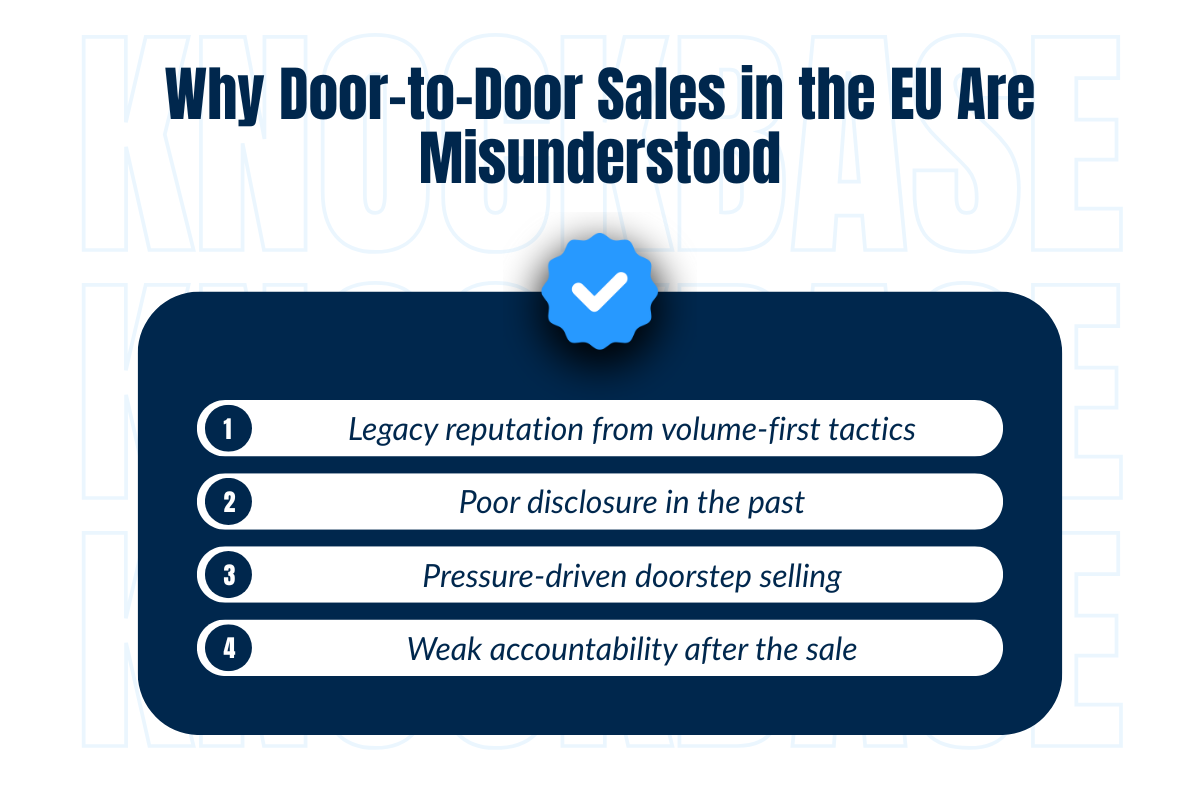
In recent EU consumer enforcement actions, off-premises sales have consistently ranked among the most scrutinized channels, not because the model itself is illegal, but because it historically operated with weak disclosures, poor consent handling, and little post-sale accountability.
That history still shapes how door-to-door sales are perceived today.
> Where the Outdated Perception Comes From
For years, door-to-door selling in the EU followed a volume-first approach:
- High-frequency knocking with minimal targeting
- Limited clarity on pricing, seller identity, or contract terms
- Pressure to close on the spot
- Few structured follow-ups or documented consent trails
In practice, this made door-to-door sales feel indistinguishable from cold calling: interruptive, opaque, and difficult for consumers to trust.
These tactics are no longer compatible with today’s consumer protection standards, but they continue to define public perception.
> Why Modern Door-to-Door Sales in the EU Look Different Today
By 2026, door-to-door sales in the EU operate under much tighter expectations:
- Consent and opt-in signals matter before meaningful selling begins
- Pricing, seller details, and contract conditions must be clearly explained upfront
- Sales teams are expected to inform, not pressure
- Interactions are documented, followed up, and integrated into broader sales systems
As a result, modern door-to-door sales function less like informal doorstep pitching and more like regulated, face-to-face direct marketing, where trust, relevance, and transparency determine outcomes.
Do Door-to-Door Sales and Door-to-Door Selling Still Exist in 2026?
Despite its reputation, door-to-door selling has not disappeared from the EU. What has disappeared is the unstructured, high-pressure version.
In 2026, door-to-door sales continue to be used but selectively, deliberately, and within clearly defined boundaries.
1. Where Door-to-Door Sales Are Still Actively Used in the EU
Door-to-door sales remain active in EU markets where products or services benefit from local context, explanation, or physical presence, such as utilities, home services, energy upgrades, and subscription-based offerings tied to a specific address.
In these cases, door-to-door is not treated as a standalone channel. It is often coordinated with digital touchpoints and compliance systems, operating alongside channels like direct electronic marketing rather than competing with them. The goal is not reach, but relevance.
2. Why In-Person Selling Still Delivers Value in Specific Contexts
In-person selling continues to work when buyers need clarity before committing. For certain products, face-to-face conversations help address objections, explain pricing structures, and establish legitimacy more effectively than remote outreach alone.
For potential customers, the value lies in immediacy and transparency, being able to ask questions, assess credibility, and understand terms in real time. For businesses, this allows early intent qualification, reducing wasted follow-ups and misaligned leads.
Door-to-Door Sales vs Cold Calling: Why the Comparison Falls Apart
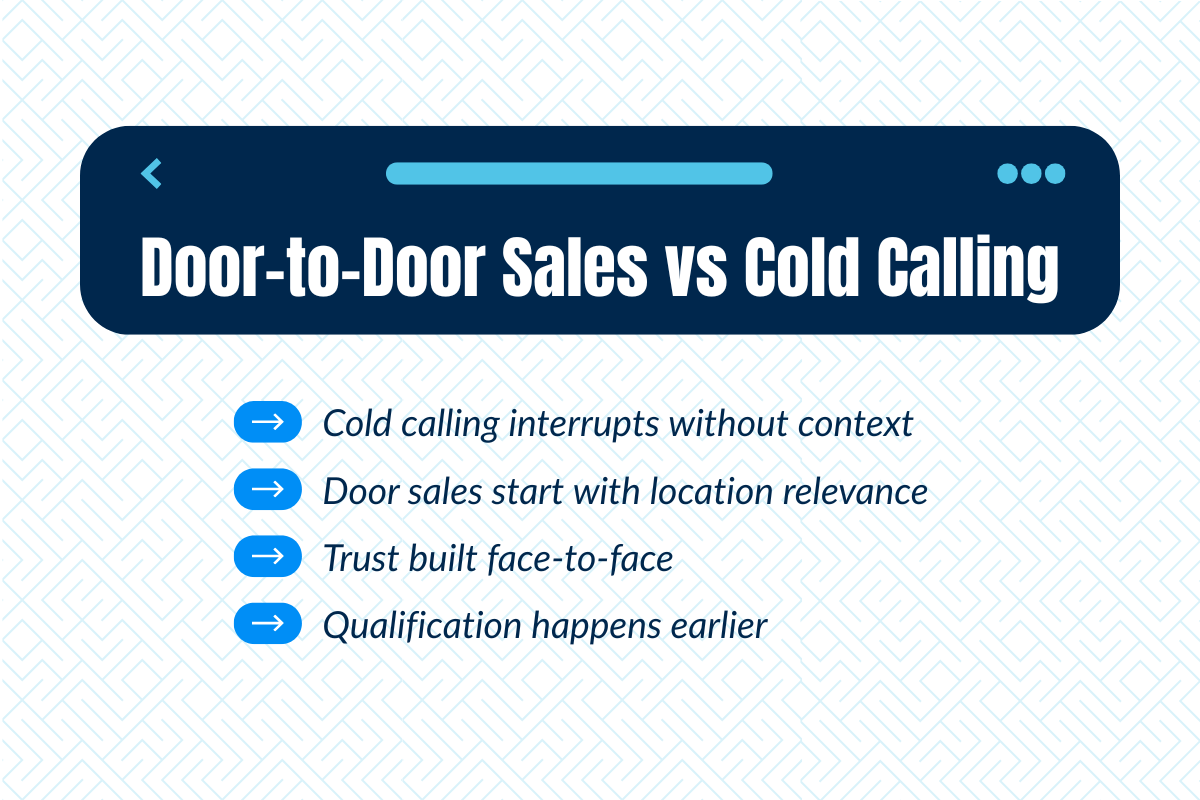
Door-to-door sales and cold calling are often grouped together because both involve outbound outreach.
In practice, they operate on very different mechanics. The comparison breaks down once you look at how each interaction starts, what information is exchanged, and how credibility is established.
1. Why Cold Calling Relies on Interruption, Not Context
Cold calling typically begins without situational relevance. Calls are placed based on contact lists rather than physical or local context, and conversations often start before the buyer understands who is calling, why, or how their details were sourced.
This structure creates friction early in the interaction:
- The buyer is interrupted mid-activity
- Credibility must be established verbally and immediately
- Relevance is assumed rather than demonstrated
As a result, cold calling depends heavily on persuasion within a short time window, which has contributed to declining response rates and trust issues over time.
2. How Door-to-Door Sales Are Structured Around Relevance
Door-to-door sales begin with physical and situational context. The interaction is tied to a specific location, service area, or product relevance that is immediately visible to the buyer.
This changes the structure of the conversation:
- The reason for contact is apparent from the outset
- Questions and objections surface earlier and more naturally
- The interaction can focus on explanation rather than interruption
Instead of compressing trust-building into seconds, door-to-door sales allow for clearer positioning, informed discussion, and better qualification before any next step is proposed.
>> Why this distinction matters
Understanding this difference is critical to evaluating modern door-to-door sales. Treating door-to-door as a variation of cold calling obscures why the two channels are regulated differently, and why one has been forced to evolve rather than disappear.
Are Door-to-Door Sales Legal in the EU?
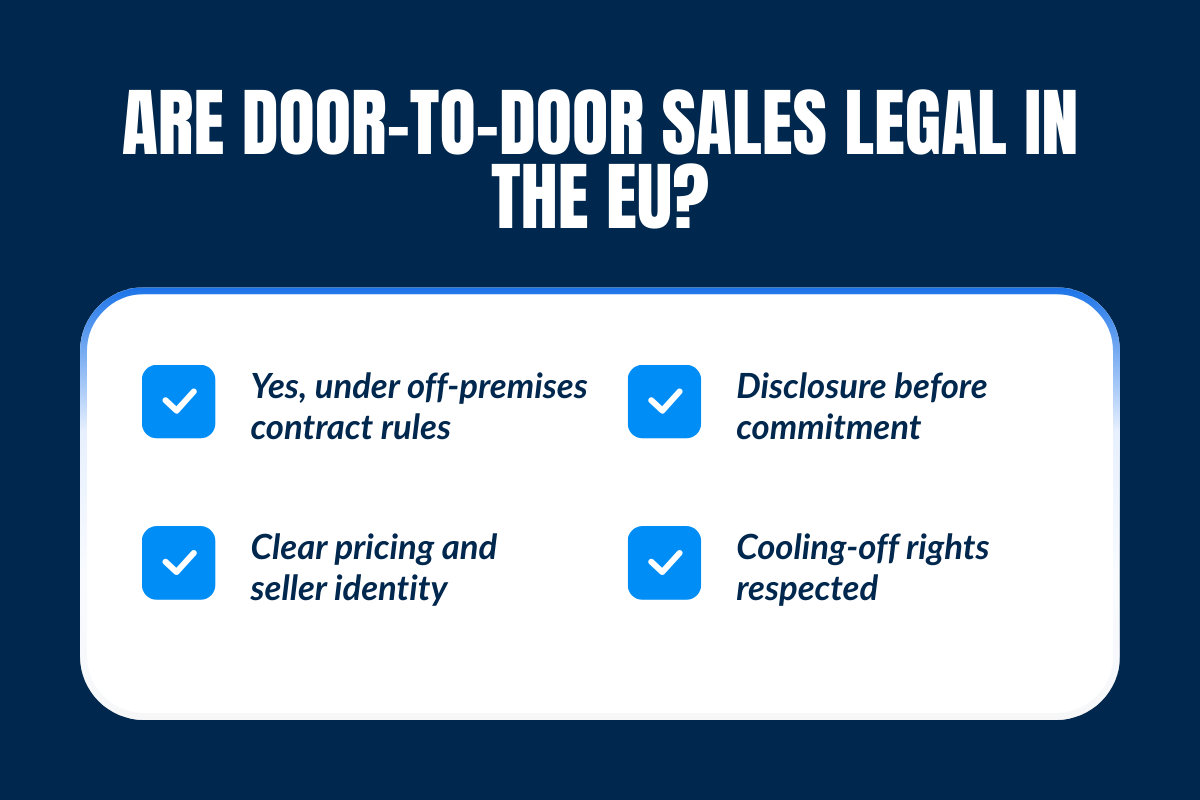
Door-to-door sales are legal across eu countries, but only when they comply with strict consumer protection rules governing off-premises contracts.
These rules are designed to ensure buyers receive clear information, have meaningful choices, and are not pressured into decisions they cannot easily reverse.
Legality, in this context, is not about whether door-to-door selling is allowed but how it is conducted.
1. Consent, Opt-In, and the Legal Sales Process
EU law places strong emphasis on informed consent before any contract is signed. In door-to-door sales, this means sellers must establish legitimacy and transparency early in the interaction.
At a minimum, compliant door-to-door sales require:
- Clear identification of the seller and the service provider they represent
- Transparent explanation of pricing, fees, and contract terms
- Disclosure of cancellation rights and cooling-off periods
- Respect for opt-in signals and explicit opt-out requests
Any agreement reached without this information being clearly communicated risks being invalid or unenforceable.
2. Why Disclosure Matters Before the Sale, Not After
One of the biggest shifts in EU enforcement is timing. Information cannot be buried in follow-up documents or shared only after verbal agreement. Pricing, seller details, and contractual conditions must be clear before commitment.
This has reshaped door-to-door sales into a more structured process:
- Conversations are slower but more deliberate
- Sales reps focus on explanation over persuasion
- Documentation and follow-ups support compliance, not pressure
In practice, modern door-to-door sales resemble regulated direct marketing interactions rather than informal doorstep agreements.
The Modern Door-to-Door Sales Process Explained
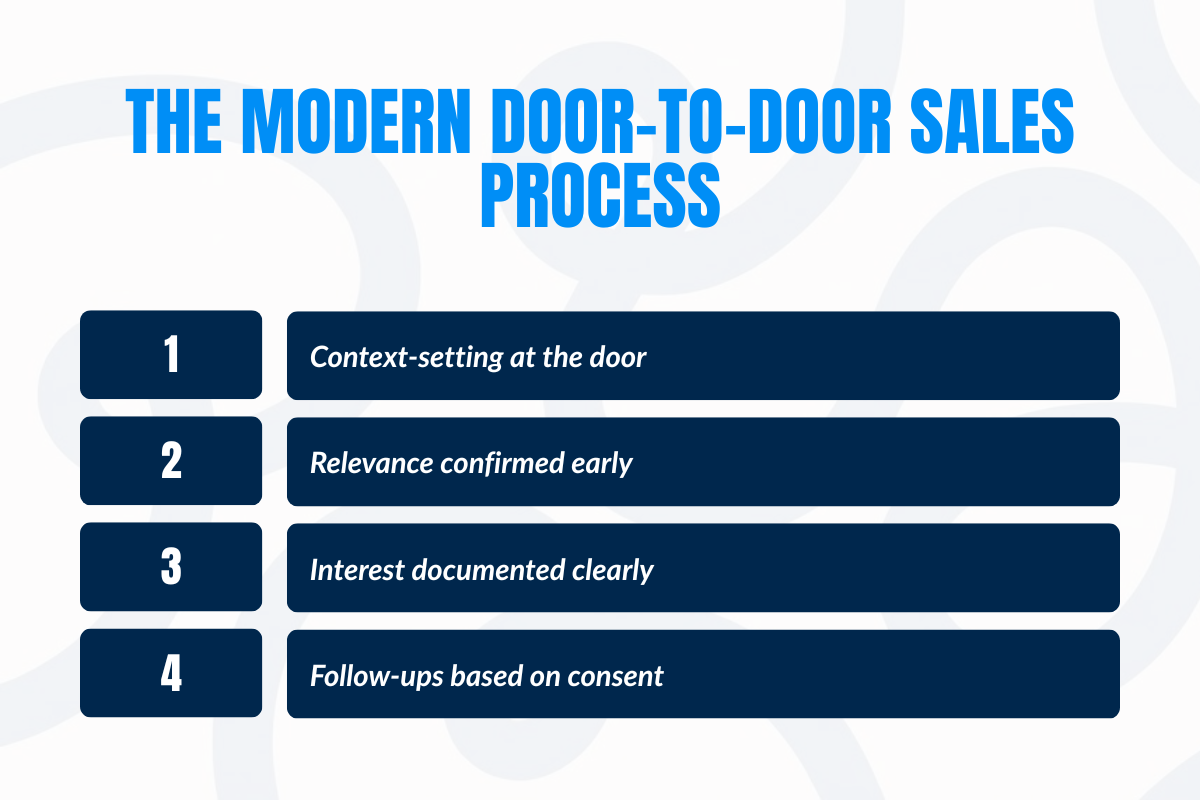
Modern door-to-door sales in the EU follow a defined, repeatable process designed to support transparency, consent, and informed decision-making. The goal is no longer to close quickly, but to qualify interest responsibly and move the conversation forward only when it makes sense.
1. How Door-to-Door Sales Start at the Door
The first interaction is about context-setting, not selling. Sales reps are expected to explain who they are, why they are there, and the relevance of the conversation to the household before discussing any offer.
In many modern door-to-door sales models, this first interaction is informed by some level of prior consent.
That consent may come from earlier expressions of interest, local outreach, or clear contextual relevance tied to the property or service area.
Before any product discussion begins, sales reps are expected to confirm consent, explicit or implicit and give the customer a clear opportunity to decline.
This early stage focuses on:
- Establishing legitimacy and intent
- Confirming relevance to the location or service area
- Giving the customer space to engage or decline
If interest isn’t present, the process ends. If it is, the conversation becomes informational rather than persuasive.
2. Why Process Discipline Matters More Than Volume
In 2026, effective door-to-door sales prioritize process discipline over scale. Every step, initial contact, explanation, qualification, and follow-up is documented and intentional.
This discipline improves outcomes in several ways:
- Customers receive consistent, accurate information
- Sales reps avoid misaligned conversations
- Follow-ups are based on genuine interest, not assumption
As a result, door-to-door sales function as a structured entry point into the sales funnel rather than a standalone closing tactic.
How Sales Reps Approach Door-to-Door Differently in 2026?
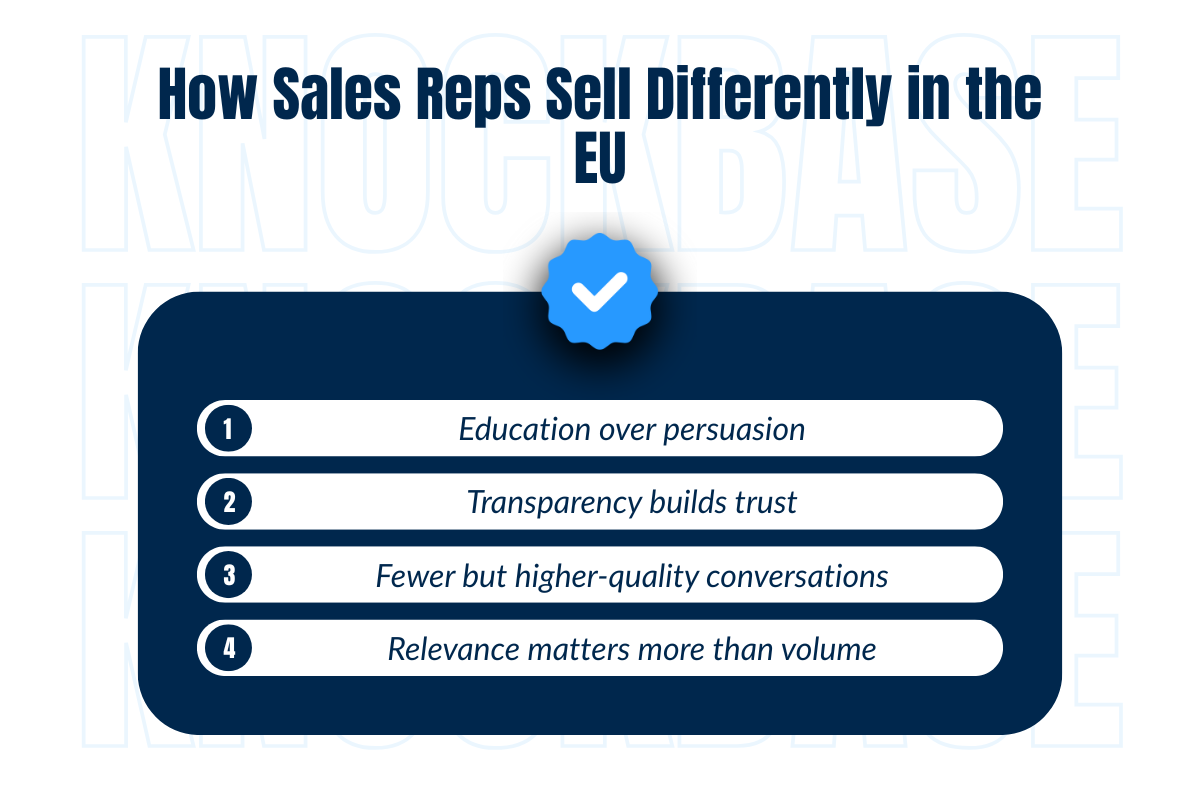
The role of the door-to-door sales rep has changed significantly in the EU. In 2026, effectiveness is no longer measured by how many doors are knocked, but by how responsibly each interaction is handled.
This has led to a more deliberate, information-led sales approach that prioritizes clarity and relevance over speed.
1. Education-First Conversations at the Door
Modern door-to-door interactions begin with explanation, not persuasion. Sales reps are expected to help customers understand what is being offered, why it may be relevant, and what the next steps would involve, without assuming intent.
This education-first mindset reduces friction early in the conversation:
- Customers can ask questions before any commitment is discussed
- Misalignment is identified quickly
- Pressure-driven tactics are intentionally avoided
When interest exists, it develops from understanding rather than urgency.
2. Trust, Transparency, and Relevance in D2D Sales
Trust in door-to-door sales is now built through transparency and consistency, as sales reps focus on actions that help win trust early in the interaction.
They must be clear about who they represent, what they are offering, and what happens after the interaction, especially if follow-ups are involved.
Relevance also matters more than ever. Conversations that clearly connect the offer to the customer’s situation are more likely to continue, while generic pitches are expected to stop early.
In practice, this leads to fewer but higher-quality interactions that align with both consumer expectations and regulatory standards.
Door Sales as a Strategic Direct Marketing Channel
Door sales in the EU no longer operate as an isolated outreach tactic. In 2026, they function as part of a broader direct marketing strategy, one that combines in-person conversations with structured systems for qualification, follow-up, and accountability.
Rather than aiming for immediate conversion, modern door sales are designed to initiate a compliant first touch.
The objective is to establish relevance, confirm interest, and create a clear path for the next interaction, whether that happens digitally or through a scheduled follow-up.
1. Where Door-to-Door Fits Within Direct Marketing
In this model, the door interaction acts as a high-context entry point. Unlike remote channels, it allows sales reps to explain offers in real time, answer questions, and determine whether to proceed with the conversation.
When interest is confirmed, door-to-door becomes the starting signal within a coordinated sales system.
2. Combining Offline Conversations with Online Follow-Ups
What happens after the door interaction matters more than the knock itself. Follow-ups are typically handled through structured channels, such as marketing emails, where information can be reviewed at the customer’s pace and consent preferences are respected.
This handoff requires accurate data capture at the door, including a verified e-mail address, and clear expectations for the communication that follows. When done correctly, offline conversations and online follow-ups reinforce each other, rather than competing for attention.
Generating Quality Leads Through Door-to-Door Sales
In 2026, the value of door-to-door selling lies in generating quality leads and in conversations that begin with relevance and progress only when genuine interest is present.
This shift starts with selecting the right target audience.
Door-to-door works best when outreach is limited to locations, households, or situations where the offer clearly applies. Without that alignment, even compliant interactions are unlikely to convert.
1. Why Face-to-Face Interaction Still Delivers Higher Intent
In-person conversations surface intent faster than remote outreach. Questions, objections, and hesitation appear immediately, allowing sales reps to qualify interest before investing further time.
This is especially true in sectors like home improvement, where context matters, and buyers often need clarification before engaging seriously.
2. Filtering Interest Before the First Follow-Up
Modern door-to-door sales rely on early qualification rather than assumption. Interest expressed at the door is recorded, contextualized, and used to accurately track leads through the next stages of the sales process.
When this filtering is done well:
- Follow-ups are based on confirmed intent
- Prospects receive only relevant information
- Sales teams avoid wasting time on misaligned outreach
As a result, door-to-door becomes a precise lead-generation channel rather than a blunt acquisition tool.
Using Customer Feedback to Improve Door-to-Door Sales
In modern door-to-door sales, feedback is not an afterthought but a core input for improving how the channel operates. Conversations at the door surface objections, confusion, and expectations that are often invisible in digital-only outreach.
When captured correctly, this feedback helps sales teams refine messaging, identify friction points, and improve how offers are explained before any commitment is discussed.
1. What Real Conversations Reveal That Data Alone Can’t
Face-to-face interactions expose gaps that dashboards and reports often miss. Customers may question pricing clarity, express concerns about timing, or highlight information they expected to receive earlier in the process.
These signals are valuable because they reflect real decision-making conditions rather than assumed behavior. Over time, patterns in these conversations help teams adjust how they approach similar households and situations.
2. Adapting Messaging Based on Feedback
To be useful, feedback must be actionable. This requires a clear method for recording outcomes and associating them with accurate contact details, so insights can be reviewed and applied across future interactions.
When feedback loops are handled well:
- Explanations become clearer and more consistent
- Misunderstandings decrease earlier in the process
- Follow-ups align more closely with customer expectations
In practice, customer feedback turns door-to-door sales into a learning channel, one that improves precision and performance over time.
To learn more about how integrating a CRM in your workflow can help, read: The Benefits of Integrating CRM with Door-to-Door Sales
Follow-Ups That Turn Door-to-Door Conversations Into More Deals
In 2026, follow-ups are expected to be timely, relevant, and clearly connected to the context of the conversation that took place.
Poorly timed or generic follow-ups can undo otherwise strong interactions. Well-structured follow-ups, by contrast, move conversations forward without pressure.
1. Timing, Relevance, and Respectful Follow-Ups
Effective follow-ups are grounded in what was actually discussed at the door. Timing matters, not to create urgency, but to maintain continuity while the conversation is still fresh.
Strong follow-ups share a few characteristics:
- They reference the specific points raised during the visit
- They arrive when the customer expects them
- They provide clarity, not repetition
Respect is central to this stage. Customers should feel that follow-ups exist to support decision-making, not to force it.
2. Moving From Interest to Action
When interest is genuine, follow-ups help translate understanding into next steps. This might involve sharing additional information, confirming details, or outlining what happens if the customer chooses to proceed.
The key is alignment. Actions should follow naturally from expressed interest, not from assumptions.
When follow-ups align with the customer’s pace and priorities, door-to-door conversations are more likely to progress toward outcomes without relying on pressure or volume.
How Door-to-Door Sales Help Boost Conversions in 2026?
When done correctly, face-to-face conversations in door sales introduce a personal touch that helps reduce uncertainty early in the decision-making process.
Rather than relying on scripted persuasion, modern door-to-door sales focus on clarity, relevance, and responsiveness, which directly influence conversion rates.
1. Why Trust-Led Selling Converts Better
In regulated EU markets, conversion is closely tied to confidence. Customers are more likely to move forward when they understand what is being offered, who is offering it, and what happens next.
This is where building trust becomes central to performance. Transparent explanations, consistent follow-ups, and the absence of pressure signals reliability.
Over time, these signals compound, making conversion a byproduct of good process rather than a function of sales intensity.
2. Reducing Friction in the Buying Decision
Door-to-door sales reduce friction by addressing questions in real time and removing ambiguity early.
Objections surface faster, expectations are set clearly, and misalignment is resolved before it turns into drop-off later in the funnel.
As a result, conversions improve not through urgency, but through informed choice, an outcome that aligns with both consumer expectations and regulatory standards in 2026.
Learn how to boost your D2D efficiency in 2026, read: Top Features of Knockbase That Boost D2D Sales Efficiency
Common Mistakes Businesses Still Make with Door-to-Door Sales
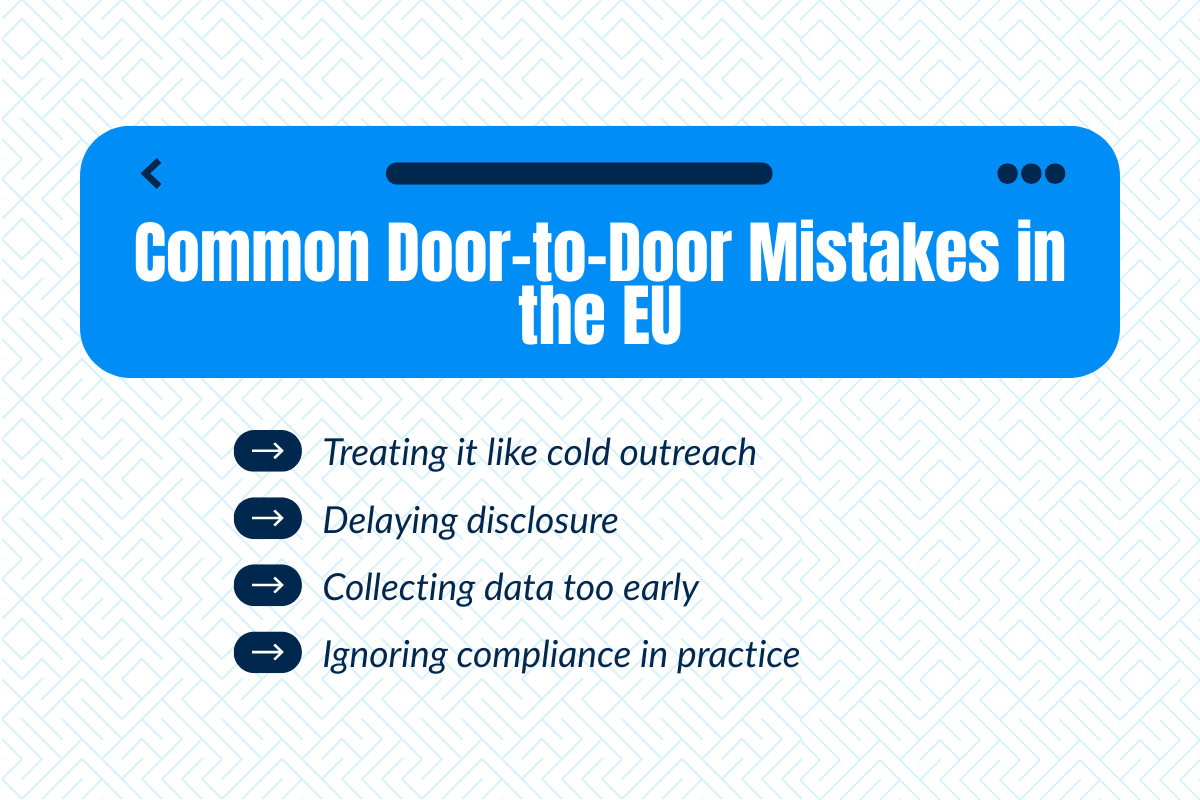
Despite tighter rules and clearer expectations, many businesses continue to apply outdated assumptions to door-to-door sales.
These mistakes don’t usually stem from bad intent but from treating door-to-door as a high-speed acquisition channel rather than a regulated, information-led one.
1. Treating Door-to-Door Like Cold Outreach
One common error is approaching door-to-door with the same mindset as mass outreach. This leads to generic pitches, poor contextual relevance, and conversations that end quickly because they fail to acknowledge why the interaction is happening in the first place.
Modern door-to-door sales require situational awareness and restraint. Without that, even compliant efforts struggle to gain traction.
2. Ignoring Legal Requirements in Early Interactions
Another frequent mistake is delaying disclosure. Some businesses still assume details can be clarified later, after interest is secured.
In reality, legal requirements demand that pricing, seller identity, and contract conditions be clear before any commitment is discussed.
When this information is missing or deferred, trust gets eroded, and agreements may become unenforceable.
3. Gathering Information Too Early or Without Context
Door-to-door conversations are not an invitation to immediately gather information. Asking for personal details before relevance or interest is established creates friction and raises concerns.
Effective teams allow the conversation to develop first. Information is collected only when it serves a clear purpose, such as enabling a requested follow-up, rather than as a default step.
Is Door-to-Door Sales Right for Your Business in the EU?
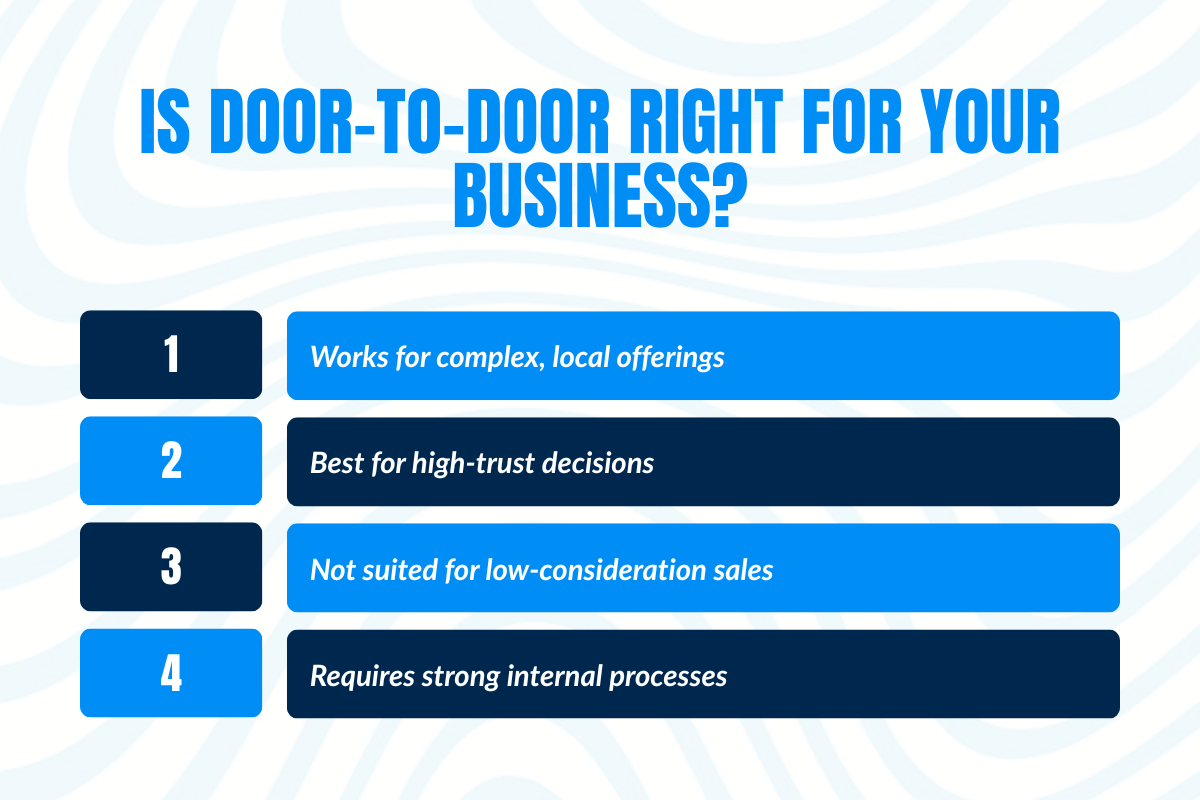
Door-to-door sales are not a universal solution, and they are not meant to be.
In 2026, their effectiveness depends on whether the model aligns with how a business sells, who it sells to, and how consistently it can operate across many countries with varying enforcement priorities and consumer expectations.
1. When Door-to-Door Makes Sense
Door-to-door sales tend to work best when the offering benefits from explanation, local relevance, or visible context. Products and services that are tied to a specific location, usage pattern, or installation requirement often see stronger engagement through in-person conversations.
This is why door-to-door remains relevant in categories such as utilities, energy upgrades, and home security, where buyers may want clarity before taking the next step.
In these cases, door-to-door serves as an entry point, qualifies interest, and sets expectations rather than pushing immediate conversion.
2. When Other Channels Work Better
For businesses selling low-consideration products or services that do not require explanation, door-to-door may introduce unnecessary friction.
If relevance cannot be established quickly, or if follow-ups are difficult to manage at scale, other channels may be more efficient.
Door-to-door sales work best when the sales process, compliance capabilities, and customer expectations are designed to support it, not when it is used as a fallback channel.
Find out what strategies the top 1% using in our latest blog: Door-to-Door Sales in 2026: Strategies the Top 1% Are Using
Wrapping Up
In 2026, the model for door-to-door sales in the EU is defined less by persistence and more by discipline: clear disclosure, informed conversations, and respect for consumer choice.
Businesses that still view door-to-door as a shortcut to quick conversions are likely to struggle. Those that treat it as a structured, compliant entry point into the sales process can still generate meaningful results.
The difference lies in execution. When aligned with regulation, integrated into broader sales systems, and handled responsibly, door-to-door remains a viable channel, just one that demands far more precision than it once did.
Knockbase: Modern Sales Needs Modern Infrastructure
Door-to-door sales are evolving, and as EU regulations tighten and customer expectations rise, teams need systems that support compliant outreach, clear documentation, and consistent follow-ups at scale.
Knockbase can help your sales teams manage door-to-door operations with clarity, structure, and control.
Book a demo to see how it works in real workflows.
FAQs
1. Are door-to-door sales still allowed in the EU?
Yes. Door-to-door sales are legal in the EU when conducted in line with consumer protection rules for off-premises contracts, including clear disclosure, consent, and cancellation rights.
2. How are door-to-door sales different from cold calling?
Cold calling relies on interruption and remote persuasion. Door-to-door sales are tied to physical context and face-to-face interaction, allowing relevance and explanation to be established upfront.
3. Do door-to-door sales still work in 2026?
They can, but only when used selectively. Door-to-door sales work best for offerings that require explanation, local relevance, or higher buyer confidence before moving forward.
4. What makes modern door-to-door sales compliant?
Compliance depends on transparency before commitment, clear pricing, seller identification, informed consent, and respect for opt-out rights throughout the interaction.
5. Is door-to-door suitable for every business?
No. Door-to-door sales are most effective when the product, audience, and internal processes are designed to support informed, regulated selling rather than high-volume outreach.
6. What information must be shared before signing a door-to-door contract?
Sellers must clearly explain their identity, pricing, contract terms, and cancellation rights before any agreement is made.
7. Do door-to-door rules vary across EU countries?
EU rules are broadly harmonized, but enforcement and expectations can differ by country, requiring businesses to adapt locally.

Canvassing Software ROI: How Sales Managers Should Calculate Cost-Per-Knock vs Cost-Per-Lead in 2026