Door-to-door sales in Canada face unique challenges. Teams have to deal with high-pressure sales tactics and new rules to stay ahead in the competitive edge.
Harsh winters, long distances, and local regulations reduce the number of doors reps can knock and limit follow-up opportunities.
For example, heavy snowfall and rain make canvassing difficult, and some provinces (such as Ontario) ban certain unsolicited sales and mandate a 10-day cancellation period for contracts.
As a result, even high effort does not consistently translate into closed deals. This also means, in most cases, it’s not lack of services that holds back growth; it’s a lack of standardized systems and visibility. Without structure, performance becomes unpredictable.
Why Door-to-Door Sales Canada Struggles With Consistency and How Top Teams Fix It
In many Canadian canvassing teams, results vary more than motivation. Sales representatives put in long hours, yet weekly door-to-door selling performance bounces up and down.
The key issue is consistency, not effort. Successful door-to-door salesmen recognize this and build performance systems instead of relying on poor quality work. They track the right sales pitch daily and use data-driven routines.
Top door-to-door salespeople don’t just hope reps will do their best; they set clear targets, use real-time dashboards, and enforce follow-up schedules. That keeps everyone on the same page and offers a cooling period.
In this blog, we’ll break down why Canadian D2D sales often see uneven results and how top teams solve it. We’ll cover how weather, turnover, and fragmented tools amplify this “consistency gap,” and explain what high-performing teams do differently.
You’ll learn the core principles like daily activity benchmarks, real-time tracking, and automated follow-ups that drive consistent performance. We’ll also show how modern technology (including apps built for D2D) can turn effort into a repeatable system for predictable growth.
Key Takeaways
- Canadian D2D sales struggle due to inconsistent follow-up and tracking, not because reps aren’t working hard.
- High-performing teams build repeatable systems (metrics, routines, tools) rather than relying on pep talks.
- Managers need live dashboards of each rep’s activity to spot issues early.
- A disciplined follow-up process after every knock protects money.
- Modern D2D apps (like Knockbase) integrate advantage knocking, data capture, and follow-ups so every rep across all regions works the same way.
Ready to scale door-to-door sales in Canada? Talk with our expert and know how! Schedule a call with Knockbase now.
Determine The Reality of Door-to-Door Sales in Canada Today
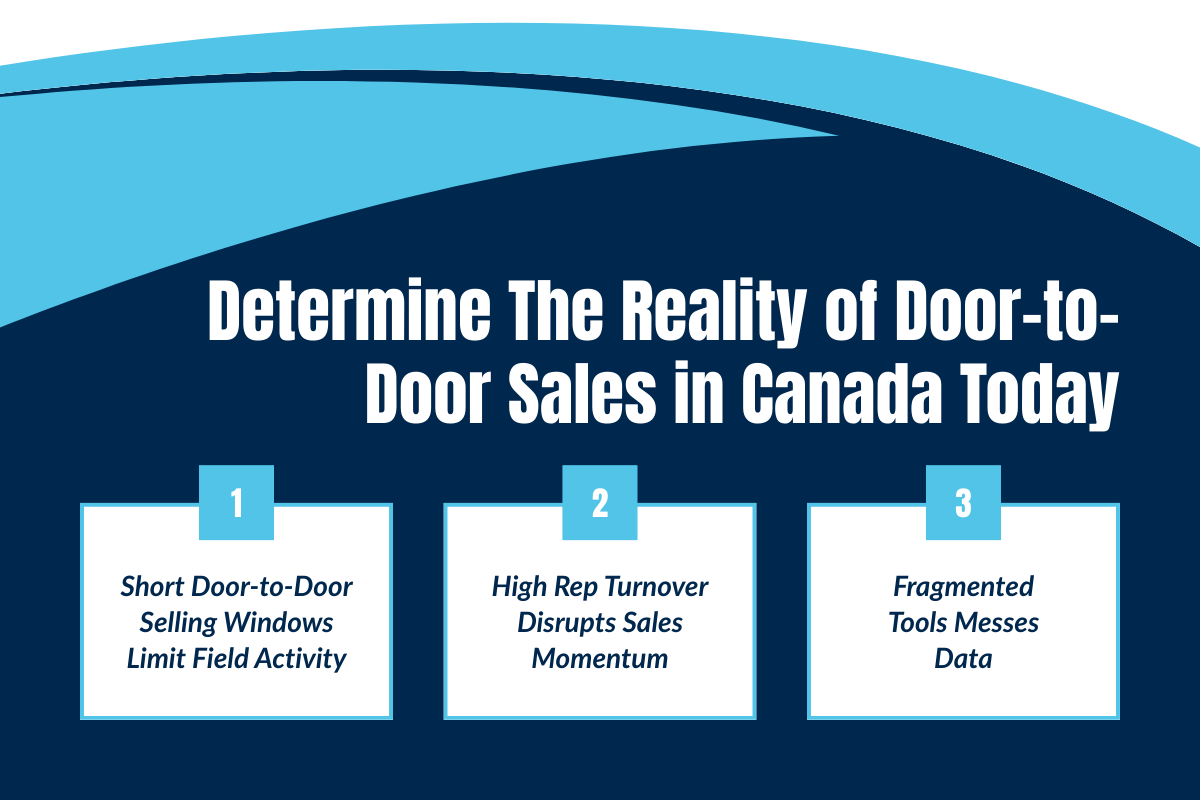
I. Short Door-to-Door Selling Windows Limit Field Activity
Canada’s climate and geography create narrow selling windows for door-to-door teams, especially when territory planning isn’t structured around clear systems like route optimization. Most reps knock on doorsteps during spring and summer, while long winters slow or fully stop field job activity.
Holidays and vacation seasons further reduce homeowner availability. These gaps shorten active selling time and place more pressure on teams to connect within a limited time. Many provinces require door-to-door salespeople to be licensed and bonded.
II. High Rep Turnover Disrupts Sales Momentum
Door-to-door salespeople in Canada also face high rep turnover. Industry data shows the average sales rep is around 30 to 35 percent. When reps leave mid-cycle, open leads lose continuity. Follow-ups stop, deals turn out cold, and each canceled purchase resets the internet and accessibility, forcing managers to rebuild pipelines repeatedly.
III. Fragmented Tools Messes Data
Many teams still rely on spreadsheets, messaging apps, and shared calendars. But this way lead data spreads across tools instead of living in one system.
One rep logs details in Excel. Another sends updates in a group chat on the phone. Managers struggle to see real progress because there is no single source of truth.
IV. Unpredictable Growth Despite Strong Demand
Demand for door-to-door sales services remains strong across many Canadian markets. However, growth still feels unstable for most business teams.
Inconsistent tracking and missed follow-ups also cause sharp swings in results. A few top reps may carry a strong month, but lost leads and gaps in visibility drag down the next one.
How Low Consistency Is the Biggest Pain Point for Canadian Door-to-Door Salespeople?
1. Activity drops when no one is watching.
When daily knocks and conversations are not tracked, reps slow down on hard days. A few missed hours turn into fewer doors knocked. And without visibility, managers only notice the drop after results slip.
2. Leads fade between the door knock and the follow-up.
Hundreds of thousands of potential customers show interest during the first visit, but never hear back. Most sales need multiple follow-ups to close, often five or more. When companies lack a clear follow-up system, missed calls and delayed service callbacks quietly kill 30 to 50 percent of potential client deals. [Source]
3. Too much depends on a small group of reps.
In many teams, only 20 to 25 percent of reps carry most of the consumer services or home repair services. Surveys show roughly one in five reps consistently beat the mark. When those top performers slow down or take time off, the entire team feels it.
Why Most Door-to-Door Sales Teams Stop Growing After Early Wins?
Many door-to-door sales teams grow rapidly at the start, then hit a wall. The reasons are usually simple. Growth depends on effort instead of structure. Here is how that plays out in real teams:
| What Holds Teams Back | What It Looks Like on the Ground | Why Growth Slows Down |
|---|---|---|
| Hustle works only at small scale | Reps knock aggressively and close early deals. Results look strong at first. | Performance depends on individual effort, not systems. When top reps leave or slow down, results drop. |
| Manual reporting drains managers | Managers chase updates via calls and texts. Reports are compiled late at night. | Time spent collecting data replaces coaching and planning. Errors increase, decisions slow down. |
| No standardized rep workflow | Each rep uses a different pitch and follow-up method. Some perform, others don’t. | Winning behaviors stay with individuals instead of becoming team-wide standards. |
| Decisions based on guesswork | Territory selection and messaging rely on instinct. Data is delayed or incomplete. | Leaders react instead of plan. Mistakes repeat, and growth becomes unpredictable. |
What's the result in the end?
At a smaller scale, raw effort can hide these issues. As the business grows, that buffer disappears. Regulatory requirements also become more prominent, especially in sectors like home repair and home maintenance, where consumer protection laws are strict.
At that stage, manual tracking and scattered reports stop being manageable. Without automation, standardized workflows, and shared visibility across the team, performance becomes uneven and revenue unpredictable. Growth exposes the cracks that effort alone can no longer cover.
What High-Performing Door-to-Door Teams in Canada Do Differently?
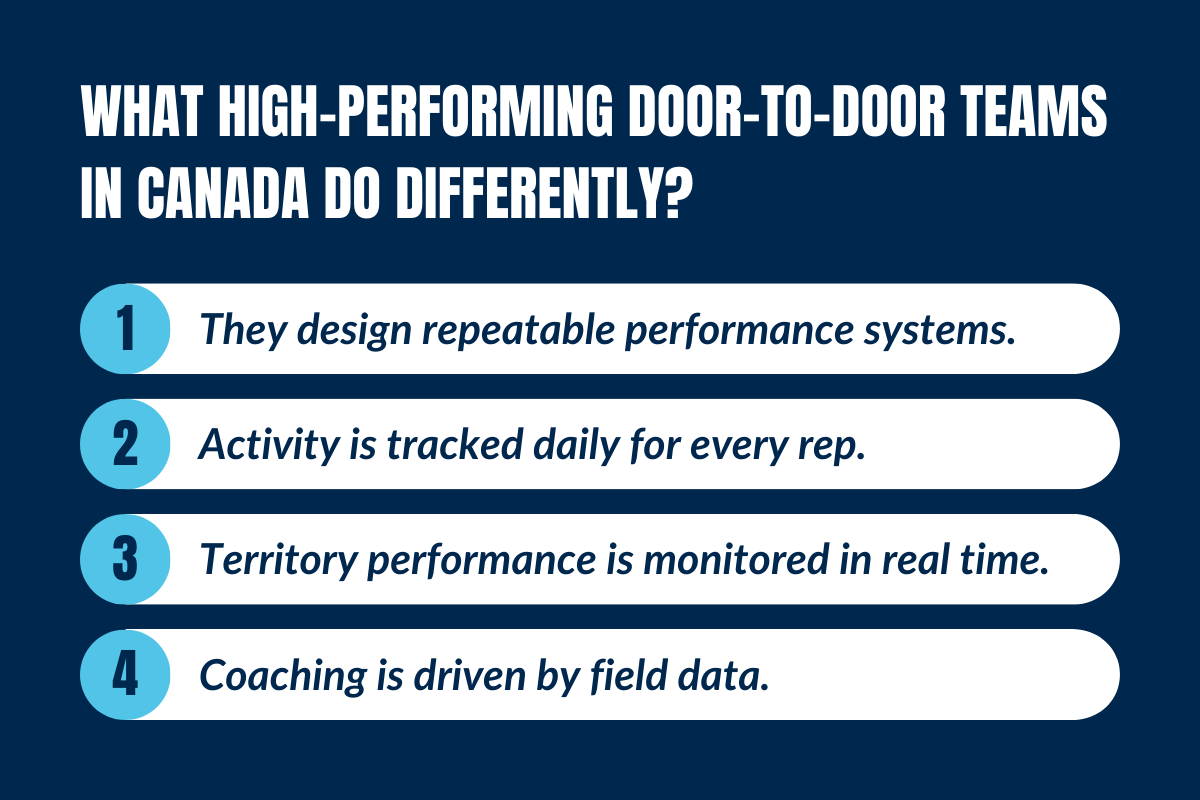
Top D2D sales teams overcome these issues by building reliable performance systems:
Step 1: They design repeatable performance systems
- Rather than aggressive routines, they write down the ideal daily plan for reps.
- Every rep knows exactly what metrics to hit each day. This takes luck out of the equation.
- In practice, this means having clear targets (doors per day, lead goals, etc.) and a step-by-step workflow for knocks, qualification, and follow-up.
Step 2: Activity is tracked daily for every rep.
- High performers use mobile CRM apps or sales software to sign in each knock and get results in real time.
- Managers see exactly how many doors each rep hit, how many conversations they had, and what deals are pending.
- As one sales guide notes, modern canvassing managers employ digital tools that “collect, visualize, and report data in real time”. Daily dashboards keep everyone accountable to the plan.
Step 3: Territory performance is monitored in real time
- Leaders aren’t blind to the field. They track territory coverage through GPS or heatmaps. If a zone is lagging behind, they redirect reps immediately.
- Apps can highlight uncovered areas or an over-reliance on one location. This real-time visibility benefit lets managers fix course before a problem becomes a missed month.
Step 4: Coaching is driven by field data
- Instead of generic pep talks, leaders analyze actual field data. They review which times/areas yield the best leads and coach reps who are lagging behind daily benchmarks through advanced technology.
- This data-driven coaching helps all reps improve, not just the natural overachievers.
Watch How Performance Systems Create Consistency in D2D Sales
In door-to-door sales, effort feels productive, but systems create predictability. Building those reliable systems focuses on three pillars: defined daily benchmarks, real-time visibility, and structured follow-up.
When activity tracking, territory coverage, follow-up workflows, and coaching all connect inside one structured system, performance stops swinging month to month. Results become measurable instead of accidental.
Instead of relying on a few high performers to carry the team, managers gain visibility into daily execution across every rep and every neighborhood. Small dips are corrected early. Momentum compounds instead of collapsing.
Consistency in D2D doesn’t come from pushing harder. It comes from designing a system where performance is visible, repeatable, and correctable in real time.
Why Spreadsheets and Messaging Apps Break at Scale?
Many small sales teams start with spreadsheets and group chats to coordinate. But during the expansion stage, these tools fall apart. Updates from the field arrive late (if at all), data is scattered, and no one is truly accountable. In a study, manual reporting via Excel was found to “inevitably lead to numerous errors” and wasted hours.
In practice, teams using disconnected tools face:
| Traditional Approach | Modern D2D Software |
|---|---|
| Lead Tracking: Siloed Excel sheets or notebooks. Updates are delayed, and leads easily get lost. | Real-Time Tracking: A centralized app lets reps update leads in real time. Managers see all lead status live |
| Route Planning: Static paper maps or guesswork, often causing overlapping coverage. | Smart Routing: Dynamic route planners optimize farm areas for complete coverage and efficiency. |
| Compliance & Outreach: English-only scripts; manual consent logs (risky). | Built-In Tools: FR/EN interfaces and templates ensure bilingual outreach, with automated consent capture. |
| Visibility: No single dashboard; managers are blind to field activity | Dashboards & Gamification: Real-time performance dashboards and leaderboards keep reps accountable. |
How Technology Is Reshaping Door-to-Door Sales in Canada?
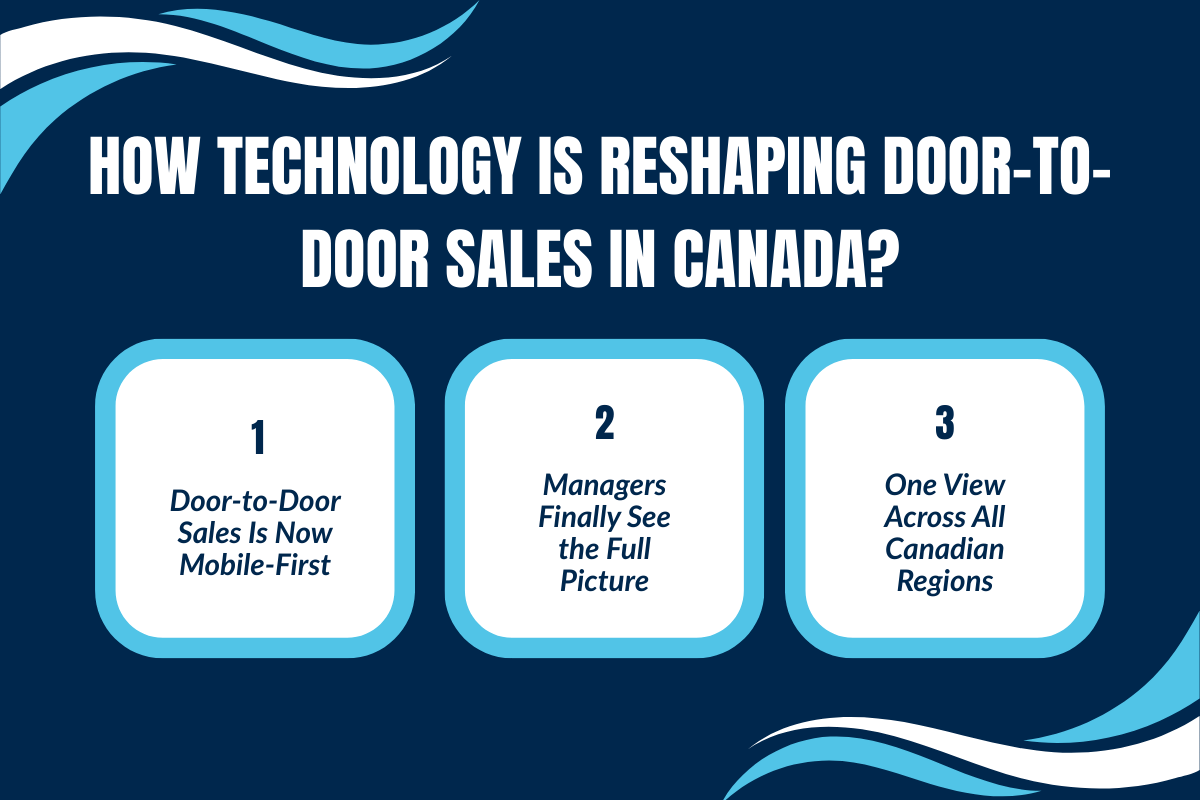
1. Door-to-Door Sales Is Now Mobile-First
Door-to-door sales used to rely on clipboards, printed maps, and memory. That setup no longer holds up. High-performing teams now equip reps with a single mobile tool that runs their entire day.
Routes are clear before they start, leads are captured right after each conversation, and follow-ups are scheduled immediately. When everything is in one place, reps stay focused on doors, not admin work.
Note: Salespeople should always present government or company-issued photo identification before engaging in sales pitches.
2. Managers Finally See the Full Picture
Technology removes the mystery from field performance. Managers no longer wait for updates or chase reps for numbers. They can see activity in real time. Who is knocking? Where are they working? What results are they getting? This visibility makes it easier to step in early and keep performance steady.
3. One View Across All Canadian Regions
Canadian teams often work across multiple provinces, each with its own rules and conditions. A centralized system pulls all activity into one view. That includes regions with language requirements like Quebec. Managers can compare territories, spot trends, and adjust coverage without delay.
Conclusion: Consistency Wins Door-to-Door Sales in Canada
Door-to-door sales in Canada have never been about a lack of effort. Teams work hard in short seasons and tough conditions. The real challenge is consistency. When daily activity, follow-ups, and performance tracking are not structured, results swing week to week, no matter how motivated the reps are.
The teams that win focus on systems. Clear daily workflows, real-time visibility, and reliable follow-up turn effort into predictable outcomes. With the right structure and tools in place, door-to-door sales become easier to manage, easier to scale, and far more stable over time.
About Knockbase
Knockbase is built with real door-to-door work in mind, not adapted from office software. It helps teams run the day the same way, no matter who is knocking. Every rep follows a clear flow. Where to go. What to log. What to do next. That consistency removes a lot of guesswork from the field. It also fits how sales actually work in Canada. Knockbase supports offline too, so reps in rural areas can still capture leads without worrying about signal.
If your door-to-door sales team in Canada relies on motivation and manual tracking, results will keep fluctuating. Knockbase helps you standardize daily rep activity, track performance in real time, and protect every lead after the door knock. Book a demo today.
FAQs
Q.1 Is door-to-door sales legal in Canada?
Door-to-door selling is allowed in Canada. However, there are different laws in all provinces regarding how this Business is conducted and varying rules for the specific industries that have limits established by the government concerning door-to-door selling.
Q.2 When did Ontario ban door-to-door sales?
Ontario made door-to-door selling illegal for a select few types of home services in 2018 under the Consumer Protection Act as a safeguard against the use of high-pressure selling tactics against consumers.
Q.3 What is the industry code for door-to-door sales in Canada?
There is no one universal code for direct sales of products at the consumer's home in Canada. Codes are regulated by their province’s Consumer Protection Legislative Act as well as specific guidelines set forth by each industry.
Q.4 What is the 3 3 3 rule in sales?
The 3 3 3 rule often refers to making three contact attempts, over three days, using three different channels. It helps reps stay persistent without overwhelming prospects. Door-to-door teams use this rule alongside structured follow-up tools like Knockbase to ensure no lead is forgotten.

Canvassing Software ROI: How Sales Managers Should Calculate Cost-Per-Knock vs Cost-Per-Lead in 2026