Door-to-door sales are re-emerging as a high-conversion alternative to increasingly expensive and unpredictable digital channels.
And now, when marketers are struggling with rising ad costs and shrinking targeting data, teams are scaling using a channel that doesn’t rely on algorithms at all, i.e., door-to-door sales.
In a privacy-first environment, where control is changing, tracking restrictions are increasing, competition for ad space has intensified, and higher customer acquisition costs are making digital channels less predictable.
As a result, many companies are rethinking how they generate leads and, instead of relying entirely on platforms they don’t control, are exploring channels that enable direct interaction with potential customers.
Why Door-to-Door Sales Is Making a Comeback in 2026
What if we tell you that door-to-door sales now is something many marketers wrote off years ago, but never left the scene. With rising customer acquisition costs and stricter privacy regulations limiting targeting, businesses are turning to direct, face-to-face outreach to regain control over lead generation.
Face-to-face outreach allows companies to build trust quickly, clearly explain product benefits, and generate higher-quality, more conversion-ready leads without relying on algorithms or paid ad platforms.
This section explores why door-to-door sales are making a comeback, how they compare to digital marketing, and how modern teams use structured processes and door-to-door sales software to scale outreach into a predictable growth channel.
Key Takeaways
- Rising ad costs and privacy changes are making paid acquisition less predictable for many businesses.
- Door-to-door sales are gaining attention again because they allow companies to reach potential customers without relying on algorithms.
- Face-to-face conversations often create stronger trust and a clearer understanding of product benefits.
- Modern door-to-door teams rely on structured territories, defined workflows, and consistent activity tracking.
- Field sales software helps managers gain visibility into rep activity and improve decision-making.
- Many companies are combining digital marketing with direct outreach to create a more balanced growth strategy.
Turn Door-to-Door Sales into a Structured Growth Channel
Running a successful door-to-door operation requires more than motivated reps. Your team needs clear territories, visibility into field activity, and a system that turns daily outreach into measurable results.
That's where Knockbase can help your business organize field teams, track rep performance, and scale door-to-door sales with better insights. Book a personalized demo today.
Are Paid Ads Becoming Too Expensive to Rely On Anymore?
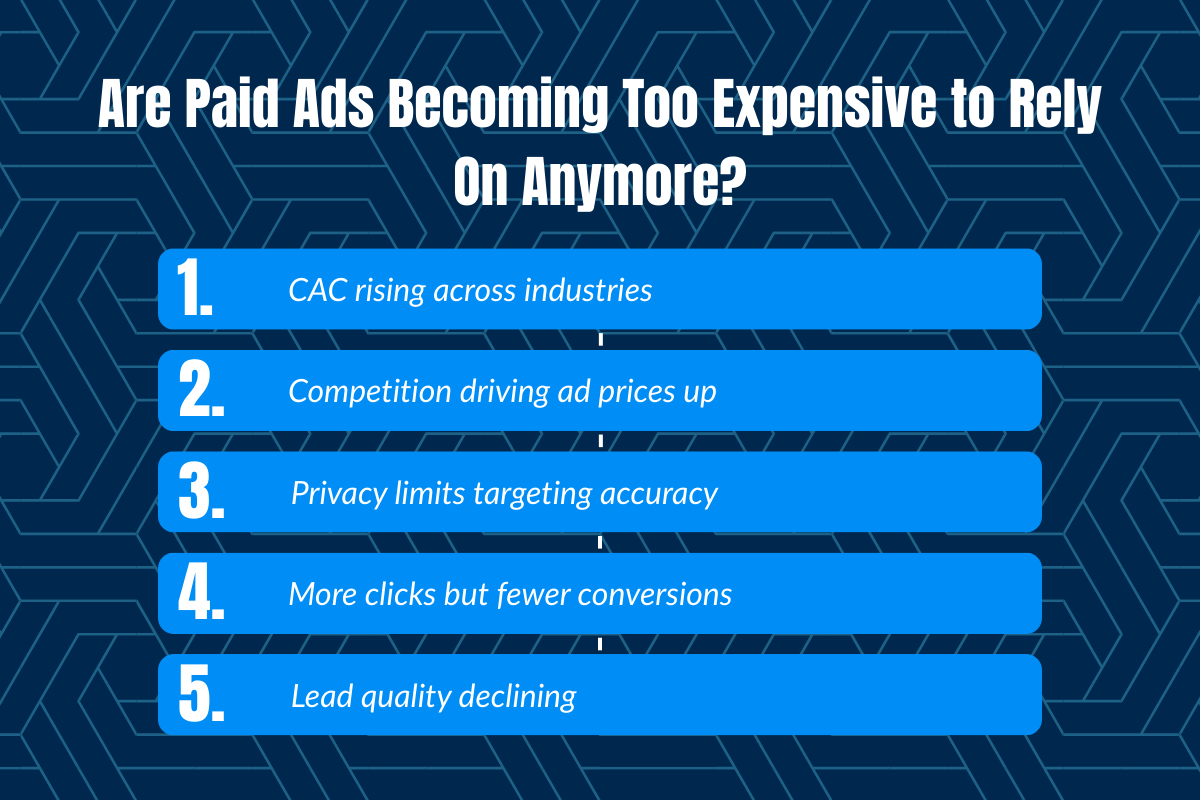
Search engines and social media made it possible to reach large audiences quickly and to scale campaigns as budgets increased. However, rising competition, privacy changes, and evolving platform policies have made paid acquisition more difficult to sustain.
As costs rise and targeting becomes less precise, companies are now questioning whether relying solely on digital campaigns remains the most effective strategy.
1. What Rising CAC Looks Like Across Industries
Customer acquisition cost (CAC) has steadily increased across many sectors. As more companies compete for the same online attention, advertising platforms have become more expensive.
Businesses often respond by increasing budgets, but higher spending does not always produce proportional results.
In many cases, companies are paying more for the same number of leads, which reduces overall efficiency in their marketing efforts.
2. Why Targeting Isn’t What It Used to Be
Changes in privacy regulations and platform tracking policies have significantly affected how advertisers target audiences.
Restrictions on third-party tracking and data collection mean that campaigns now have less precise targeting signals.
As a result, businesses may reach broader audiences but with less certainty that those viewers will become customers.
3. The Hidden Cost: Lower-Quality Leads
Beyond higher costs, many companies are also seeing a decline in lead quality from paid campaigns.
While ads can still generate large numbers of clicks, those interactions do not always translate into meaningful conversations or purchases.
Businesses may see increased traffic but fewer conversions, which creates additional pressure on marketing teams to find alternative ways to generate qualified leads.
Is Door-to-Door Sales Still Effective in 2026?
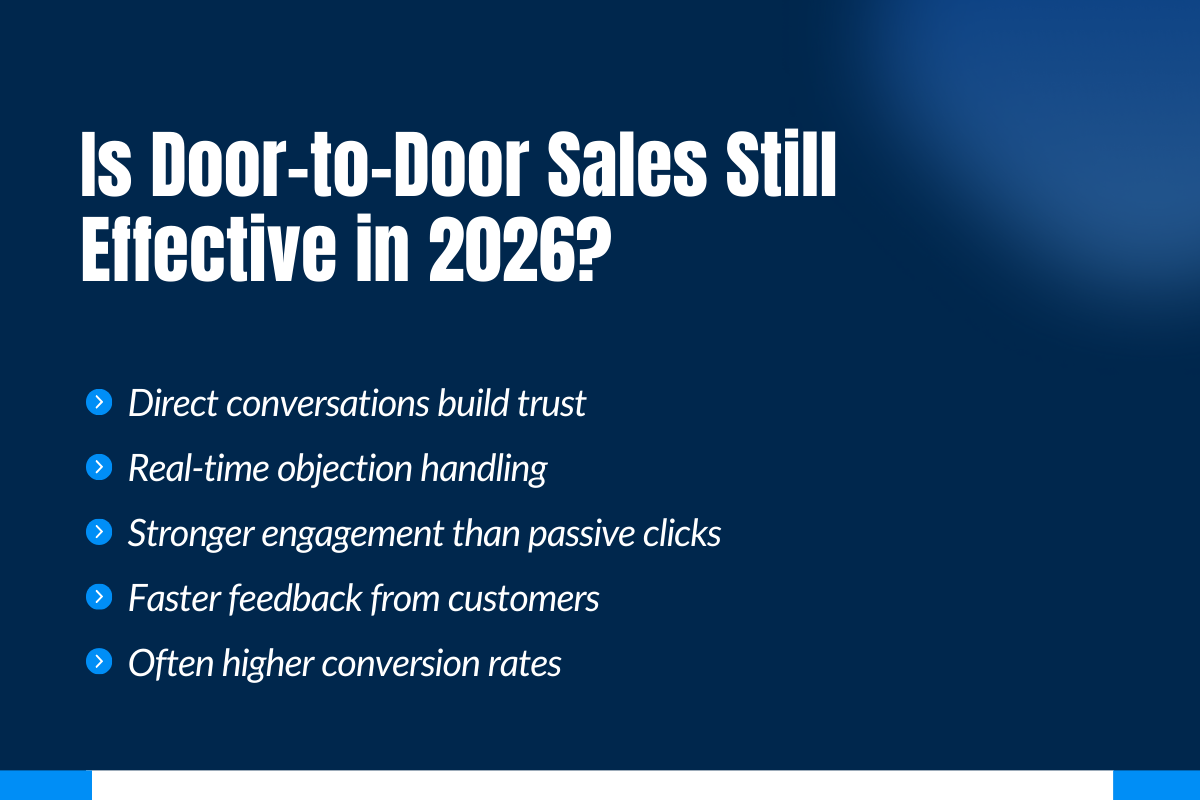
Despite the dominance of digital marketing over the past decade, many businesses are rediscovering the value of direct outreach.
For the right industries and sales models, door-to-door sales continue to deliver strong results because it focuses on human interaction rather than platform-driven visibility.
1. What the Data and Trends Are Showing
Recent trends show a gradual resurgence in offline customer acquisition channels. As digital marketing becomes more crowded, businesses are experimenting with approaches that rely less on advertising algorithms and more on direct interaction.
Industry data suggests that top performers in D2D sales often see conversion rates of 2–5%, compared to roughly 1% for many digital marketing channels. The difference often comes from the trust and clarity created during face-to-face conversations.
Door-to-door outreach also provides immediate conversations with potential buyers and offers real-time feedback from the market.
Instead of waiting for campaign reports or analytics dashboards, sales teams then quickly understand how people respond to an offer and adjust their approach accordingly.
2. Why Face-to-Face Selling Still Converts
Face-to-face interactions create a level of trust that digital channels often struggle to replicate. When a representative speaks directly with a potential customer, they can answer questions instantly and explain the value of a product or service in context.
This personalized interaction allows customers to ask questions and receive tailored explanations in real time.
These conversations often feel more personal and transparent than online messaging. For most people, this direct interaction helps them feel more confident about making a decision.
3. Where It Outperforms Digital Channels
Door-to-door outreach tends to perform best in industries where trust, explanation, and local presence play a major role in the decision process.
Businesses selling services such as solar installation, home improvement, or security solutions often benefit from this approach.
When products require explanation or involve a significant investment, speaking directly with a knowledgeable representative makes it easier for customers to evaluate the offer before committing.
Why Are Businesses Going Back to Door-to-Door Sales?
Door-to-door selling allows businesses to create direct interactions with potential buyers instead of relying entirely on platforms that control reach, targeting, and cost.
For many teams, the appeal is in-person conversations as they make it easier to understand what customers actually need and what influences purchasing decisions.
1. Control Over Lead Generation (No Algorithms)
Digital marketing often relies on platforms that determine how visible an ad is and how much it costs to reach potential customers, which is why algorithm updates or rising ad costs can quickly affect results.
With door-to-door outreach, businesses can control how they generate leads. Here, sales representatives can focus on neighborhoods that match their ideal audience and adjust their pitch based on what they learn in the field.
This gives teams more control over how they generate opportunities for future sales.
2. Real Conversations Beat Passive Clicks
When someone clicks an ad, skims a page, and leaves without interacting further, passive engagement is created.
In contrast, face-to-face outreach creates real talk with potential customers. A representative can explain product benefits clearly, maintain eye contact, ask open-ended questions, and address concerns immediately.
These conversations often reveal the point customers care about most before deciding whether to move forward.
3. Faster Feedback from the Market
Another advantage of door-to-door outreach is how quickly teams learn from real interactions. Reps hear objections, questions, and reactions directly from people in the neighborhoods they visit.
This feedback helps businesses refine messaging, improve closing techniques, and strengthen overall sales skills.
Over time, teams develop valuable skills that help them understand their audience better and improve how they approach conversations in the field.
What Does Modern Door-to-Door Sales Actually Look Like Today?
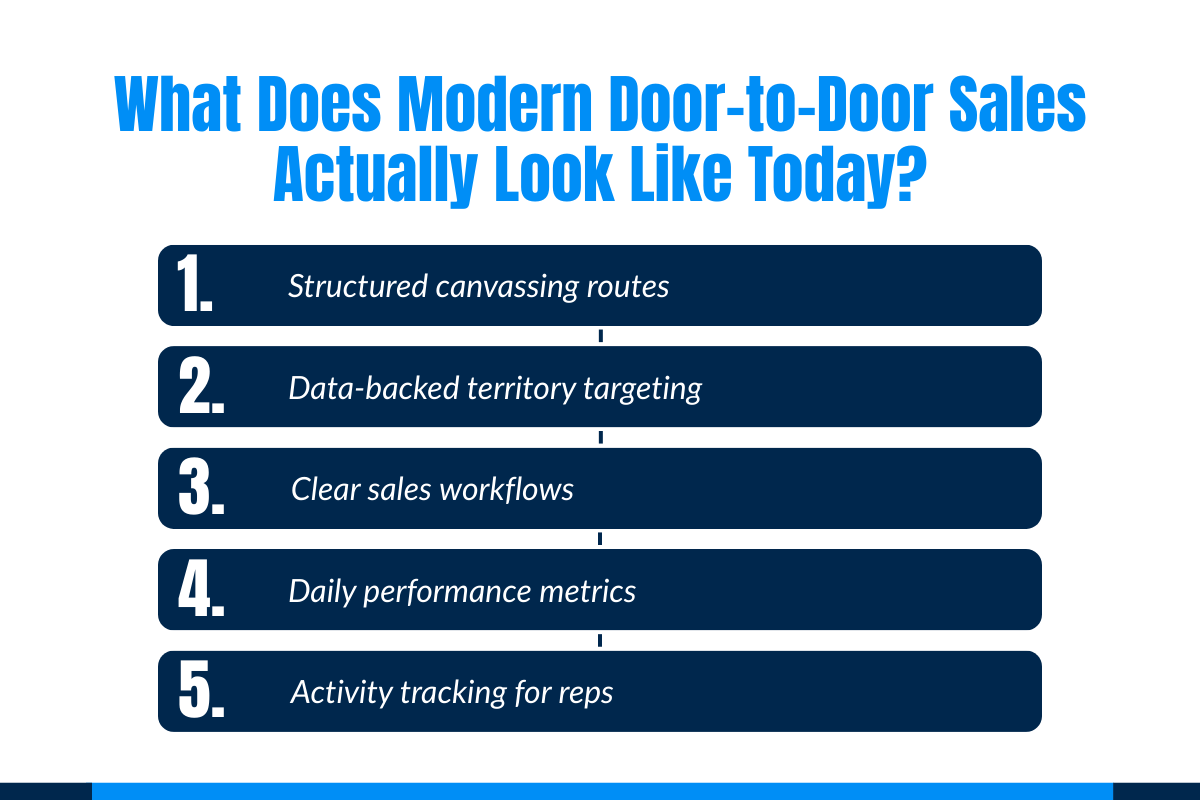
The image many people associate with door-to-door sales, a door salesman working randomly through neighborhoods, is now old. Today, successful teams treat field outreach as a structured operational channel rather than an improvised activity.
Modern outside sales organizations rely on defined processes, targeted territories, and clear performance tracking.
Instead of relying purely on instinct, door-to-door sales teams combine field experience with data to improve how they approach each door and conversation.
1. From Guesswork to Structured Canvassing
Traditional door selling often depended on individual intuition. Reps would choose streets randomly and deliver a pitch-based approach without much coordination across the sales team.
Modern teams use structured canvassing strategies with defined routes, outreach goals, and clear workflows.
This helps salespeople stay focused, maintain consistency, and improve their ability to sell products effectively across different neighborhoods.
2. Territory Targeting Is Now Data-Backed
Today’s companies rarely approach neighborhoods blindly. Instead, they analyze local market conditions, existing current customers, and demographic patterns before sending reps into the field.
This allows teams to gather information about which areas are most likely to respond to their product or service.
For industries like solar panels and other local services, smarter territory targeting helps increase the chances of productive conversations.
3. Daily Metrics Drive Performance
Many modern teams now track activity, conversations, and conversion rates using data-driven door-to-door sales analytics to understand which neighborhoods, scripts, and reps generate the most revenue.
Tracking these metrics also helps teams identify what works, support reps on bad days, and ensure consistent sales efforts lead to measurable outcomes over time.
If you’re looking to bring this level of structure into your field operations, tools like Knockbase can help you manage territories, track performance, and give your reps the clarity they need in the field.
Book a demo to see how Knockbase supports modern door-to-door sales teams.
Door-to-Door Sales vs Digital Marketing: Which One Wins Today?
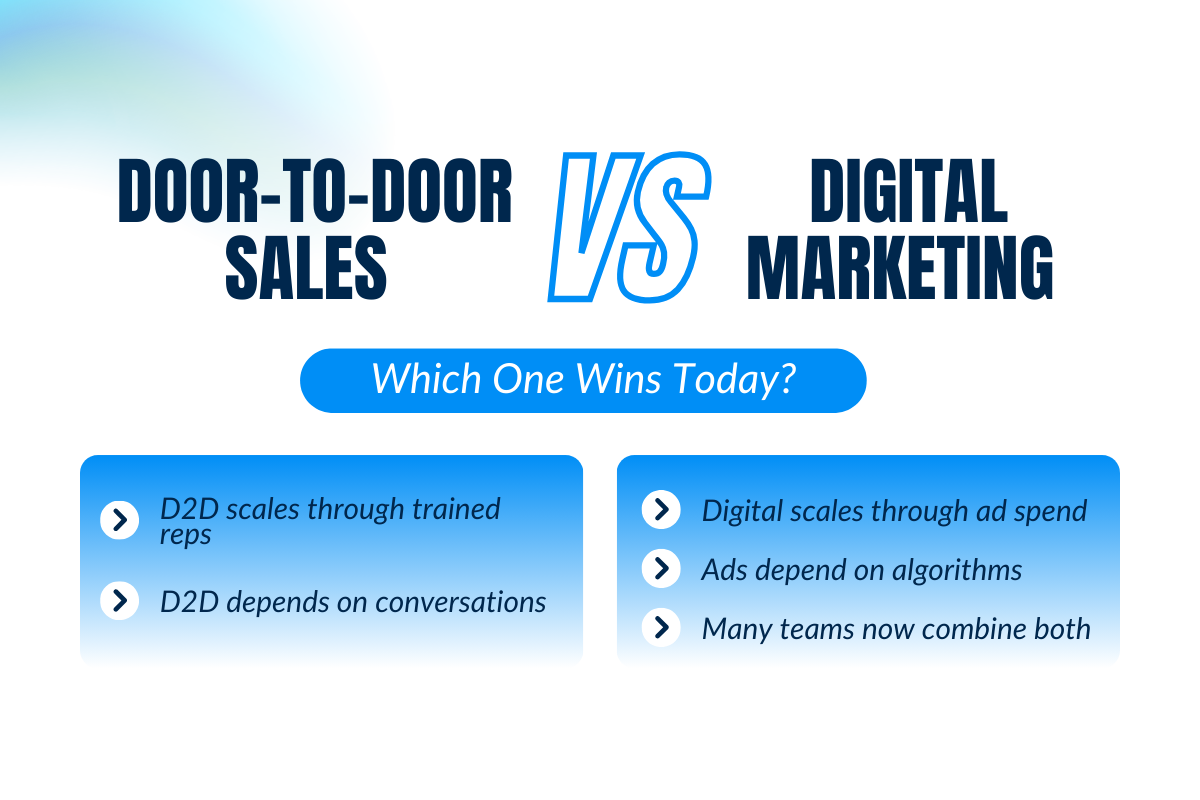
Businesses now are increasingly comparing door-to-door sales with digital marketing channels as acquisition costs continue to rise.
While online campaigns offer scale and automation, direct outreach provides control over how and where conversations happen.
Rather than replacing each other entirely, these two approaches represent different models of customer acquisition, one driven by ad spend and algorithms, the other driven by human interaction and effort.
1. Cost Comparison: CAC vs Effort-Based Acquisition
Digital marketing typically relies on paid channels, where businesses invest continuously in advertising to reach potential customers.
But as competition increases, customer acquisition cost (CAC) often rises because companies must spend more to generate the same number of leads.
Door-to-door outreach, on the other hand, is primarily effort-driven. Instead of increasing ad budgets, companies scale through trained sales teams and structured field activity. While it does require time and coordination, it gives businesses more control over how acquisition costs grow.
2. Conversion Quality: Intent vs Interruption
Online campaigns often reach large audiences, but many interactions begin with low intent. Users may click an ad out of curiosity rather than a clear need to buy. At the door, conversations tend to feel more intentional.
A salesperson can explain product benefits, answer questions immediately, and adapt the sales pitch based on the customer’s reactions.
This direct interaction often leads to more meaningful conversations and stronger engagement.
3. Scalability: Ads vs Teams
Digital marketing scales primarily through budget expansion and increasing ad spend quickly increases reach, but it also exposes businesses to platform changes and rising costs.
Door-to-door sales scale differently by expanding the sales team, improving territory coverage, and refining the sales approach.
While this requires operational coordination, it can provide a more predictable path to acquiring new customers without depending entirely on advertising platforms.
As digital acquisition costs rise and targeting becomes less reliable, companies are rediscovering channels that rely on direct human interaction. In fact, many teams are re-evaluating why door-to-door sales still outperform digital channels for certain local services and high-trust purchases.
What Problems Still Hold Teams Back from Doing Door-to-Door Sales?
Even as more companies reconsider door-to-door sales, many teams hesitate to adopt it. The challenge is rarely the idea of direct outreach itself.
Instead, the difficulty lies in managing field operations, measuring performance, and maintaining consistency across a growing sales team.
Without the right systems in place, even motivated sales representatives can struggle to turn their daily activity into predictable results.
1. “We Can’t Track What Our Reps Are Doing.”
One of the most common concerns among managers is the visibility gap in field sales. When reps spend the day knocking on doors and speaking with potential customers, it can be difficult to understand how those sales efforts translate into outcomes.
Managers may only hear about closed deals or appointment setting at the end of the day, while valuable insights about conversations, objections, and opportunities remain unrecorded.
Without clear activity tracking, it becomes harder to understand which sales techniques are actually working in the field.
2. “It’s Hard to Scale and Manage Teams.”
Door-to-door operations can become complex as companies expand their sales team. More territories, reps, and conversations mean more coordination.
Without clear systems, managers may struggle to align sales goals, monitor progress, and support reps consistently.
Operational friction grows when teams rely on manual updates or multiple tools, making it harder to guide other reps toward the practices used by the best reps.
3. “We Don’t Have a System, Just Effort.”
Many companies start door-to-door outreach informally, relying on individual initiative rather than a defined sales process.
While some experienced reps may succeed through instinct and strong product knowledge, this approach often leads to inconsistent results.
Without structure, teams may struggle with territory coverage, follow-up, and capturing insights from customer conversations.
Over time, the lack of a repeatable system makes it difficult to learn from the field, refine the sales approach, and scale success across the organization.
How D2D Sales Software Bridges the Gap Between Effort and Insights?
Door-to-door sales often depend on individual effort, but without visibility into daily activity, it can be difficult for managers to understand what is actually driving results.
Teams may be working hard in the field, yet leadership lacks clear data on coverage, conversations, and outcomes.
D2D sales software helps close this gap by transforming field activity into measurable insights. Instead of relying on manual updates, businesses can get a clearer view of how sales efforts translate into performance.
1. Turning Rep Activity into Measurable Data
In many door-to-door operations, daily activity is difficult to track consistently. Reps may record notes manually or report outcomes at the end of the day, leading to incomplete or delayed information.
The software automatically captures key actions, logging field activity such as visits, conversations, and outcomes. This creates a more reliable record of what happens during the day and helps teams understand how effort connects to results.
2. Giving Managers Real-Time Visibility
Field sales teams spend most of their time away from the office, making performance difficult to monitor.
With real-time visibility into activity and progress, managers can track performance without relying on constant follow-ups or manual reporting.
This makes it easier to support teams in the field, identify gaps early, and respond quickly when adjustments are needed.
3. Creating a Repeatable, Scalable System
As teams grow, consistency becomes more important. Without standardized workflows, each representative may approach outreach differently, making performance harder to manage.
D2D sales software introduces structure by supporting consistent processes across teams. Clear activity tracking and shared insights help businesses replicate successful approaches, making it easier to scale door-to-door operations while maintaining quality and accountability.
How Knockbase Powers Door-to-Door Sales in a Privacy-First Era?
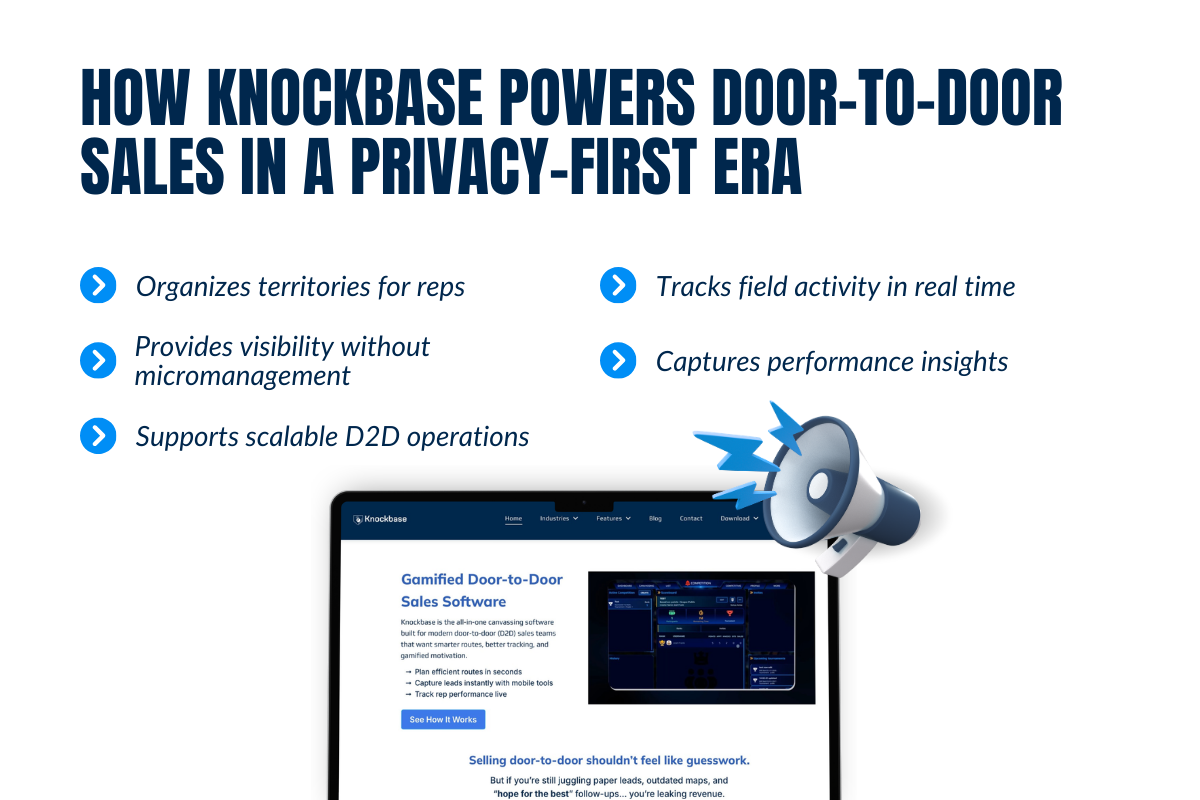
Knockbase helps companies turn door-to-door sales into an organized, data-driven operation, giving sales teams and managers the tools to execute consistently and improve performance over time.
1. Organizing Territories and Daily Execution
Without clear territory planning, sales representatives often rely on guesswork when deciding where to go and which neighborhoods to cover. This can lead to missed opportunities and uneven outreach.
>> Knockbase helps teams organize territories and plan daily activity, so reps know exactly where to focus. With a clear structure in place, field teams can spend less time deciding where to go and more time speaking with potential customers.
2. Making Performance Visible Without Micromanagement
One of the biggest challenges in field sales is understanding what happens outside the office. Managers often struggle to track rep activity without constant check-ins or manual reporting.
>> Knockbase provides shared visibility into daily field activity, allowing managers to monitor progress without micromanaging their teams. Sales leaders can quickly see coverage, activity levels, and outcomes, making it easier to support teams and identify areas for improvement.
3. Supporting Consistent, Data-Backed Decision Making
When field activity isn’t tracked consistently, decisions are often based on assumptions rather than real performance data.
>> Knockbase captures key activity and performance insights, helping managers understand which territories, approaches, and strategies lead to results. With better data, teams can refine their approach, allocate resources more effectively, and build a repeatable system for growth.
Should You Add Door-to-Door Sales to Your Growth Strategy?
Not every business needs door-to-door outreach. But for companies struggling with rising acquisition costs or declining digital performance, it can become a powerful complement to existing marketing channels.
The key is understanding when this approach fits your business model and how to test it in a structured way before scaling.
> When It Makes Sense (Use Cases)
Door-to-door sales tend to work best when the product or service benefits from direct explanation and trust-building.
It is often effective for:
- High-ticket offers where customers want to ask questions before committing
- Local markets where businesses serve specific neighborhoods or regions
- Trust-dependent sales where personal interaction helps build credibility
In these cases, a direct conversation can shorten the decision process and improve conversion quality.
> When It May Not Be the Right Fit
Door-to-door outreach is not ideal for every business model.
It may be less effective for:
- Fully digital products that can be purchased quickly online
- Low-margin, high-volume models where the cost of in-person outreach outweighs the potential return
Businesses in these categories typically benefit more from scalable digital acquisition channels.
> How to Start Small and Test Effectively
Companies considering door-to-door sales don’t need to launch a large operation immediately. A small, structured pilot often provides the best insights.
Start by:
- Launching a pilot team in a clearly defined territory
- Tracking daily activity and conversion metrics
- Using early feedback to refine the approach and messaging
Testing on a small scale allows teams to evaluate performance, identify what works, and build a repeatable process before expanding further.
Conclusion
Door-to-door sales are returning as many digital acquisition channels become less predictable. Rising advertising costs, declining targeting precision, and lower-quality leads have pushed companies to reconsider how they generate customers.
When sales representatives speak with potential customers face-to-face, they can address concerns, adapt their pitch in real time, and build trust faster than most online interactions allow.
For businesses operating in local markets or selling services that require explanation, this approach often leads to stronger engagement and higher-quality opportunities.
In a privacy-first marketing world where algorithms control less and relationships matter more, the companies that combine human interaction with data-driven systems will have a clear advantage.
See How Modern Teams Run Door-to-Door Sales with Knockbase
Door-to-door sales work best when effort turns into measurable results. Without visibility into rep activity, territory coverage, and performance, even the most motivated sales teams struggle to scale.
Knockbase helps businesses turn field sales into a structured, trackable system. Track rep activity, organize territories, monitor performance, and improve conversion rates, all from one platform.
Book a demo to see how Knockbase helps sales teams scale door-to-door operations.
FAQs
1. Why are businesses returning to door-to-door sales in 2026?
Businesses are returning to door-to-door sales because rising digital ads costs and stricter privacy rules have reduced targeting precision. Direct conversations allow sales reps to clearly explain product benefits, build trust faster, and generate higher-quality leads than many passive digital marketing channels.
2. Is door-to-door selling still effective today?
Yes, door-to-door selling remains effective for industries where customers prefer personal interaction before making a purchase. In many field teams, experienced reps can generate more than two sales in a single neighborhood visit, especially in services like solar panels, security systems, and home services, where customers want quick answers before deciding.
3. Is door-to-door sales legal?
Yes, door sales are legal in most regions, but companies must follow local regulations. Many cities require permits for door knocking, restrict outreach during certain hours, or enforce “no solicitation” rules.
4. Why do face-to-face sales conversations convert well?
An in-person conversation allows a salesperson to build trust through tone, body language, and direct explanation of product benefits. The best reps can adjust their pitch based on the homeowner’s reactions, answer objections immediately, and guide the conversation toward a clear next step.
5. What industries use door-to-door sales the most?
Several industries still rely heavily on D2D sales to generate new customers, including solar installation, pest control, roofing, and security systems. These businesses often serve local markets where explaining the service face-to-face helps customers understand the offer before making a decision.
6. How is modern door knocking different from traditional door-to-door sales?
Modern door knocking is more structured and data-driven. Companies now support outside sales teams with territory planning, activity tracking, and performance metrics. This helps managers reduce high turnover, identify what top performers are doing differently, and eliminate time-consuming processes by using better sales tools.
7. Is door-knocking better than cold calling?
Door knocking can sometimes outperform cold calling because the interaction is personal and immediate. A sales rep can build trust quickly, read customer reactions, and explain product benefits directly, while cold calls are often ignored or blocked before a conversation even begins.

Canvassing Software ROI: How Sales Managers Should Calculate Cost-Per-Knock vs Cost-Per-Lead in 2026