SalesRabbit built its reputation on one thing, and that is getting reps organized in the field. And for a long time, that was enough. But in 2026, D2D sales directors aren't just asking, "Can my reps track doors?" They're asking, "Why are my reps quitting after 60 days, and why can't I see who's actually converting?"
That's where the gap shows up.
This comparison is an honest breakdown of what each platform is actually built for and which one wins when your team starts to scale, your pricing bill climbs, and your leaderboard stops motivating your sales reps.
If you're managing a home services team of 10–50 sales reps and you're starting to feel the ceiling, this comparison is written for you.
Knockbase vs SalesRabbit: Best Door-to-Door Sales Software Comparison
When comparing Knockbase vs. SalesRabbit, the decision comes down to scale and visibility. SalesRabbit is a reliable door-knocking software with strong territory mapping and rep tracking, particularly for solar teams.
Knockbase emphasizes leaderboard-driven motivation, simplified mobile workflows, and built-in tools for scheduling, follow-ups, and performance tracking within its comprehensive door-to-door sales software.
If you are a D2D sales director at home services companies, the best choice depends on whether your company prioritizes a full-featured ecosystem or a more streamlined, engagement-focused platform.
Knockbase vs. SalesRabbit: Quick Comparison for Field Sales Teams
Here’s how the key features compare across both canvassing software platforms:
| Feature | Knockbase | SalesRabbit |
|---|---|---|
| Gamification | Advanced, streaks, challenges, milestones, conversion-based rankings | Leaderboards via Amplify add-on; activity-driven |
| Territory Management | Enforcement with real-time alerts | Strong mapping; limited enforcement |
| Manager Dashboard | Conversion-focused with coaching signals | Activity-focused; rep-centric views |
| Follow-Up Automation | Built-in with alerts and aging indicators | Limited native automation; more robust workflows via add‑ons |
| Integrations | Native home services stack | 60+ integrations; strong CRM coverage |
| Pricing Model | Scales moderately; contact for a quote | Per-user with add-ons; scales steeply |
| Mobile UX | Speed + motivation built in | Stable, proven; mapping-forward |
| Primary Market | Home services D2D (5–50 reps) | Solar, roofing, telecom (all sizes) |
TL;DR — Who Should Choose What
Choose Knockbase if: You're running a home services team of 5–50 reps and your #1 problems are rep drop-off, manager visibility gaps, and follow-up consistency. You need the platform to drive motivation, not just track activity.
Choose SalesRabbit if: You're in solar or roofing, already have a large team (100+ reps), rely heavily on existing integrations, and need a proven platform with wide industry adoption.
Platform Overview: What Each Tool Is Built For
Knockbase Overview
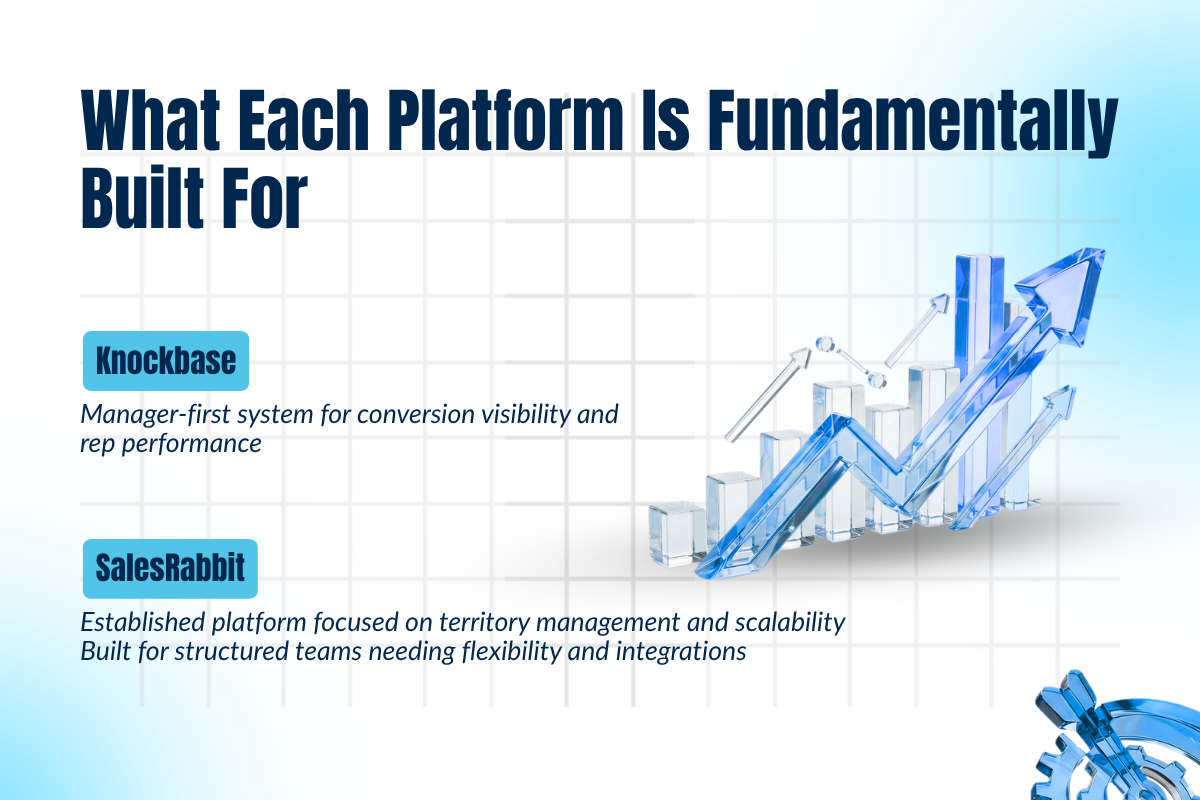
Knockbase is a canvassing software for door-to-door sales teams built specifically for home services teams, covering solar, roofing, pest control, HVAC, and adjacent verticals.
Its design philosophy is manager-first: the platform is built so that sales directors have real-time visibility into what's happening in the field, not just end-of-day reports.
The core of the product is a mobile-first canvassing app that combines route optimization, lead generation, lead capture, appointment scheduling, territory management, and gamified sales performance tracking in one interface. This makes it particularly relevant for outside sales teams that need everything in one system.
What sets Knockbase apart from most D2D platforms is its emphasis on the conversion layer: not just whether reps are knocking doors, but which reps are converting and why. That distinction matters more as teams grow.
SalesRabbit Overview
SalesRabbit is the category's largest player, with more than 85,000 active users and a strong following in roofing, solar sales, and telecom.
Founded in 2013, it has had over a decade to build out its product suite, which now includes lead management and area management, rep tracking, digital contracts, DataGrid AI (its lead-prioritization engine), and Amplify, its analytics and gamification module. It also supports basic lead tracking and digital contracts within the platform.
Its territory management tools are especially strong for teams managing sales territories at scale, aligning with many of the top features to look for in door-to-door sales software.
It is, in many ways, the safe default for D2D teams that haven't settled on a platform, particularly those in roofing and solar. Its integrations are extensive (60+ apps, including Salesforce and HubSpot), its mobile app is stable, and its onboarding process is well documented.
Where it shows limitations is in the coaching and retention layer, which is what happens after the rep is in the field, and whether managers have the signals they need to intervene before a lead goes cold or a rep goes quiet.
Insight: Most teams evaluating a switch from SalesRabbit aren't looking for new features. They're looking for better visibility and a motivation engine that actually sticks past the first month.
Core Differences Between Knockbase and SalesRabbit
1. Rep Tool vs. Sales Management Platform
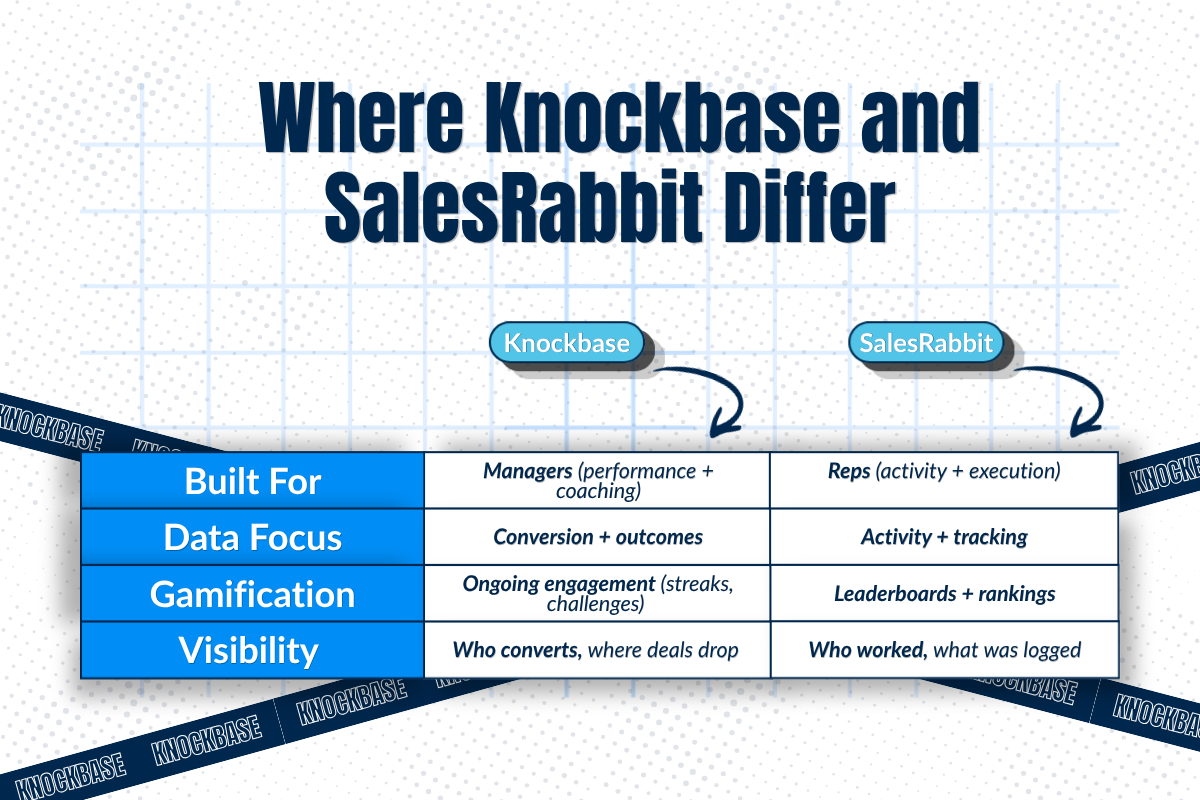
This is the most important distinction in the framing between the two products.
a) SalesRabbit is built rep-first
The interface is optimized for what the individual field sales reps need in the field: territory assignment, lead pins, route navigation, and digital contracts. Managers get reporting, but the primary design beneficiary is the rep on the ground.
b) Knockbase is built manager-first
The platform is designed so that sales directors and team leads have real-time conversion data, follow-up alerts, and territory performance signals, not just raw activity counts. Reps benefit from a clean, fast mobile experience, but the system is architected for the person making coaching decisions.
In practice, the difference looks like this: two reps each knock 80 doors in a day. SalesRabbit logs the activity and stores the conversion data for your next report. Knockbase turns that data into action, showing you exactly where the pitch is failing in real-time and ensuring no lead goes stale by pushing 'backlog' notifications directly to your phone."
Activity data and performance data are not the same thing, and for managers trying to coach their teams, only one of them is actionable.
2. Gamification: Why Leaderboards Alone Don't Cut It Anymore
Both platforms have gamification, but they are not the same product.
a) SalesRabbit Gamification
SalesRabbit Amplify is a mature, high-performance gamification engine designed specifically for the complexities of D2D sales. Rather than a basic visibility tool, it provides a comprehensive ecosystem of digital leaderboards, automated incentives, and social feeds that drive elite-level competition across large organizations. It's included in Pro and Enterprise plans.
The limitation is structural: leaderboard-only gamification tends to lose its impact after 6 to 8 weeks. Once reps know where they rank and that ranking doesn't change much, the motivational signal fades. Teams end up with a tool that was exciting at launch and ignored two months later.
b) Knockbase Gamification Engine
Knockbase's gamification engine is built around the psychology of sustained engagement: streaks that reward consistent effort, challenges that create short-term goals, milestones that mark career progress, and real-time recognition that surfaces wins in the moment.
Crucially, rankings are conversion-based, not just activity-based, aligning the incentive structure with outcomes rather than effort.
In a role with notoriously high turnover, the difference between a gamification system that keeps reps engaged for 60 days versus one that keeps them engaged throughout their first year is a meaningful operational and financial difference.
3. Manager Visibility: The Biggest Gap in Most D2D Software
Ask most D2D sales directors and sales managers what they actually need from their software, and the answer is almost never "more activity data." It's: Why did this territory underperform? Which rep needs coaching? Which leads are about to go cold?
a) What SalesRabbit Shows
SalesRabbit's manager view gives you doors knocked, leads created, GPS location, and basic pipeline status. It's good to know your reps are in the field.
It’s less helpful for diagnosing why performance is trending down or which specific follow‑ups are slipping, since the manager's view is more activity‑focused and less conversion‑driven.
b) What Knockbase Shows
Knockbase's manager dashboard is oriented around coaching decisions: conversion rates by rep (not just volume), lead aging with follow-up gap alerts, territory-level performance comparisons, and signals that help managers intervene before a deal is lost rather than after.
The gap matters because activity data creates the illusion of oversight. A manager who can see that all 15 reps knocked 60+ doors today feels informed, but they don't know which reps are converting, which leads are sitting untouched for 48 hours, or which territory is systematically underperforming. That's where revenue leaks in growing teams.
4. Mobile App Experience: What Reps Actually Use Daily
a) SalesRabbit Mobile UX
SalesRabbit's mobile app is one of its most praised features. It's stable, intuitive, and works in offline mode, which matters enormously for field sales teams operating in low-connectivity areas.
Territory assignment and sales routes are clean, lead pins are simple, and the navigation is familiar enough that new reps are productive quickly.
Known friction points from verified reviews include occasional sync delays when managing large numbers of pins, and some glitches tied to software updates. Android users have historically had a less consistent experience than iOS users. (source: softwareadvice)
b) Knockbase Mobile UX
Knockbase's mobile app is designed around the workflow of a single rep's full day: route planning, door logging, lead capture, follow-up scheduling, and leaderboard check-ins, all within one interface without tab-switching. The gamification layer is embedded in the daily rep experience rather than siloed in a reporting view.
The practical test for any field-rep tool is: does the app make the job easier, or does it add more steps?
Knockbase's unified workflow is designed to reduce friction between the door and the CRM, keeping reps in one place rather than bouncing between tools.
5. Pricing Comparison: What Happens as You Scale
This is where the decision often gets made for growing teams.
a) SalesRabbit Pricing Model
SalesRabbit’s pricing is structured per user, with several tiers and add‑ons. While exact prices can vary by region and contract, the general structure is:
- Team: Starts at approximately $59/user/month (billed annually), with a small‑team minimum of 5 seats.
- Pro: Around $49–$75/user/month (depending on plan and billing term), aimed at teams that need Amplify and advanced features.
- Enterprise: Custom pricing for larger organizations.
- Add‑ons: Features like DataGrid AI, Digital Contracts, Scheduler, Mover Leads, and weather overlays are priced separately on top of the base plan.
For a team of 10 reps on Pro plus a couple of key add‑ons, the total cost can reach roughly $600–$800/month or more.
At 25–50 reps, the per‑user billing model compounds quickly, especially when advanced analytics and gamification require the higher tier. Some reviewers note that the monthly cost can feel high for smaller or cost‑sensitive teams, even though the feature set is robust.
Reviewers note that the monthly subscription price may be out of reach for small businesses.
b) Knockbase Pricing Model
Knockbase does not publish pricing publicly. Quotes are provided directly based on team size and feature requirements, and are often evaluated alongside how well its door-to-door sales software manages leads efficiently.
What's consistent in their positioning is that their model is designed for scaling teams, with full feature access built into mid-tier plans rather than gated behind add-ons.
For teams in the 15–50 rep range evaluating the total cost of ownership, this structural difference is worth running the numbers on directly.
| Team size | SalesRabbit (annual Pro, some add‑ons) | Knockbase (quote‑based, mid‑tier) |
|---|---|---|
| 10 reps | Moderate (often $500–$800/month) | Similar or slightly lower |
| 25 reps | High (can exceed $1,500/month) | Controlled, more predictable |
| 50 reps | Expensive (often $2,000+/month) personalized | More scalable, bundle‑oriented |
Reviews & Reputation: What the Market is Saying
| Platform | G2 Rating (2026) | Capterra Rating | Common Positives | Common Complaints |
|---|---|---|---|---|
| SalesRabbit | 4.5/5 (200+ reviews) | 4.6/5 (150+ reviews) | Mapping, ease of use, and integrations | Bugs/crashes, cost at scale, sync delays (esp. Android) |
| Knockbase | Limited (4.7/5 on early reviews) | Emerging (4.6/5) | Visibility, simplicity, motivation | Newer entrant |
1. SalesRabbit
SalesRabbit has strong overall ratings across platforms like G2 and Capterra, with users consistently highlighting ease of use, territory mapping, and field organization as key strengths.
Common positives:
- Intuitive mobile app and simple lead tracking
- Strong territory visualization and routing
- Helps reps stay organized and efficient in the field
Where the feedback starts to split:
- Reports of bugs, crashes, and performance issues during heavy usage
- Occasional complaints around cost and scalability for smaller or growing teams
- Learning curve and complexity as more features are layered in
Pattern: SalesRabbit is widely trusted and battle-tested, but not always frictionless as teams scale or workflows get more complex.
2. Knockbase
Public review volume for Knockbase is still limited compared to SalesRabbit, which is expected, given its newer status, but it is already expanding into vertical-specific solutions like HVAC sales software for D2D growth.
However, its positioning and early feedback consistently emphasize:
- Simplicity and ease of daily use
- Real-time tracking and visibility
- Strong rep engagement through built-in motivation features
What is consistent across third-party roundups and product positioning is a clear pattern: Knockbase is built as a focused, D2D-specific system, not a general-purpose field sales tool, with a dedicated canvassing app for solar and roofing door-to-door sales.
It is typically highlighted for:
- Real-time performance tracking and actionable metrics
- Built-in gamification (leaderboards, goals, rewards)
- Unified canvassing workflows (lead capture, routing, territory management)
- Simplicity and ease of use across teams
External comparisons also position it as a highly specialized tool for high-volume door-to-door teams, particularly in home services and similar verticals.
What This Means for Buyers
SalesRabbit has the advantage of volume and market validation. Knockbase competes on experience and focus. Most teams don’t switch because SalesRabbit is “bad.” They switch when:
- The tool feels heavier than it should
- costs become harder to justify
- Or visibility into actual performance is still not where it needs to be
Insight: Market sentiment doesn’t point to a broken product. It points to a gap between having the system and getting the outcome from it.
(Sources: Capterra, G2, ConveYour)
Switching from SalesRabbit: What Teams Need to Know
Switching from SalesRabbit is rarely driven by a single issue; it usually happens when small frictions like cost, engagement, and visibility start compounding as the team grows. Most teams reach this point when gaps in the sales process start affecting conversions and follow-ups.
This section breaks down what actually pushes teams to evaluate alternatives, what the migration realistically involves, and what tends to change once the switch is made.
Common Triggers for Switching
Teams that begin evaluating SalesRabbit alternatives typically share one or more of these pain points:
a) Rising costs at scale: Per-user billing with required add-ons becomes expensive quickly as headcount grows. A team that was comfortable at 10 reps may find the cost structure punishing at 30.
b) Gamification that stopped working: Leaderboard-only systems tend to peak in engagement early, then fade. When reps stop caring about the board, managers often have no other engagement lever.
c) Visibility gaps: When managers can track activity but not performance, coaching becomes reactive. Teams start noticing this pattern when they realize they're always fixing problems after they've already cost deals.
What the Migration Actually Involves
Switching D2D platforms is less disruptive than most teams fear, but it does require planning around three areas:
a) Data transfer: Lead history, territory configurations, and rep assignments need to be migrated. The complexity here depends on how much historical data you have and whether your current stack involves third-party integrations that need to be reconnected.
b) Rep onboarding: Most field reps adapt to a new app interface within a few days, especially if the new platform is simpler to use in their daily workflow. Knockbase's mobile-first, unified design is intended to reduce ramp time.
c) Integration setup and compatibility with existing software solutions: If your team uses CRM or operations tools that integrate with SalesRabbit, confirm compatibility with Knockbase before committing. Knockbase is built for the home services stack; verifying your specific tools takes one conversation with their team.
What Changes After the Switch
Teams that make the move from SalesRabbit to a more visibility‑focused platform often report improvements similar to those seen by telecom and fiber teams adopting door-to-door canvassing software for telecom sales:
- faster follow‑up cadences (because alerts surface gaps in real time)
- improved rep accountability (because performance data is visible, not just activity)
- Higher sustained engagement from the gamification layer
Final Verdict: Which Platform Wins in 2026?
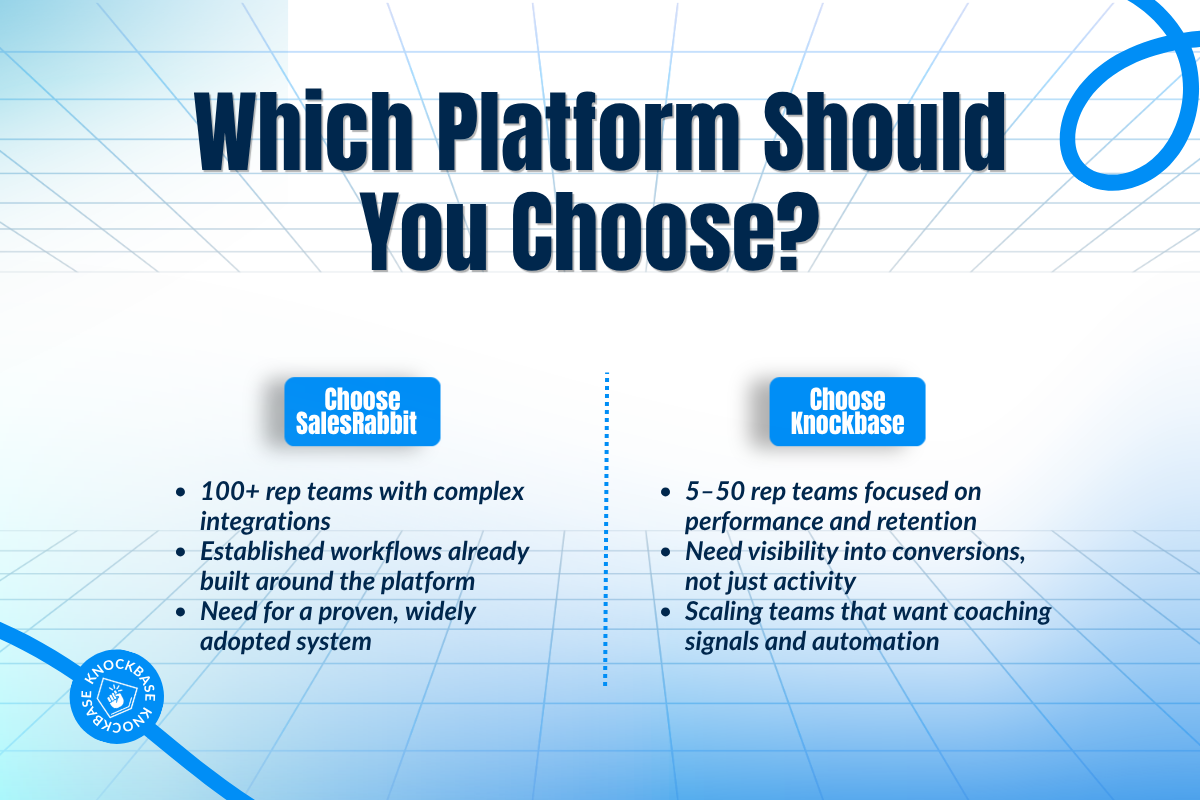
Choose SalesRabbit if:
- You're running a 100+ rep enterprise that needs legacy API integrations and deep hierarchical permissions
- Your team is primarily in solar or roofing and already has SalesRabbit embedded in your workflows
- Wide third-party integration coverage is a hard requirement
- You need a large, proven user base behind the product for stakeholder confidence
Choose Knockbase if:
- You have 5–50 reps in home services, and your #1 challenge is rep retention and field activity visibility
- You want gamification that sustains engagement beyond the first two months
- You need your managers to coach off conversion data, not just door counts
- You're scaling and want a pricing model that doesn't compound with every new hire
- You want follow-up automation and lead aging alerts built into the platform
SalesRabbit is reliable and widely adopted, but can become feature‑heavy and costly as teams grow, especially if add‑ons are required.
Knockbase is optimized for growth and built for the inflection point most home services teams hit somewhere between 10 and 50 reps, when effort alone stops predicting outcomes, and managers need software that shows them why performance is happening, not just that it is.
In 2026, for home services D2D teams that want their reps knocking more doors and staying longer, Knockbase is the sharper fit.
See Knockbase in Action
If you're running a D2D home services team and you're evaluating if your current platform is costing you performance, it's worth 20 minutes to see what the manager visibility layer actually looks like.
Book a Demo today and get a live walkthrough of the features that matter most to your team size and vertical.
FAQs
1. Is Knockbase a good alternative to SalesRabbit?
Yes, Knockbase is designed to support the entire sales process, from lead capture to follow-ups and conversion tracking, with a stronger focus on real-time insights and team performance. For teams that want a simpler system that reps actually use daily, it can be a strong alternative.
2. Does SalesRabbit support gamification?
Yes. SalesRabbit includes leaderboard-based gamification and offers more advanced features through its Amplify module, such as competitions and performance tracking. It is effective for enabling teams early on, but the impact depends on how consistently it drives team performance over time.
3. How long does it take to switch platforms?
Most teams can switch within a few days to a couple of weeks, depending on data migration and integrations. The transition typically involves moving leads, setting up territories, and onboarding reps. Since both platforms are built for on-the-go access, most reps adapt quickly to a new interface.
4. Which door-to-door sales software is best for field sales representatives?
The best tool depends on what field sales representatives need daily. SalesRabbit is strong for mapping and territory coverage, while Knockbase focuses more on workflow simplicity and visibility. The right tool is the one that reduces friction in daily execution while helping teams maintain consistent performance in the field.
5. How does Knockbase compare to other canvassing software like Badger Maps?
Compared to tools like Badger Maps, which focus primarily on route planning, Knockbase is built to manage a larger portion of the workflow. It combines routing with lead tracking, follow-ups, and performance visibility, making it better aligned with teams that prefer a single system over multiple software solutions.
6. What should budget-conscious teams look for in D2D sales software?
Budget-conscious teams should evaluate total cost, including how pricing scales with headcount, whether key features require add-ons, and how well the platform supports CRM integrations. The right tool should balance cost with usability, especially for large sales teams where costs compound quickly.

Canvassing Software ROI: How Sales Managers Should Calculate Cost-Per-Knock vs Cost-Per-Lead in 2026