One of your sales reps knocks on a homeowner's door on Monday, only for another rep from your own company to knock on the very same door on Thursday. Neither knows the other has already been there.
It is the scene that plays out weekly on almost every canvassing team we talk to.
A flaw in your canvassing strategy does not just waste time and fuel; it also hurts your brand's credibility. Your team comes across as uncoordinated and overly pushy, weakening homeowners' trust before your sales reps even have a chance to deliver their sales pitch.
If you run a solar, roofing, construction, or pest control business that relies on canvassing to generate new sales, territory overlap can be one of the biggest blows to your field sales operations.
How to Eliminate Territory Overlap in Door-to-Door Sales Teams
Territory overlap takes place when multiple sales reps target the same block or leads.
It wastes precious selling hours, burns out valuable fuel, and damages your brand reputation.
It can become the single biggest revenue leak, washing away the results of all your hard-earned canvassing efforts.
In this blog, we will uncover the true cost of territory overlap, the warning signs to watch out for, and how canvassing software can eliminate duplicate coverage, optimize territories, and help your sales team close more deals.
Key Takeaways
- Territory overlap increases fuel costs, wastes selling hours, causes commission disputes, and results in lost revenue in door-to-door sales.
- Duplicate door-knocking also damages your brand credibility and frustrates homeowners, reducing trust and conversion rates.
- Canvassing software with live territory mapping, real-time sales or political campaign volunteer tracking, and route optimization helps prevent overlap, maximize territory coverage, and improve team coordination.
What Territory Overlap Actually Is (and why it is easy to miss)
Territory overlap happens when two or more sales reps work in the same geographic area unaware of hitting the same prospects' doors.
These actions are rarely intentional, but it can quietly become one of the biggest revenue drains for any door-to-door sales team.
These are not intentional mistakes but predictable results of managing territories with tools that were never built to track them in real time.
It usually happens because:
- Territories are assigned using whiteboards, spreadsheets, or verbal agreements. Once sales reps are in the field, there is little visibility or tracking beyond calls and texts.
- Reps self-select "hot" neighborhoods instead of sticking to the territories assigned by managers.
- Team leaders create new routes or change territory boundaries mid-season, but not everyone is updated.
- Multiple teams such as setters, closers, and storm chasers work on the same area without sharing information.
None of these are intentional mistakes. They are the direct result of territory management that relies on manual processes rather than real-time visibility.
As businesses scale outreach and expand their field teams, co-ordinating territories is a must!
Poor team communication often leads to territory overlap. It does not just cost your team a door knock, but other challenges too, such as losing qualified leads and a potential customer's trust.
The Hidden Costs of Territory Overlap in Door-to-Door Sales
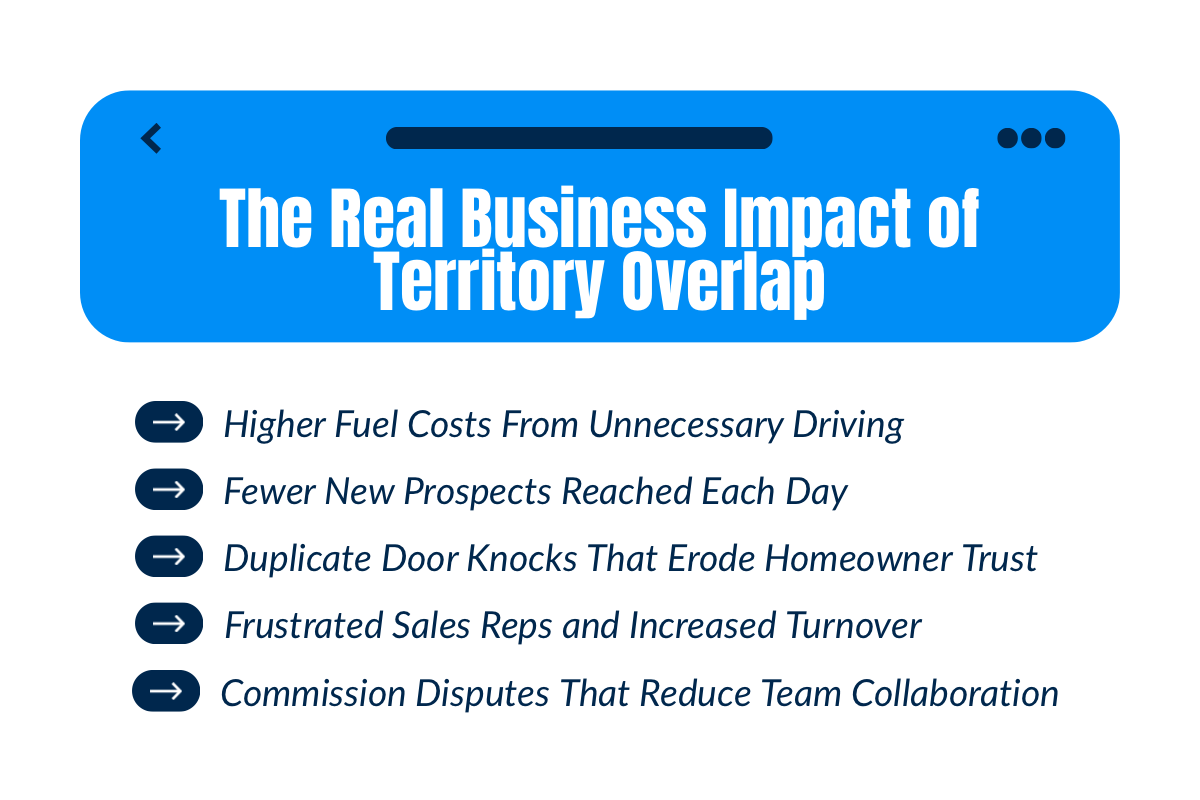
Territory overlap does not show up as one big loss. It shows up as a dozen small ones, stacked every single day. Here is where the money actually goes.
1. Wasted Fuel and Drive Time
When sales territories overlap, your team wastes valuable selling hours in the field. With poor route mapping, reps often drive longer routes, cover the same areas multiple times, and travel unnecessary miles.
This not only reduces the number of customer visits they can make each day but also increases fuel costs and overall operating expenses.
You end up paying the team to travel rather than engaging directly and closing deals.
2. Duplicated Hours Reps Could Spend Prospecting Fresh Doors
Sales reps spend valuable time tracking canvassing metrics such as doors knocked, voter identification for political canvassing, lead conversion rates, and the geographic areas with the highest conversions.
They also spend time adjusting routes, updating records, and creating walk lists.
Every hour spent on these manual tasks is time taken away from customer interactions that could be used to provide demonstrations, answer questions, build trust, and close more deals.
A modern canvassing app with real-time data collection, route optimization, GPS tracking, and lead management automates these processes.
With instant visibility and real-time tracking of field activities, reps can spend more time engaging with prospects to improve productivity and increase conversion rates, while sales managers can devise strategies.
3. Homeowner Fatigue and Brand Damage
Nothing damages a brand's credibility faster than two sales reps from the same company knocking on the same homeowner's door within days of each other with the same sales pitch.
Instead of appearing professional and well-organized, the business comes across as uncoordinated and reliant on high-pressure sales tactics.
A poor first impression can quickly erode trust, making homeowners less likely to engage or do business with the brand.
Homeowners talk to neighbors, and a duplicated knock can create negative word-of-mouth across an entire neighborhood.
4. Field Rep Frustration and Turnover
When field reps overlap in the same territories, they waste valuable selling time and miss opportunities to close deals that could have earned them commissions.
The problem gets even worse when reps drive long distances only to discover that the territory was already covered by another teammate a few days earlier.
Having no access to real-time territory data and updated walk lists with field updates, sales reps often duplicate work and do not realize it.
After spending hours on the road, knocking on doors, and facing repeated rejection, discovering that their effort was unnecessary is both frustrating and demoralizing.
These inefficiencies reduce earnings, increase physical and mental fatigue, and contribute to higher turnover among field sales teams.
5. Commission Disputes between Reps
When two sales reps target the same prospect at different times, a common question arises: who should receive the commission if the deal closes?
When there is no automation for field data collection, and there is no centralized record of each sales rep's field operations activities, it becomes difficult to determine who first contacted the prospect or contributed most to the sale.
These commission disputes create unnecessary conflicts, consume managers' time, and can quickly damage a high-performing competitive team culture into a toxic one.
Quick math on what Territory Overlap Really Costs:
| Cost driver | What it looks like |
|---|---|
| Fuel & vehicle wear | Longer routes and re-driven areas increase fuel spend and maintenance costs. |
| Wasted selling hours | Reps re-knock old doors instead of prospecting new ones |
| Fewer new opportunities | Duplicate coverage means fewer fresh doors knocked, and fewer leads |
| Higher turnover | Ongoing frustration from inefficient territory management drives reps out — and drives up recruiting costs. |
The Warning Signs in Your Own Canvassing Tactics
Most sales canvassing and political campaigns do not fail because of poor strategy; they fail because of inefficient operations, which a smart canvassing CRM for field sales teams is designed to fix.
When your CRM lacks the features needed to streamline field operations, teams waste time, duplicate efforts, and miss opportunities.
These operational inefficiencies reduce productivity, lower conversion rates, and make it difficult for campaigns to achieve their sales or voter outreach goals.
1. Duplicate Addresses Across Sales Reps Activity Logs
If you check the walk lists for each sales rep and review the addresses of all the doors they have knocked, the same property location appearing under different field reps is a clear sign of territory overlap.
Duplication reveals a lack of coordination in territory planning, leading to wasted efforts and sales time, along with an inconsistent customer experience.
2. Inconsistent Contact Rates Across "Equal" Territories
When a CRM lacks real-time data capture for every door knocked, highlighting geographic and demographic insights, campaign managers and team leaders rely on guesswork and feedback from field reps.
A lack of accurate field data means they struggle to create strategic walk lists for follow-ups and new prospects.
The lack of data-driven route planning makes it difficult to identify high-density neighborhoods with the greatest concentration of warm leads, resulting in inefficient canvassing and missed sales opportunities.
This makes it hard to spot which neighborhoods actually have the most warm leads.
3. Fuel or Mileage Spikes Without Matching Lead Volume
When fuel and mileage costs increase and do not correspond to the rise in the number of leads generated, it often points to inefficient route planning or overlapping territories.
Longer travel distances, duplicate visits, and unnecessary driving consume more fuel while reducing the time field reps spend engaging with warm prospects.
Outreach volume declines, conversion rates drop, and the overall cost of running a sales or political canvassing campaign increases, which impacts revenues.
4. Sales Reps Reporting "dead" doors in territories that haven't been worked yet
Sales teams may flag territories as unresponsive, but the real issue could be that the area was skipped by a sales rep, already worked by another team, or the leads in the region were captured by competitors.
Without real-time analytics and reporting tools after every door knocked, campaign managers lack the visibility needed to understand what actually happened in the field.
It often leads to inaccurate assumptions about territory saturation and allows sales reps to skip complex or densely populated neighborhoods that may have a high potential for lead conversions.
How Canvassing Software Can Resolve the Overlap Issues
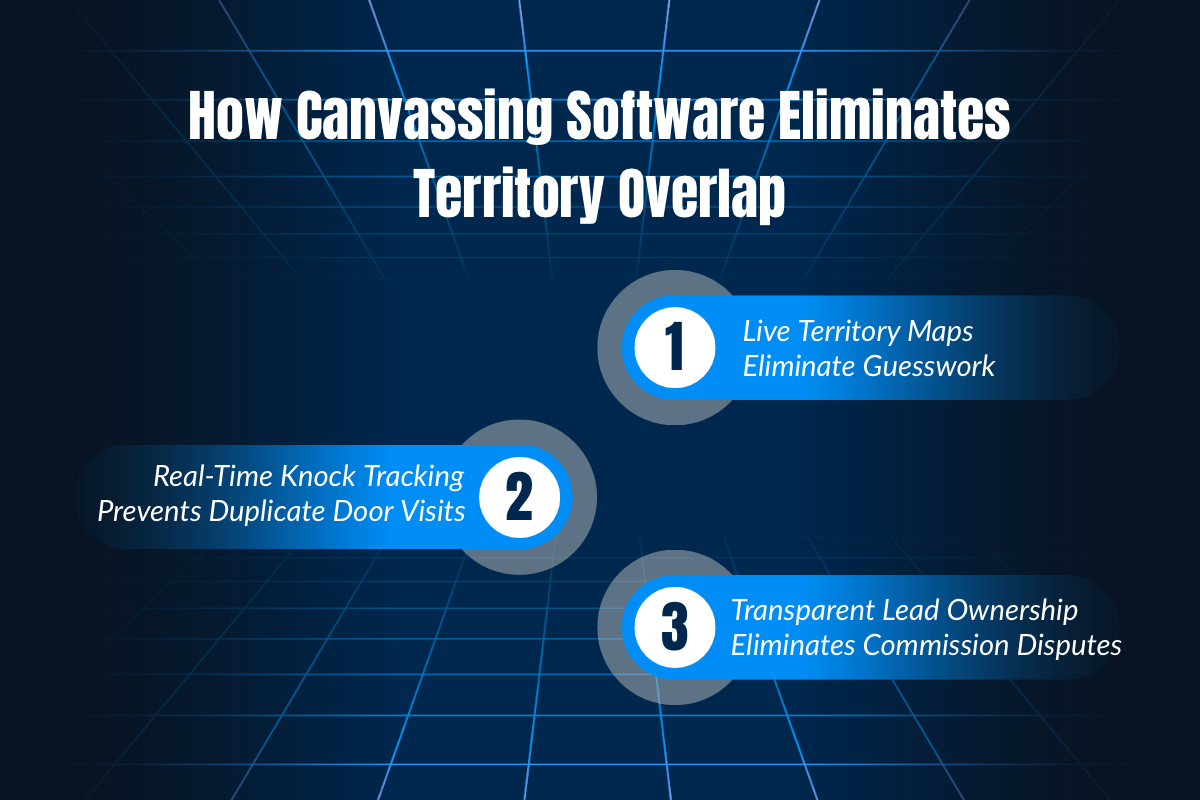
1. A Live Map Replaces Memory and Guesswork
Instead of relying on field reps to decide which routes to take, a good canvassing app with advanced mapping tools empowers managers to plan and optimize territories using live maps.
They can digitally visualize territory boundaries, assign routes strategically, and use built-in route optimization to identify the shortest and most efficient paths, enabling field reps to cover the maximum number of doors each day.
2. Real-Time Knock and Status Tracking Prevents Re-Knocks Before They Happen
Territory management software logs every interaction at each door knocked, allowing sales reps to instantly update lead statuses for sales pipeline management or record survey responses during political canvassing.
These updates are instantly available to managers and team members, improving collaboration among sales reps and strengthening political canvassing volunteer coordination, ensuring everyone has access to the latest field data.
It eliminates duplicate door knocks and reliance on guesswork or sales reps' memory when reporting field activities during team meetings.
Real-time visibility enables managers to make faster data-driven decisions to optimize future canvassing campaigns.
3. Fair and Transparent Commission Tracking Reduces Sales Reps' Turnover
Every door knocked, lead interaction, and status update is automatically time-stamped through real-time data entry in canvassing tools. This creates a clear record of which sales rep generated the lead, who handled follow-ups, and ultimately closed the deal.
With complete visibility into the sales journey, managers can accurately assign commissions, eliminate disputes over lead ownership, and reward performance fairly.
Transparent commission tracking boosts sales rep trust and retention while reducing turnover.
The Bottom Line: Stop Losing Revenue to Overlapping Sales Territories
Getting field sales reps to shift from manual data entry to mobile canvassing software can feel overwhelming, especially during an active campaign.
The transition may temporarily slow door-knocking activity as reps learn to use the new tool.
At the same time, data migration errors can create duplicate leads, omit critical territories, or result in incorrect territory assignments, leading to overlap and missed opportunities.
However, with a phased rollout, proper training, and accurate data migration, teams can adopt the software smoothly, which would make field operations smoother.
Here is the step-by-step process for getting started with the new tool while replacing your existing system.
Step 1: Import your Existing Territory Boundaries First
Before assigning new routes or creating walk lists, import your existing territory management data into the canvassing software.
Preserving familiar territory boundaries, walk lists, and lead records ensures a smooth transition while preventing duplicate visits, territory overlap, and missed leads.
Step 2: Run a Shadow Period Before Changing Anyone's Workflow
The new canvassing software should not become the primary tool immediately. Instead, it should run parallel to your existing system during a short trial period until training, onboarding, and data validation are complete.
Using the new tool along with the current process allows field reps and managers to become familiar with essential features and resolve any issues before a complete transition.
This phased approach minimizes disruption and ensures a smooth rollout during active campaigns.
Step 3: Standardize Onboarding for New Hires from Day One
Once the new tool is in use, every new hire in the sales and marketing teams should be onboarded and trained to use the system from their very first day.
A structured onboarding and coaching program, combined with continuous feedback from employees, helps identify challenges early and ensures they receive the assistance they need.
This approach accelerates adoption, encouraging consistent and maximum usage of all key features of the new system to deliver positive output.
See it Work on Your Own Territories with Knockbase.
Here is how Knockbase can be an assistant to prevent territory overlap:
- Visual Territory Mapping: Knockbase's interactive territory maps give managers a clear view of assigned and covered areas while tracking canvassers' locations in real time.
- Real-Time Knock Tracking: Managers gain live visibility into doors knocked, territories covered, homeowner interactions, and shared customer notes.
- Route Optimization: Advanced route optimization considers traffic conditions, travel distance, and scheduled appointments to reduce drive time and improve efficiency.
If you want to see how shared territory maps, real-time door knock tracking, and route optimization can transform your team's canvassing, book a free demo call with our Knockbase Experts and experience the canvassing software and explore how the software works on your own territories.
Frequently Asked Questions (FAQ)
1. What is Territory Overlap in Door-to-Door Sales?
Territory overlap occurs when two or more sales representatives work in the same geographic area, knocking on the same doors or targeting the same leads because they lack real-time visibility into each other's activities.
It results in homeowners being approached multiple times by representatives from the same company, creating frustration and damaging the brand's reputation. It also leads to wasted time, fuel, and labor, while increasing commission disputes and reducing overall sales efficiency.
2. How do I know if my D2D team has a Territory Overlap Problem?
You can identify territory overlap when sales activity logs show duplicate addresses, contact rates are unusually low in territories that should be performing well, fuel costs rise without a corresponding increase in lead volume, and commission disputes become a recurring issue.
These are clear indicators that multiple sales reps may be targeting the same prospects instead of covering new territories efficiently.
3. Can Canvassing Software really Prevent Territory Overlap?
Yes. Canvassing software with built-in advanced features and a user-friendly interface provides every team member with live visibility into door-knocking activities, customer interactions, and lead statuses. This enables teams to create more strategic walk lists, optimize routes for greater efficiency, and avoid duplicate territory allocations.
4. Will Switching to Canvassing Software Disrupt my Team Mid-Season?
No. If you roll out the new canvassing tool using a phased approach while running it alongside your existing system, you can maintain productivity throughout the transition. This approach minimizes duplicate data entry, reduces the impact of technical issues or bugs, and prevents disruptions to active canvassing campaigns.
5. What is the Difference between Canvassing Software and a Regular CRM?
Canvassing software is built specifically to manage face-to-face and door-to-door outreach for political canvassing and sales campaigns. It maps geographic territories, assigns walk lists, tracks live field activities, and provides real-time insights to maximize outreach in sales and better tactics for political, democratic, or progressive campaigns.
In contrast, a traditional CRM is primarily a desk-based system designed to manage the entire customer lifecycle, track sales pipelines, and store detailed records of customer interactions and communication history.

Canvassing Software ROI: How Sales Managers Should Calculate Cost-Per-Knock vs Cost-Per-Lead in 2026