You're standing at a door. You knocked. You hear footsteps. You have about four seconds before the homeowner opens up, sizes you up, and decides whether to hear you out or shut you down.
That four-second window is where most reps lose the sale - not at the close, not during objections. Right there, at the door.
Most door-to-door sales scripts fail because they were written for a different era. Homeowners in 2026 are more skeptical, more distracted, and more aware of sales tactics than ever. Generic openers get doors closed. Stiff, rehearsed pitches get eye rolls. And reps who show up without a flexible, human-sounding script leave money - and appointments - on the table.
This guide gives you the actual scripts, frameworks, and objection-handling language that work in the field right now. Not theory. Not fluff. Real language, real scenarios, and the psychology behind why each piece works.
Whether you're a new rep still building confidence or a veteran trying to sharpen your close rate, this is the most practical D2D sales script resource you'll find.
Key Takeaways
- Most door-to-door sales scripts fail because they sound robotic, generic, and overly sales-focused.
- The highest-converting door-knocking scripts in 2026 prioritize trust, relevance, and conversation over pitching.
- A proven six-step framework helps reps move naturally from opener to appointment.
- Industry-specific scripts for roofing, solar, pest control, HVAC, and home services outperform generic approaches.
- Objection handling works best when reps acknowledge concerns, align with the homeowner, and redirect the conversation.
- The most effective closes focus on securing the next step—not forcing a sale.
- Tracking script performance and field conversations helps sales teams continuously improve results.
Door-to-Door Sales Scripts That Work in 2026
Door-to-door sales remains one of the most effective customer acquisition channels for roofing, solar, pest control, HVAC, telecom, and home service companies. But success today depends less on having a polished pitch and more on having the right conversation.
The best door-to-door sales scripts in 2026 aren’t rigid word-for-word presentations. They’re flexible frameworks designed to earn attention, build trust quickly, uncover homeowner needs, and guide prospects toward a low-pressure next step.
In this guide, you’ll find proven door-knocking scripts, objection-handling techniques, closing frameworks, and real-world examples that modern field sales teams use to generate more appointments and close more business.
Why Most Door-to-Door Sales Scripts Fail
Before we get to the good stuff, let's diagnose the problem. Because if you understand why scripts fail, you'll know how to use good ones correctly.
1. They Sound Like Scripts
The moment a homeowner hears canned language, their guard goes up. Phrases like "Hi there, how are you today!" delivered with forced enthusiasm are instantly recognizable as sales openers. The homeowner's brain says salesperson - and everything that follows gets filtered through skepticism.
The fix isn't a better script. It's a script that sounds like a real person talking.
2. Reps Pitch Before They've Built Any Rapport
The number one mistake reps make is jumping into product features within the first 30 seconds. The homeowner doesn't know you, doesn't trust you, and doesn't care about your offer yet.
Pitching before trust is built is like proposing on a first date. Even if everything you say is accurate and valuable, the timing kills it.
3. Talking Too Much, Listening Too Little
A good door-to-door script isn't a monologue - it's a conversation structure. Reps who talk nonstop (usually because they're nervous) overwhelm homeowners and miss critical buying signals. The best closers in the field speak less than 50% of the time.
4. No Personalization
"We're working in your neighborhood" is more effective than "We're running a special offer." Why? Because it's specific. Homeowners respond to relevance. Generic scripts that could apply to anyone in any city don't feel personal - and they don't convert.
5. Weak Confidence at the Door
Tonality matters more than the actual words. You can deliver the same script with flat energy or genuine conviction and get completely different results. Homeowners mirror the energy you bring to the porch.
6. Scripts Without Transitions
Most reps can open reasonably well. They struggle with the handoff - moving from the opener to the problem, from the problem to the pitch, from the pitch to the close. Clunky transitions kill momentum and give homeowners an out.
Want to Know Why Your Reps Aren’t Booking More Appointments?
Even the best script won’t work if managers can’t see what’s happening in the field. Top-performing teams track conversations, objections, appointment rates, and territory performance to understand what’s actually driving results.
See how Knockbase helps managers track rep performance, territory activity, and appointment conversion in real time. Book a Demo today.
What Makes a Great Door-to-Door Sales Script in 2026
A great D2D script in 2026 does six things well.
1. It earns attention before asking for it. A good opener creates curiosity or relevance before it does anything else. The homeowner should feel like they want to hear what comes next.
2. It's short. Every unnecessary sentence is a chance to lose the conversation. Tight, clear, purposeful language wins.
3. It sounds like a person, not a sales brochure. Contractions. Casual phrasing. Even a little humor in the right context. Real people don't speak in perfect sentences.
4. It uses pattern interrupts. Most homeowners expect a certain type of sales opener. Disrupting that pattern ("I'm not here to sell you anything today" - and meaning it) resets their frame and earns a few extra seconds of genuine attention.
5. It identifies a real problem before offering a solution. Pain-first selling is more effective than feature-first selling. Homeowners who recognize a problem you describe are far more likely to want to hear your solution.
6. It stays flexible. No script survives contact with the homeowner intact. Great reps use scripts as frameworks, not scripts. They know the structure, they know their key phrases, and they adapt to the individual in front of them.
The Best Door-to-Door Sales Script Framework
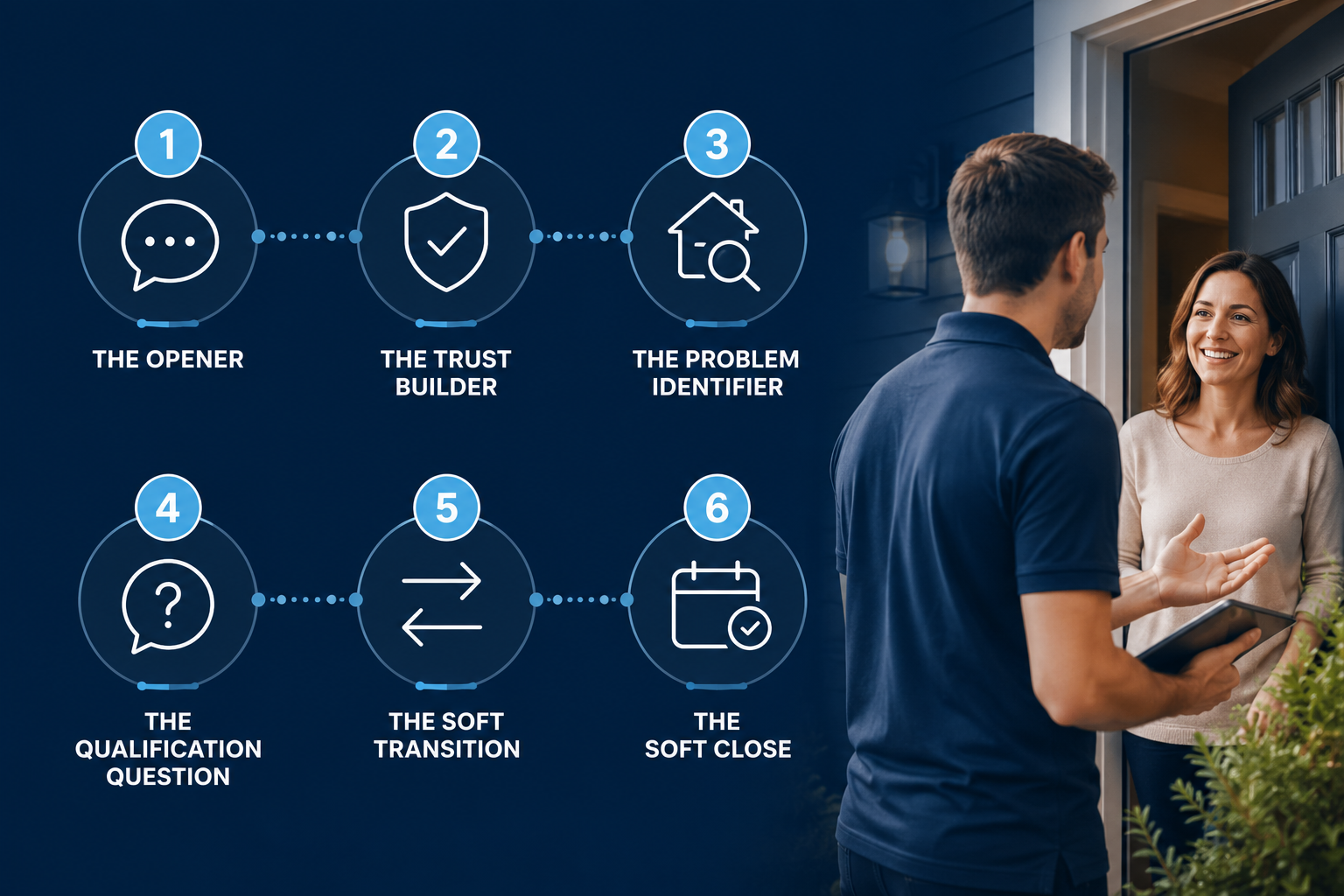
Here's the six-part structure that top-performing canvassers use. Every section of this guide maps back to this framework.
Step 1: The Opener (0–10 seconds)
Get their attention. Establish why you're there. Disarm their guard.
Goal: Make them want to keep listening.
Step 2: The Trust Builder (10–30 seconds)
Establish credibility and social proof quickly. Name-drop the neighborhood. Mention a nearby customer or project. Show that you're local, legitimate, and busy in their area.
Goal: Answer the unspoken question: Should I trust this person?
Step 3: The Problem Identifier (30–60 seconds)
Point to a specific problem the homeowner may have - ideally something visual or seasonal. This is NOT your pitch. It's a question or observation that creates relevance.
Goal: Make the homeowner think: That actually applies to me.
Step 4: The Qualification Question
Ask one or two simple questions to qualify and personalize. This shifts the conversation from pitch mode to dialogue mode.
Goal: Understand their situation. Get them talking.
Step 5: The Soft Transition
Bridge from problem to solution naturally. This is where most reps stumble. Use transition language that moves forward without pressure.
Goal: Set up the close without triggering resistance.
Step 6: The Soft Close
Ask for the appointment, the inspection, or the next step - not the sale. Make the next step low-risk and easy to say yes to.
Goal: Get a commitment to continue, not a commitment to buy.
Door-to-Door Sales Script Examples by Industry
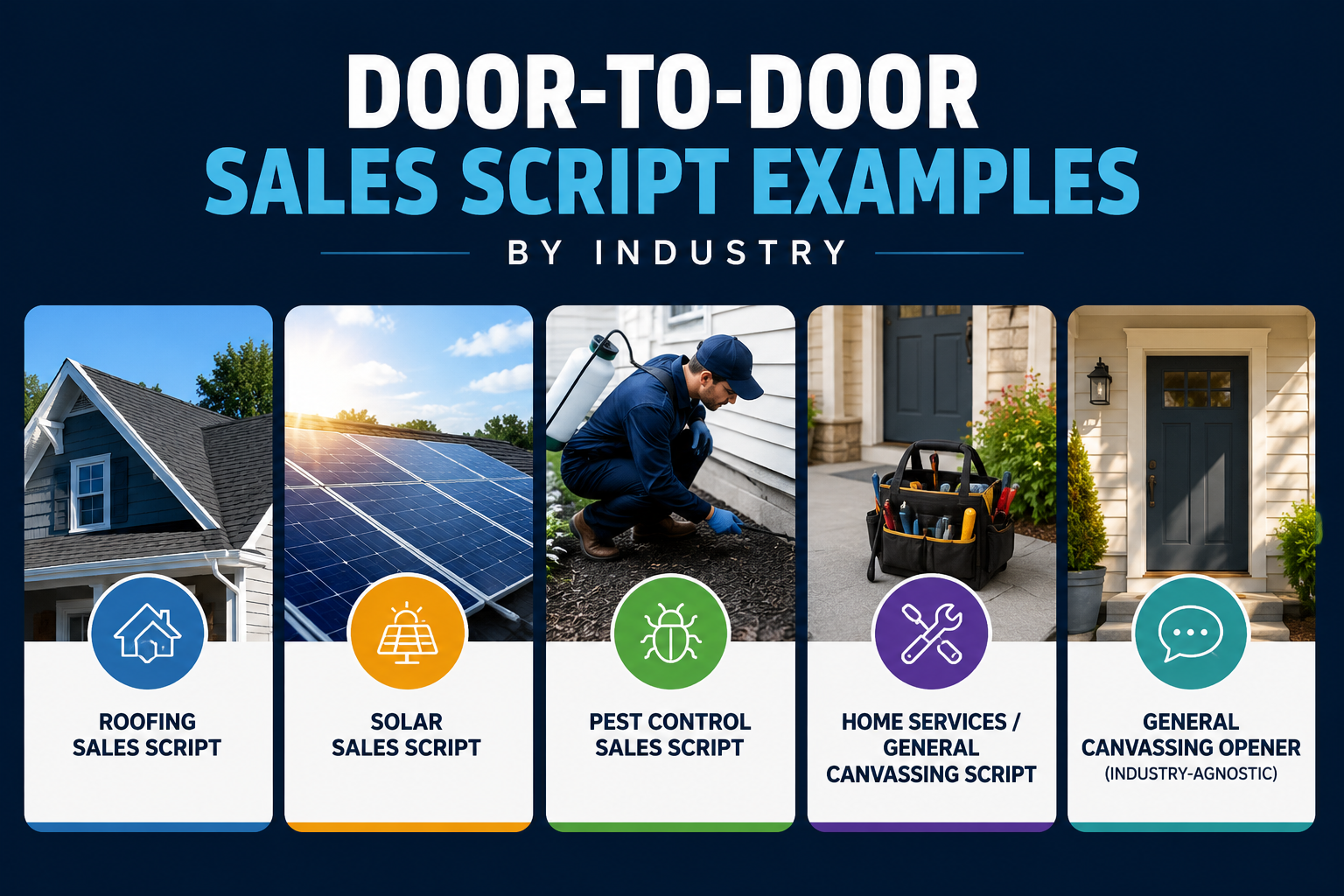
Roofing Sales Script
For solar and roofing teams, pairing strong scripts with a canvassing app built specifically for door-to-door reps keeps territory work, lead capture, and follow-up as tight as your language at the door.
The Setup: After a recent storm, or proactively for older homes with visible wear.
"Hey, how's it going - my name's [Name], I'm with [Company]. We've been doing a few roof inspections in your neighborhood this week; I actually just finished up at the [Smith/Jones] place a couple doors down. The reason I stopped by - I noticed from the street your roof has some [missing shingles/granule loss/moss buildup]. I'm not here to sell you anything today, but our inspections are completely free, and I've found a lot of homeowners in this area don't realize they have storm damage until it becomes an interior leak. Takes about fifteen minutes - would it be alright if I took a quick look while I'm here?"
Why it works:
- Opens with neighborhood social proof (nearby customer)
- States a visual observation, not a generic pitch
- "I'm not here to sell you anything" reduces pressure and earns trust
- The ask is small (15-minute free inspection), not a purchase decision
- Creates urgency without fake scarcity
H3: Roofing Objection Bridge
If they hesitate: "Totally understand - I get that a lot. Most homeowners just want to know what they're dealing with before they make any decisions. If everything looks fine, I'll tell you that and be on my way. Fair enough?"
Door-to-door canvassing software for telecom and fiber sales teams follows many of the same principles you’ll see in the next example.
Solar Sales Script
Route efficiency matters just as much as what you say at the door, and using intelligent routing to optimize your door-to-door paths prevents wasted time between qualified conversations.
The Setup: Residential neighborhoods, high utility-cost areas, or post-policy-update timing.
"Hi, I'm [Name] with [Company]. Quick question - have you noticed your electricity bill going up lately? We've been meeting with a lot of homeowners on this street, and honestly, a lot of them are surprised to find out they're eligible for programs that could eliminate most of their bill. I'm not asking you to commit to anything - we just do a quick analysis of your current usage, and I can tell you within about ten minutes whether it makes financial sense for your home specifically. Would that be worth a few minutes?"
Why it works:
- Opens with a question that's almost universally answered "yes" (bills go up)
- Anchors on financial benefit, not product features
- "Programs" language sounds more accessible than "going solar"
- Makes the next step (analysis) feel informational, not salesy
- Leaves control with the homeowner
Pest Control Sales Script
Pest operators who combine these openers with a door-knocking app tailored to pest control lead generation keep territories organized and make it easier to revisit high-potential homes at the right time.
The Setup: Spring/summer canvassing, or after visible activity in the area.
"Hey there - I'm [Name] from [Company], we're actually treating a few homes right on your block today. Reason I stopped by - this time of year we see a big uptick in [ants/roaches/mosquitoes/termites] in this neighborhood, especially around [older homes/lots with trees/homes near the drainage area]. Do you guys currently have any kind of pest protection, or are you handling things as they come up?"
Why it works:
- Nearby social proof built in ("treating homes on your block")
- Seasonal relevance makes it feel timely
- Specific local context (type of pest, local geography) adds credibility
- Ends with a question that either qualifies them or surfaces an objection
Home Services / General Canvassing Script
HVAC and other home service teams can layer these openers on top of HVAC-focused door-to-door sales software to manage routes, appointments, and follow-ups without adding admin work.
The Setup: General neighborhoods for services like window replacement, insulation, gutter guards, HVAC.
"Hi, I'm [Name] - I'm with [Company], we're a local [windows/insulation/HVAC] contractor. We just finished a project for one of your neighbors - actually wanted to make sure I talked to a few homeowners on this street while we're nearby. We're doing complimentary consultations this week, basically a quick walkthrough to identify if there are any obvious areas where you might be losing efficiency or have wear you might not know about. No obligation, no pressure - just worth knowing.
Would you have fifteen minutes this week?"
General Canvassing Opener (Industry-Agnostic)
Roofing reps who rely on a mobile-first roofing canvassing platform can test multiple versions of this opener in the field and see which language actually fills the inspection calendar.
When you need a clean, flexible opener that works across different products:
"Hi - I'm [Name], I work with a local company called [Company]. I'll keep it quick - we've been doing some work in the neighborhood recently, and I wanted to introduce myself while I was here. Quick question - [tailored question based on product/service]. Would you mind if I explained what that typically means for most homeowners?"
Best Door-Knocking Opening Lines
The opener is everything. Here are the highest-converting types, with examples and guidance on when to use each.
Curiosity Openers
These work by leaving a gap the homeowner wants to fill. Don't reveal everything upfront.
- "I wasn't actually going to stop here, but I noticed something from the street and figured you'd want to know."
- "I've got good news and potentially important news - which do you want first?"
- "Quick question - have you talked to any of your neighbors this week?"
Best for: High-skepticism areas, competitors' existing customers, reps who are confident in delivery.
Local Reference Openers
Ground the conversation in something specific to their neighborhood or street.
- "We just finished up at [number] [Street Name] - your neighbor over there, [first name if known] - and I wanted to catch a few more homes while I was in the area."
- "We've been pretty busy on [Street/Neighborhood] this month - a lot of homeowners here have been qualifying for [program/service]."
Best for: Any rep with actual neighborhood data. Pairs well with canvassing software that tracks which homes have been visited.
Problem-Based Openers
Lead with the pain point before introducing yourself or your company.
- "I don't know if you've noticed, but we've seen a lot of [damage/pest activity/energy loss] in homes on this block recently."
- "Quick question - when's the last time someone checked your [roof/HVAC system/windows] after a season like we just had?"
Best for: Post-storm canvassing, seasonal campaigns, high-awareness service categories.
Social Proof Openers
Let the neighborhood do your selling for you.
- "Hi - your neighbor [first name] actually suggested I stop by. We just finished a project for them, and they mentioned you might be interested."
- "We're working with about fourteen homes on your street right now - I wanted to make sure I introduced myself before we wrapped up in this area."
Best for: Anytime you genuinely have a neighbor reference or area density. Never fabricate these.
Low-Pressure Openers
Disarm resistance before it has a chance to form.
- "I promise I'll be quick - I'm not here to pitch you anything. I just wanted to leave some information and answer any questions you might have."
- "I know you probably weren't expecting a knock - I'll be out of your hair in two minutes."
Best for: "No soliciting" areas (used carefully), repeat-visit homeowners, skeptical body language from the start.
Objection Handling Scripts That Actually Work
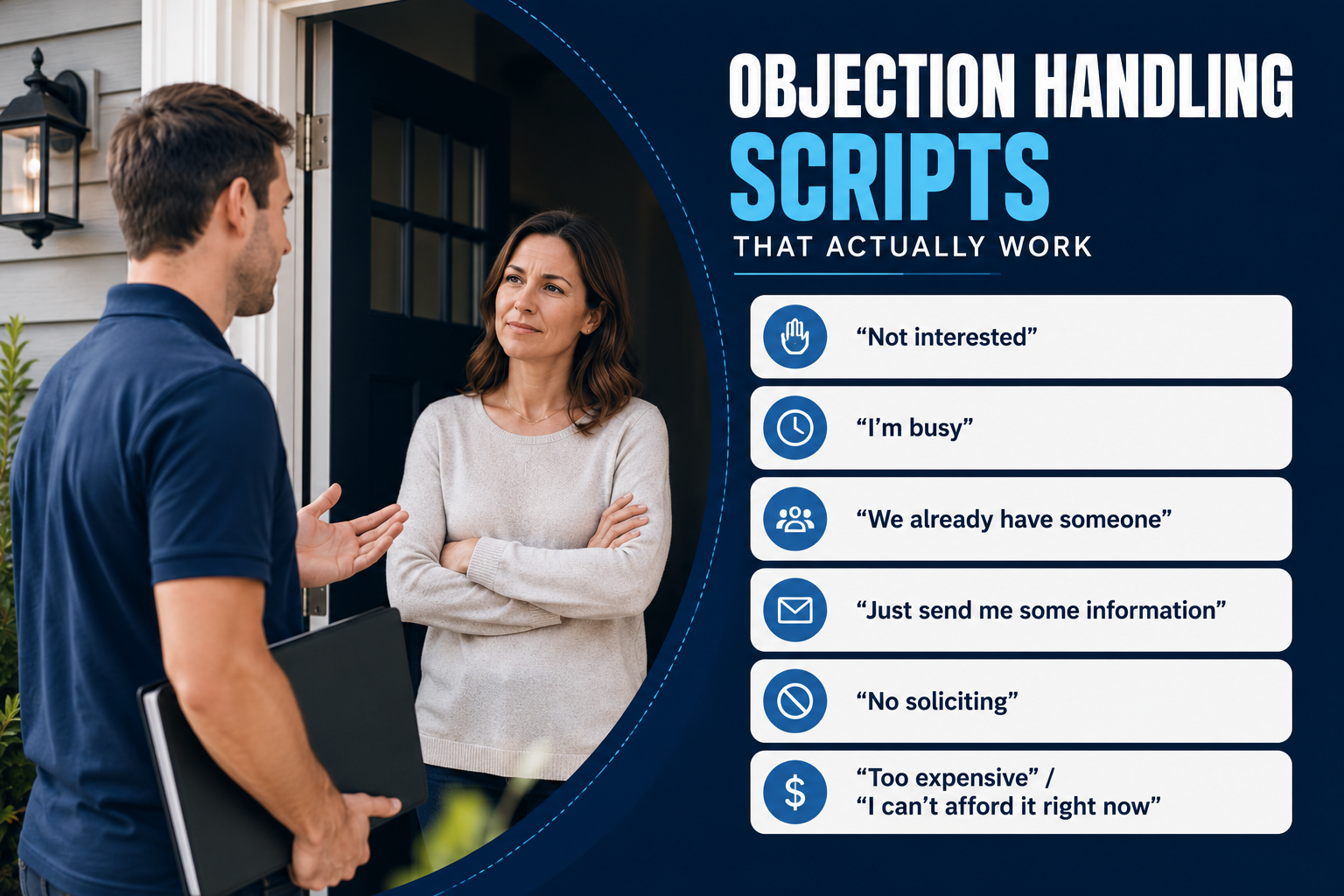
This is where deals are won or lost. Most reps hear an objection and either fold immediately or push back awkwardly. The better move is to acknowledge, align, and redirect.
Here's how to handle the most common objections at the door.
"Not interested"
The Weak Response: "Are you sure? It's really quick and could save you a lot of money!" Why it fails: It argues with them and increases pressure.
The Stronger Response: "Totally fair - most people say that before they hear what I'm actually here about. Real quick, I just wanted to let you know [one-sentence relevant hook]. If that's not relevant, I'll leave you alone. But if it is, it might actually be worth two minutes."
Psychology: You're not fighting the objection - you're bypassing it by offering something genuinely relevant. The "if that's not relevant" line signals low pressure and increases willingness to listen.
"I'm busy"
The Weak Response: "I'll only take a second!" Why it fails: Everyone says this, and it sets up a promise you might not keep.
The Stronger Response: "I hear you - I'll literally be 60 seconds. Can I just leave you with one thing before I go?"
Or, for scheduling: "No problem at all. When would be a better time to come back - would tomorrow morning or later this week work better for you?"
Psychology: Offering to come back shifts from an intrusion to an appointment. Most people prefer that to an awkward brush-off.
"We already have someone"
The Weak Response: "Oh yeah? Well we're actually better because..." Why it fails: It's immediately adversarial.
The Stronger Response: "That's great - most of the homeowners I talk to do. Can I ask how long you've been with them? The reason I ask is that [seasonal/price/product] has changed a lot recently, and a lot of people are finding out they can get [better price/better service/newer technology] without even switching - they just didn't know to ask."
Psychology: You're not attacking their current provider. You're planting a seed of comparison - letting them decide.
"Just send me some information"
The Weak Response: "Sure! What's your email?" Why it fails: Information requests are usually polite dismissals. Almost no one reads the email.
The Stronger Response: "Absolutely - I'd rather do that than waste your time anyway. Quick question though - is [core pain point] something you're actually thinking about, or would you be looking at this more [season/timing]-wise?"
Psychology: Asking a clarifying question re-engages them without pressure. If they answer, you're back in a conversation. If they really just want info, you can offer it - but most people will talk.
"No soliciting"
The Weak Response: Arguing about whether what you're doing counts as soliciting. Why it fails: Even if you're right, you've already lost.
The Stronger Response: "I completely respect that - I wasn't planning to sell you anything today. We've actually been doing [work/inspections/consultations] for a few of your neighbors and I just wanted to introduce myself. If you ever want to know what we found in the area, you're welcome to reach out. Here's my card."
Psychology: You've complied with the request, established presence without pressure, and left a tangible follow-up touchpoint. Many homeowners call back.
"Too expensive" / "I can't afford it right now"
The Weak Response: "We have financing!" Why it fails: It sounds like you prepared for this objection, which signals high-pressure sales.
The Stronger Response: "That's fair, and I'm not here to push something that doesn't make sense. Can I ask - is it the upfront cost that's the issue, or is it more about whether it's worth the investment? Those are two pretty different conversations."
Psychology: You're separating "I can't afford it" (a resource objection) from "I don't see the value" (a belief objection). Each gets handled differently, and asking the question shows you're actually listening.
Closing Scripts That Don't Sound Pushy
The biggest mistake in D2D closing is asking for too much too soon. The goal at the door isn't always a signed contract - often it's an appointment, an inspection, or an agreement to talk more. Make the next step small and easy.
Micro-Commitment Closes
Build toward the sale through a series of small yeses.
- "Does it make sense to at least take a look while I'm here?"
- "Would it be worth fifteen minutes to find out if you qualify?"
- "Is there any reason you wouldn't want to know what this would cost you?"
Each of these is a low-stakes question that moves the conversation forward without putting the homeowner on the defensive.
Assumptive Language
Assume the next step will happen, rather than asking permission for it.
- "I can schedule you for an inspection - does Thursday or Friday work better?"
- "Let me write down your address, and I'll have my manager reach out tomorrow."
- "I'll put you down for [time slot] - you can always reschedule if something comes up."
Note: Assumptive language only works when you've earned enough trust to use it. Use it too early, and it backfires.
Appointment-Setting Language
For service businesses where the in-home appointment is the conversion goal:
- "Here's what I'd suggest - let me set up a quick consultation for you. There's no commitment, it's completely free, and you'll know exactly where you stand. What day works best this week?"
- "I can put you on our schedule for this area. We're here through [day] - would morning or afternoon be better for you?"
Soft Close After Objection
Use this when you've handled an objection, and you're ready to move forward:
- "So based on what you told me - does it make sense to take the next step and just see what this looks like for your home?"
- "I think you'd actually be a good fit for this. Want to find out for sure?"
Common Door-to-Door Script Mistakes
Even with great scripts, execution matters. Here are the mistakes that kill conversion rates even when the language is right.
- Over-talking. Once a homeowner says "okay" or shows genuine interest, stop talking. Reps who keep pitching after the homeowner is ready often talk themselves out of a close.
- Sounding rehearsed. There's a difference between knowing your script well and sounding like you're reciting it. If you're focusing on what to say next, you're not listening - and homeowners can feel it.
- Talking too fast. Fast talking signals nervousness, which signals inexperience, which signals risk. Slow down deliberately. Pauses build authority.
- Ignoring body language. Crossed arms, glances inside the house, hand on the door - homeowners give constant signals. Good reps adjust in real time based on what they're seeing.
- Feature dumping. Listing product features before the homeowner has acknowledged a problem is backward. Lead with their pain point, not your product's specs.
- Skipping the qualification question. Not all homeowners are good fits. Spending 20 minutes with someone who rents, just signed a contract with a competitor, or genuinely has no need wastes time that could go to qualified prospects.
- Not using a natural transition. The leap from "here's the problem" to "here's my solution" is where momentum dies if the rep doesn't nail the bridge language. Practice transitions as carefully as you practice openers.
Door-to-door sales software with real-time data and analytics is exactly how top sales teams improve scripts using data
The best D2D teams don't just hand reps a script and send them into the field. They track what happens at the door, analyze which openers lead to appointments, and continuously refine their language based on real field data.
Here's what separates teams that improve from teams that plateau:
- They log objections systematically. When a rep hears "not interested" at 60% of doors in a specific territory, that's data - either the pitch isn't right for that demographic, or the territory needs different approach timing.
- They track which openers convert. If three reps are using different openers and one is converting at 2x the rate, that information should be shared with the whole team immediately. Most teams don't have a system to capture this.
- They monitor rep performance individually. Two reps can use the same script and get radically different results based on delivery, timing, and territory. Tracking at the rep level with modern canvassing software for training and coaching reveals who needs coaching and who should be training others.
- They correlate field activity to closed deals. More knocks don't automatically mean more closes. Teams that track qualified conversations, set appointments, and close rates at each stage using a smart canvassing CRM for field sales teams know exactly where their pipeline is leaking.
Final Thoughts
Great door-to-door sales scripts aren't silver bullets. They're tools - and like any tool, they work better in the hands of someone who's practiced with them, paid attention to what the field is telling them, and iterated based on real results.
What separates the top reps isn't just the words they use. It's the discipline to track what's working, the willingness to adjust what isn't, and the self-awareness to know the difference between a bad script and bad delivery.
If you're leading a D2D team, your job is to build both - give reps the right language and the right feedback loop, supported by a door-knocking app to boost sales performance.
If you're a rep, use these frameworks as your starting point. Get reps in the field. Track your conversations with canvassing software built for door-to-door teams. Notice what earns you an extra 30 seconds and what closes the door. The script that works best for you will be the one you've refined with your own instincts added to the framework.
Ready to give your team the tools to track performance, refine scripts, and close more doors?
Book a Knockbase Demo → Or, if you prefer to talk to someone first, you can
get in touch with the Knockbase team to walk through your specific door-to-door setup.
Knockbase is purpose-built for door-to-door and field sales teams - from canvassing route planning and territory management to rep performance tracking and lead management. Everything your team needs to run smarter in the field.
FAQ: Door-to-Door Sales Scripts
What is a good door-to-door sales script?
A good door-to-door sales script is short, conversational, and personalized to the homeowner's situation. It opens with relevance or curiosity, builds trust through local social proof, identifies a specific problem before pitching a solution, and asks for a low-commitment next step rather than an immediate sale. The best scripts sound like natural conversation, not a rehearsed pitch.
How do you introduce yourself in door-to-door sales?
Introduce yourself with your first name, your company name, and an immediate reason why you're there - ideally tied to something local and specific. For example: "Hi, I'm [Name] with [Company] - we've been working with a few homeowners on your street, and I wanted to introduce myself while I was in the area." Keep it under 15 seconds and follow it with a curiosity-building statement or question.
How do you handle objections at the door?
The most effective objection-handling formula is: acknowledge, align, redirect. Don't argue with the objection. Instead, validate it briefly ("totally fair"), then reframe the conversation around something the homeowner actually cares about. Most objections at the door aren't final - they're reflexive. The rep who stays calm and responds with genuine relevance gets the conversation back on track.
What should you never say in door-to-door sales?
Avoid: "I'll only take a second" (pressure), "I was just in the neighborhood" (vague), "I know you're busy but..." (apologetic framing), "To be honest with you..." (implies you weren't honest before), and any feature-first pitch before you've identified a problem. Also avoid disparaging competitors, making inflated promises, or using fake urgency.
How long should a D2D pitch be?
A door-to-door pitch should be as short as possible - ideally under 90 seconds before the homeowner is talking. The opener should take 10–15 seconds. The trust builder and problem identifier together should take another 30–40 seconds. After that, you should be asking questions, not speaking. Long pitches lose homeowners. Short, targeted pitches create conversations.
Do door-knocking scripts still work in 2026?
Yes - but not the kind of scripted, product-forward pitches that worked 15 years ago. In 2026, homeowners respond to conversational, personalized, low-pressure approaches that feel consultative rather than transactional. Scripts work when they're used as flexible frameworks, delivered with genuine confidence, and adapted to the individual homeowner's signals. The reps who outperform in today's field environment are those who have internalized good script structure well enough that it doesn't sound scripted at all.

Canvassing Software ROI: How Sales Managers Should Calculate Cost-Per-Knock vs Cost-Per-Lead in 2026