Running door-to-door sales teams across Canada sounds easy at first. Hire reps, assign territories, teach the pitch, and send them out to knock.
But once you are managing teams in Toronto, Calgary, and British Columbia at the same time, you realize it is not just “more reps.” It is a completely different operations challenge.
One week, you are closing energy upgrades in Ontario. The next week, new rules change what reps can legally say at the door. Meanwhile, your Vancouver team is fighting rain, strict local enforcement, and homeowners already skeptical after past bad experiences.
Now scale that to 50-200 reps across multiple provinces, each with different habits, schedules, and local realities. That is where coordination starts breaking.
If you want real door-to-door sales management Canada-wide, you need centralized control without slowing the field down. This playbook shows how.
Door-to-Door Sales Management Canada-Wide: A Practical Playbook for Centralized Control
When you scale door-to-door sales across multiple provinces, the real challenge is not getting more customers. It is making sure your business practices do not fall apart under pressure.
You can have great door-to-door selling teams, a strong product, and even excellent marketing materials. But if your territory planning is messy, your follow-up process is inconsistent, and your compliance approach is “hope nothing happens,” then you are not scaling. You are just multiplying chaos. The good news is that this can be fixed with the right operating system.
The guide explains how centralized systems, modern canvassing software, and structured routines help teams coordinate 50–200+ reps efficiently. You will learn how Canadian D2D companies scale door-to-door sales across provinces without losing control of territories, compliance, or performance tracking.
Key Takeaways
- Managing door-to-door sales across Canada is harder because laws, weather, time zones, and enforcement patterns vary by region.
- Coordination breaks when territory control, rep reporting, and coaching systems are handled through WhatsApp, spreadsheets, and memory.
- Centralized control does not mean micromanagement. It means one system for territories, performance, compliance, and reporting.
- Top teams build weekly routines around live data, not gut feel.
- A modern D2D stack includes live territory mapping, fair performance tracking, rep enablement tools, and campaign-level insights.
- Knockbase serves as a scalable control layer for distributed direct-selling teams without slowing field execution.
Ready to Bring Structure to Your Door-to-Door Operation?
Move beyond spreadsheets and group chats. Centralize territories, tracking, and compliance with Knockbase. Book your quick demo today.
Why Managing Door-to-Door Teams in Canada Is Hard?
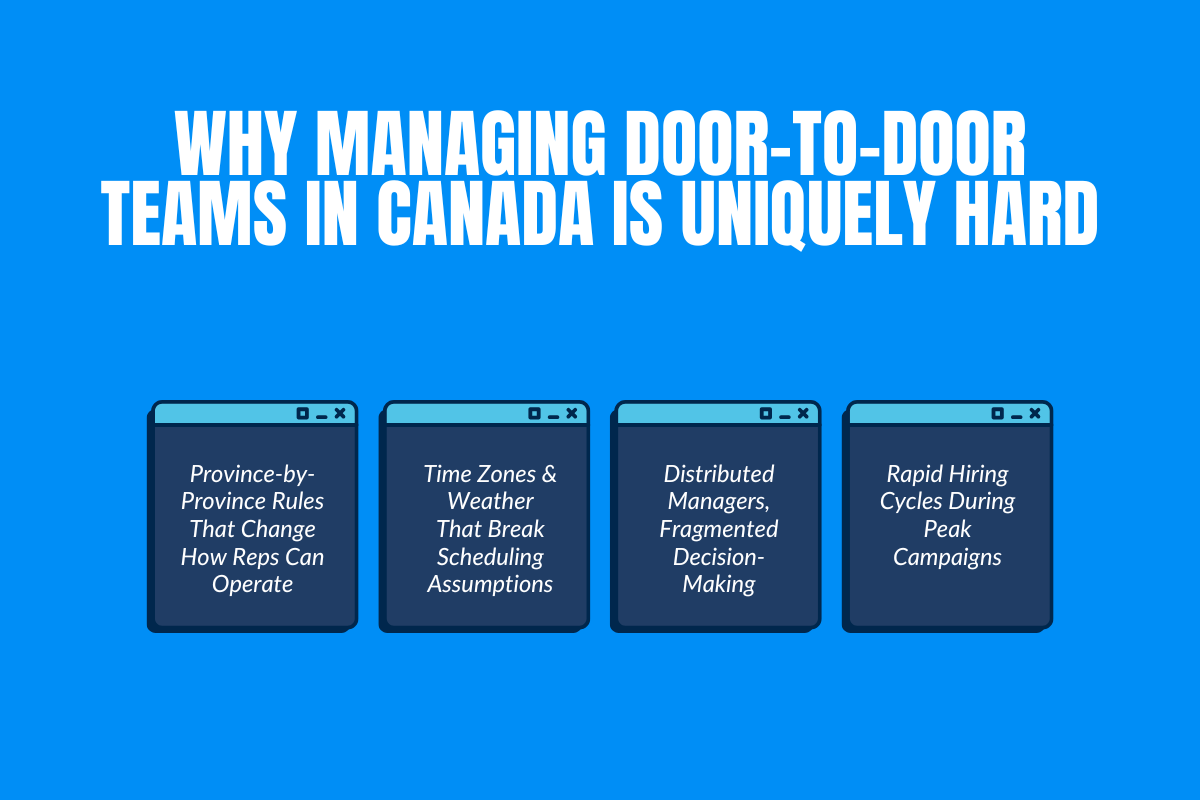
Canada is not one D2D market. It is several markets stitched together under one flag, and a lot of companies learn this the hard way. They take what worked in one city and assume it will translate everywhere. But once you expand beyond one region, you start dealing with different consumer protection laws, customer expectations, and enforcement styles.
The biggest surprise for many leaders is this: scale does not just add workload, it exposes weak systems. If your process depends on a good manager remembering everything, you do not have a process. You have a person holding the entire business together. And once you expand into multiple provinces, that person cannot hold it all anymore.
1. Province-by-Province Rules That Change How Reps Can Operate
The biggest issue with door sales in Canada is compliance, not because most companies are trying to break the law, but because they underestimate how fast consumer protection requirements change.
In many provinces, the Consumer Protection Act and similar consumer protection regulations directly impact how you sell door-to-door.
That includes rules around:
- What must be disclosed upfront
- Whether certain products are considered a restricted product
- How a contract must be presented
- Whether a cooling-off period applies
- What cancellation form needs to be provided
- What makes an agreement considered void
Let's keep it like this:
Your rep in Ontario sells a home service contract for water heaters and leaves without properly providing the cancellation form. The customer later calls the phone number for the paperwork, gets frustrated, and contacts a local consumer protection office.
Even if the deal were legitimate, the compliance gap would still pose a serious risk. And when you are running direct sales at scale, those small mistakes are not rare; they become frequent. Compliance risk grows with scale because every rep becomes a walking legal liability if the process is inconsistent.
2. Time Zones & Weather That Break Scheduling Assumptions
This is the part that sounds small until you live it. Canada’s time zones make coordination harder than most leaders expect. When your HQ is starting the day, your team in British Columbia is still waking up. When Calgary is in the middle of a shift, Toronto is already heading toward evening follow-up calls.
Then there is the weather.
Door-to-door selling depends heavily on good conditions. Snow, wind, rain, and early sunsets can destroy productivity. Even if your salespeople are motivated, you cannot knock effectively when sidewalks are icy, and homeowners refuse to open the door.
Seasonal canvassing windows also vary. Some regions get a longer selling season, while others have short bursts of opportunity. If you run on scheduling assumptions that treat it as the same everywhere, you will burn out teams and miss your target audience.
3. Distributed Managers, Fragmented Decision-Making
When you have one city to manage, you can usually run operations through one leader. One manager can oversee the team, guide sales conversations, and ensure that everyone follows the same standards.
But when you have multiple provinces, you start building layers. Regional leads, team supervisors, field trainers, and performance managers. While this structure supports growth, it also creates a new challenge—each region starts developing its own way of working. One manager is strict, another is relaxed. One pushes closing techniques aggressively, and another focuses on rapport and open-ended questions.
The result is fragmented decision-making. HQ loses visibility, and the brand experience becomes inconsistent. That inconsistency does not just impact sales; it impacts consumer trust.
4. Rapid Hiring Cycles During Peak Campaigns
If you have ever onboarded 20 to 50 door-to-door salespeople in a short window, you know the chaos. It is not just training them on the product's features. It is making sure they understand:
- How to approach a person at the door
- How to handle objections
- How to properly present the total price
- How to explain consumer rights and cancellation policies
- How to avoid misleading information
- How to document the contract properly
Rapid hiring can disrupt your delivery model because the team suddenly becomes full of new sales representatives who do not know the system. And if the system is unclear, they will invent one.
Where Coordination Breaks as Teams Grow?
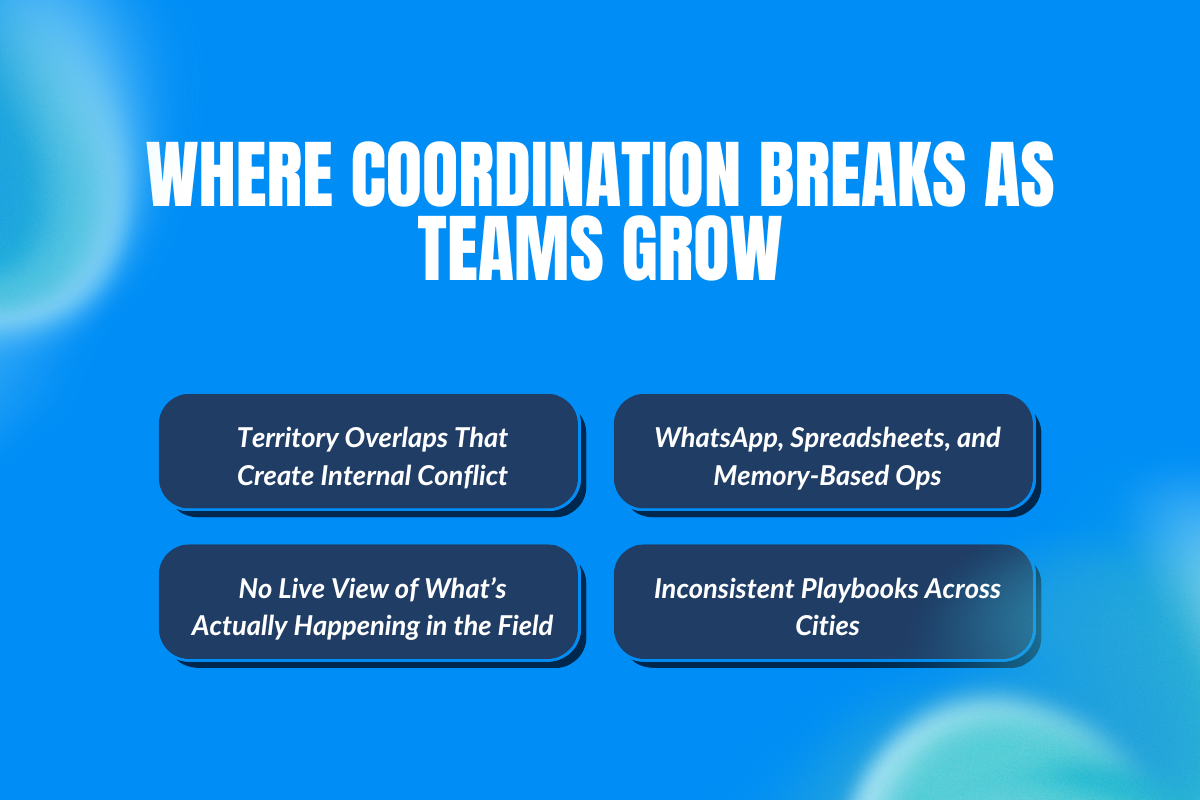
Most D2D businesses collapse because coordination breaks down under growth. When you are small, you can survive on hustle. When you scale, hustle becomes expensive.
Here are the biggest cracks that show up:
1. Territory Overlaps That Create Internal Conflict
Territory overlap is one of the fastest ways to create internal resentment. Nothing destroys morale faster than two salespeople knocking on the same block.
One rep thinks they “own” it. Another rep thinks they were assigned. The homeowner gets annoyed, and ultimately, both reps lose the deal.
It also causes missed opportunities.
While two reps fight over one neighborhood, another high-converting zone gets ignored. If your mapping system is static or manual, overlap becomes inevitable. And yes, you can “fix it with communication,” but when you have 100 reps, communication is not a system.
2. WhatsApp, Spreadsheets, and Memory-Based Ops
Territories might be tracked in spreadsheets, daily updates shared over WhatsApp, and announcements sent through group chats. Soon, communication spreads across multiple channels—one chat for managers, another for Calgary, another for Toronto.
Suddenly, nobody knows what is real. One rep says they sold door-to-door and closed two deals. Another rep says the customer wants to cancel. Someone else says the property was already visited last week.
There is no single source of truth. And once your operation runs on chat messages, updates get buried. Managers spend hours searching for information instead of coaching.
3. No Live View of What’s Actually Happening in the Field
In a scaled operation, the biggest problem is delay. When you don't have a live view of field activity, you are always reacting late.
- How do you know if a rep is struggling? Usually, only after two bad weeks of numbers.
- When do you find out that local police are enforcing a new rule? Often, only after a complaint comes in.
- At what point do you realize a territory is underperforming? Typically, after the campaign has already ended.
That delay costs money. Door-to-door sales management Canada-wide requires real-time visibility, not after-the-fact reporting.
4. Inconsistent Playbooks Across Cities
If you have teams in multiple provinces, you probably already know this problem.
- In Calgary, the team tends to be aggressive and focused on high-volume knocking.
- Meanwhile, in Toronto, the team usually takes a more formal and structured approach.
- Across Vancouver, reps are often more cautious because customers tend to be skeptical.
That sounds normal, but if each city is improvising, your company stops being one company. Your brand becomes “whatever the rep felt like saying.” That is dangerous when you sell home repair services, telecom services, natural gas upgrades, solar panels, cooling equipment, air conditioners, or home heating systems. When people are buying home repair services at the door, they need clarity and trust, not improvisation.
What “Centralized Control” Should Actually Mean in Modern D2D Ops?
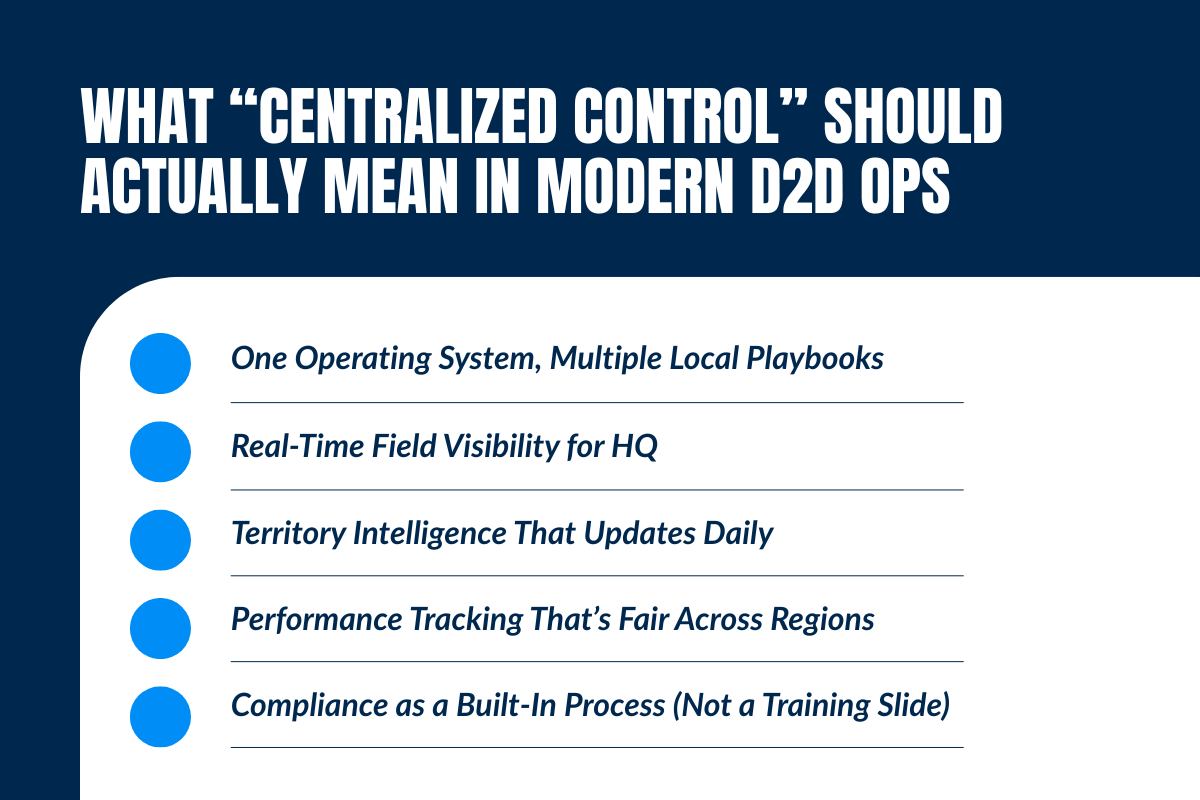
Many leaders hear “centralized control” and picture micromanagement. That is not what modern centralized control should mean. Real control means building a structure that supports fast execution.
It means your reps can sell, your managers can coach, and your HQ can see what is happening without making 40 phone calls.
What is D2D software, and how does it help?
Door-to-door software is a platform that helps teams manage territories, track activity, log customer interactions, and monitor performance, enabling field teams to operate efficiently without relying on spreadsheets or scattered communication.
I. One Operating System, Multiple Local Playbooks
Canada is a diverse market, and sales strategies often need to adapt to local culture and customer behavior. A strong D2D operation does not force every region to use the exact same script. Instead, it relies on a unified operating system while allowing local teams to adjust their approach.
That means your core workflows are standardized:
- Lead capture
- Territory assignment
- Rep check-ins
- Contract documentation
- Follow-up processes
At the same time, regional teams can tailor their messaging and conversation style to match the expectations and concerns of customers in their specific cities.
II. Real-Time Field Visibility for HQ
Headquarters should be able to understand field activity without constantly interrupting sales teams. Modern D2D systems provide real-time visibility into key operational metrics such as:
- Who is active right now
- Which areas are being covered
- How many knocks per hour are happening
- How many contacts are being made
- Which reps are falling behind
This visibility is not about monitoring individuals excessively. Instead, it allows leadership to manage the overall operation more effectively and respond quickly when adjustments are needed. When data is available in real time, managers can make informed decisions instead of relying on guesswork.
II. Territory Intelligence That Updates Daily
Territories should not be “set once and forget.” Good territory systems evolve daily based on performance. If one area produces more deals, it should get more attention. If another area is full of cancellations, it should be reviewed. Territory intelligence also prevents wasted time because wasted walking time is wasted money.
III. Performance Tracking That’s Fair Across Regions
One of the biggest mistakes in door-to-door sales is making unfair comparisons between reps. A rep in Toronto might face more skepticism. A rep in Calgary might get easier access to homeowners. A rep in British Columbia might lose hours to rain.
If you compare raw numbers without context, you create frustration. Modern performance tracking should normalize for territory conditions and campaign type to ensure fair comparisons.
IV. Compliance as a Built-In Process (Not a Training Slide)
Most teams treat consumer protection like a one-time training topic that does not work. If your reps can accidentally skip a cancellation form or fail to mention the cooling-off period, then your compliance system is broken.
Compliance should be built into the workflow so reps cannot complete a sale without the required steps. That protects your business, your customers, and your reputation.
The New D2D Management Stack: Canadian Teams Are Moving Toward
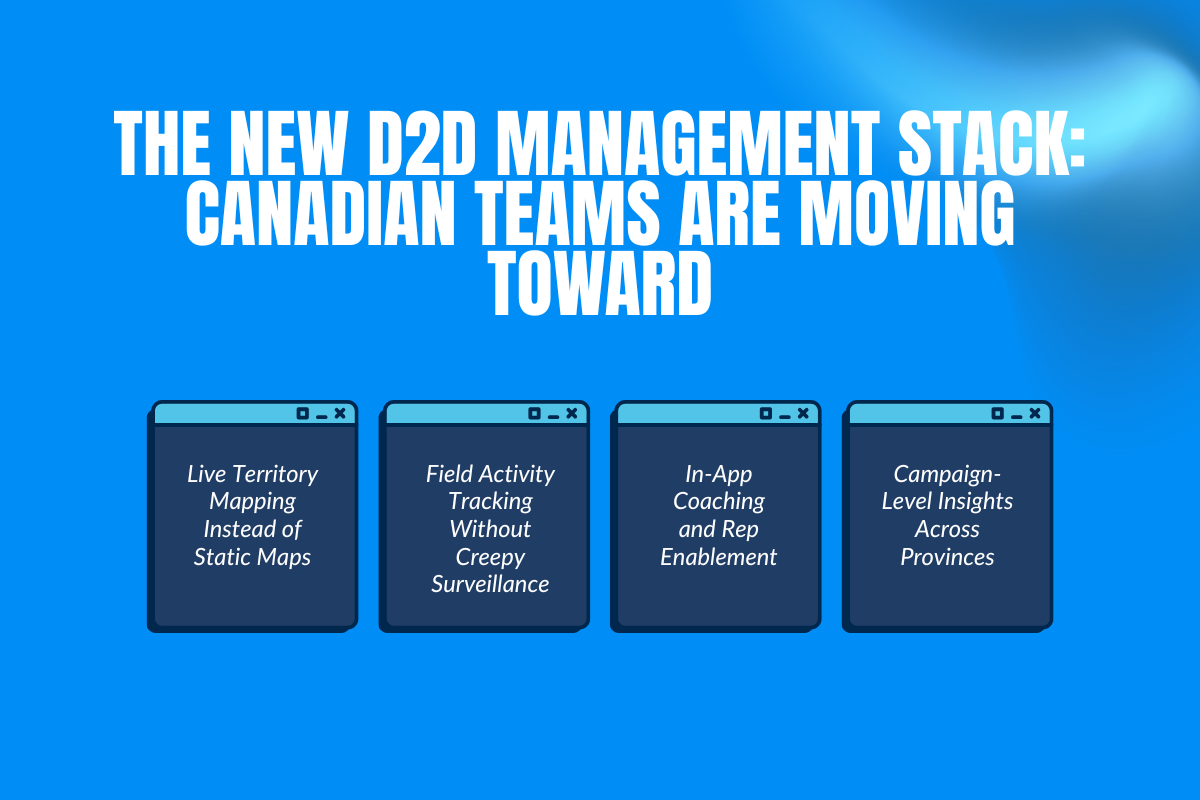
As teams scale, tools shape behavior. If your system is spreadsheets and WhatsApp, your culture becomes reactive. If your system is structured, your culture becomes professional.
Canadian direct selling teams are increasingly moving toward modern management stacks that combine mapping, reporting, coaching, and analytics.
1. Live Territory Mapping Instead of Static Maps
Static territory maps often lead to static results. Once areas are assigned, they rarely change even if performance shifts. Live mapping tools allow territories to evolve based on real activity and outcomes.
Managers can identify high-performing neighborhoods, redirect teams toward areas with stronger potential, and prevent overlap between reps. For sales teams in the field, this clarity removes guesswork.
2. Field Activity Tracking Without Creepy Surveillance
Accountability is essential in door-to-door sales, but nobody wants to feel like they are being monitored every second. Modern D2D platforms aim to balance visibility with trust.
The best systems track field activity in a way that builds trust:
- Progress updates throughout the day
- Route completion within assigned territories
- Knock counts
- Contact rates
- Conversion tracking
The goal is to support them. When reps know their effort is visible, motivation improves. When managers can see problems early, coaching becomes easier.
3. In-App Coaching and Rep Enablement
Coaching works best when it happens fast. Not two weeks later, during a review meeting. Modern systems allow managers to provide micro-feedback based on real results.
For example, if a rep’s contact rate is high but the close rate is low, the issue is probably in the closing techniques. If the close rate is high but the contact rate is low, the rep may need to improve their door approach.
These insights make coaching more specific and practical, helping reps improve without relying on vague advice.
4. Campaign-Level Insights Across Provinces
When you run multiple campaigns, you need to know what is working. Maybe solar panels perform best in one region. Maybe telecom services are closer in another way. Maybe home service contracts get more cancellations in a specific city. Campaign-level insights help you adjust strategy quickly. It is how you build a competitive edge without burning money.
How High-Performing Canadian D2D Teams Run Their Week?
Even the best systems fail if they do not translate into consistent habits. High-performing door-to-door sales teams in Canada rely on structured weekly routines that keep managers, reps, and regional leaders aligned.
Here is what high-performing teams typically do:
Monday Territory Alignment
Monday is about starting the week with clarity. Top teams begin by reviewing the previous week’s performance data and identifying where the best opportunities exist.
Managers review last week’s data:
- Where did we get more deals?
- Where did we see high cancellation rates?
- Which zones produced new customers?
- Which zones had complaints about poor-quality work or high pushback?
Based on these insights, territories are adjusted. The goal is straightforward: place reps in areas where they are most likely to succeed while avoiding zones that are showing declining performance.
Midweek Performance Checkpoints
By Wednesday, you should already know if the week is going off track. Midweek checkpoints help managers spot stalls early. This is where performance tracking matters. If a rep is behind, you do not wait until Friday; you intervene immediately.
Sometimes the fix is simple:
- Better time management
- A different pitch angle
- Stronger objection handling
- More open-ended questions
- A better understanding of the product solves the message
Rep-Level Coaching From Live Data
The most effective coaching conversations are grounded in actual performance data. A productive coaching conversation might sound like this:
“Hey, I noticed your knock volume is strong, but your conversion rate is low. What objections are you hearing at the door?"
This approach invites discussion and helps reps improve their skills without feeling criticized. Compare that with the less helpful version many reps hear:
"Your numbers are bad. Try harder."
Data-driven coaching builds trust and helps reps understand exactly where they can improve.
Regional Leader Syncs Without Spreadsheet Chaos
Regional leaders need alignment, but meetings should not be a reporting marathon. High-performing teams run short syncs where everyone looks at the same dashboard.
That means:
- Toronto knows what Calgary is doing
- Calgary can compare messaging performance
- British Columbia can highlight what customers are saying
When regional leaders share insights regularly, successful tactics spread quickly across the entire organization.
End-of-Week Territory Optimization
Friday or Saturday becomes the time to review results and prepare for the following week. High-performing teams analyze what worked and what needs adjustment before the next territory cycle begins.
Managers typically review:
- Territories that underperformed
- Reps who struggled during the week
- Offers that generated strong objections
- Deals that appear at risk of cancellation
Based on these insights, teams reallocate territories and refine their messaging. Follow-up also becomes critical at this stage. Many door-to-door deals are not lost during the initial conversation—they are lost because nobody followed up properly afterward. If you want more customers, you need a system that automates and standardizes follow-up.
How Does Knockbase Canvassing Software Help Growing D2D Teams Maintain Centralized Control?
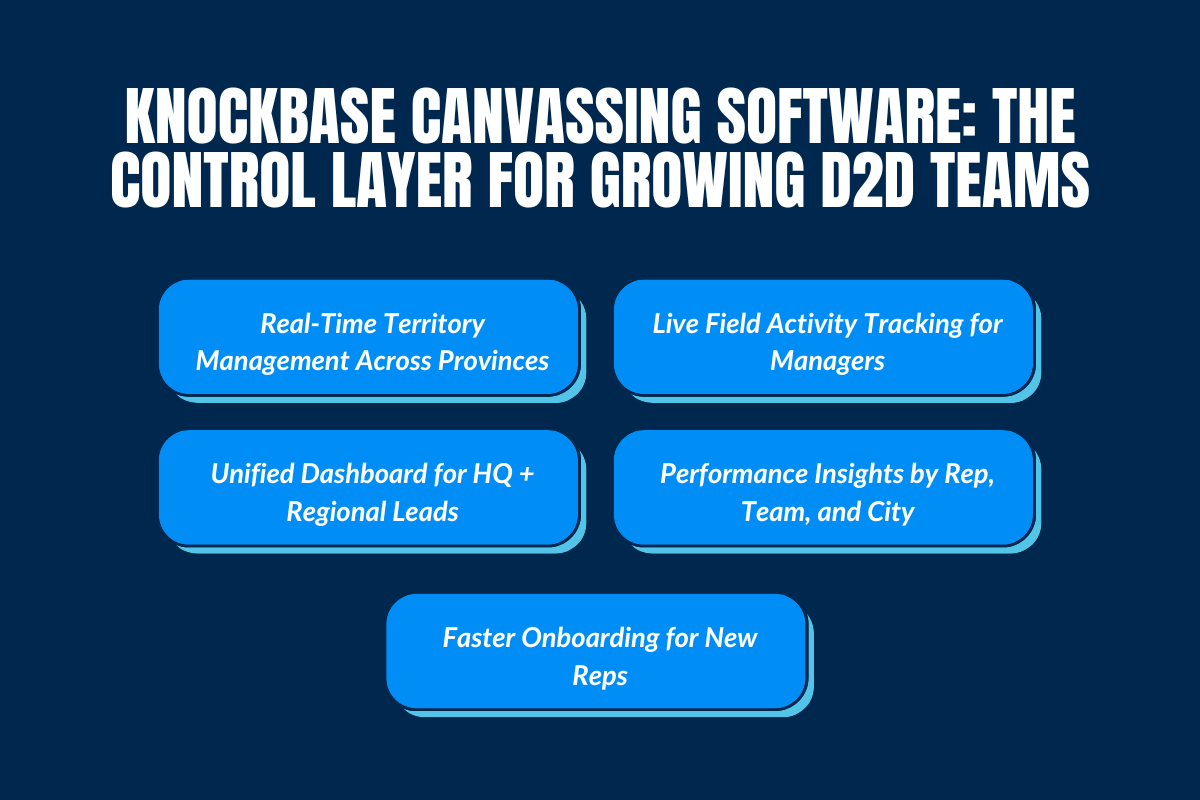
At some point, spreadsheets stop working. Group chats stop working. Manual tracking stops working. This is where software becomes the control layer.
Knockbase is designed for teams that want centralized control while still letting salespeople move fast in the field.
1. Real-Time Territory Management Across Provinces
Knockbase helps prevent territory overlap by giving managers the ability to assign and update territories in real time. Sales reps can clearly see where they should be knocking, which reduces confusion and prevents multiple reps from working the same area.
2. Live Field Activity Tracking for Managers
Managers should not have to call every rep throughout the day just to understand what is happening in the field. Knockbase provides live activity tracking so leaders can see progress as it unfolds. This allows managers to understand how teams are performing without constantly interrupting their work.
3. Unified Dashboard for HQ + Regional Leads
One of the biggest challenges in multi-region D2D operations is maintaining a consistent view of performance. When each region operates with its own spreadsheets and reporting methods, leadership often spends valuable time reconciling conflicting information. Knockbase addresses this by providing a unified dashboard where headquarters and regional managers can view the same data in real time.
4. Performance Insights by Rep, Team, and City
Scaling a door-to-door sales operation requires a clear understanding of where results are coming from. Knockbase allows leaders to analyze performance across different levels of the organization, from individual reps to entire cities.
With this level of visibility, managers can identify high-performing sales reps who are ready for leadership roles, recognize underperforming reps who need coaching, and evaluate which territories are consistently generating new customers.
5. Faster Onboarding for New Reps
Onboarding is one of the most expensive parts of growth. If new reps take too long to ramp up, you lose money fast. Knockbase supports standardized onboarding workflows so new sales representatives can get productive quickly.
Final Take: Centralized Control Is How D2D Teams Scale Without Burning Out
Managing door-to-door sales across Canada is not about hiring more managers or holding more meetings. It is about building a single operating system that keeps your team aligned while still letting them execute locally. Because when you scale, confusion becomes the real enemy.
If reps do not know where to knock, what to say, or how to document deals properly, you will lose sales and increase legal risk. And if managers lack visibility, they will always react too late.
Centralized control fixes that by providing clarity for everyone. Reps get freedom to sell, leaders get visibility to steer, and your business gets the structure to scale.
That is what scalable door-to-door sales management in Canada really looks like, and Knockbase is built to make it possible.
Ready to Scale Door-to-Door Sales Across Canada Without Losing Control?
Managing door-to-door sales across Canada does not have to feel chaotic. With the right system like Knockbase, you can keep territories organized, track rep performance in real time, and stay compliant across provinces without slowing your teams down.
If you are ready to scale with clarity and control, Knockbase is built to help you do it. Book your Quick Demo today and strengthen your door-knocking game.
FAQs
1. What is the biggest operational mistake growing D2D companies make?
Most teams rely on WhatsApp, spreadsheets, and memory-based updates. This creates confusion, territory overlap, inconsistent reporting, and delayed coaching. Without one system, growth turns into chaos.
2. How do you manage door-to-door sales teams in British Columbia without losing productivity?
British Columbia teams often deal with rain, stricter enforcement, and more skeptical homeowners. The key is using live territory management, consistent compliance workflows, and real-time reporting to enable managers to adjust routes and messaging quickly.
3. What tools should a modern door-to-door sales team use to scale across provinces?
A strong D2D stack should include live territory mapping, real-time rep activity tracking, standardized sales documentation, performance dashboards, compliance checklists, and campaign-level insights. Platforms like Knockbase combine these into one system for scalable growth.
4. How can companies reduce cancellations in door-to-door sales?
Clear contract explanations, transparent pricing, proper documentation, and structured follow-up processes significantly reduce cancellation rates

Canvassing Software ROI: How Sales Managers Should Calculate Cost-Per-Knock vs Cost-Per-Lead in 2026