Door-to-door sales continue to be a powerful channel across Europe. In industries like solar, telecom, broadband, home improvement, and local services, face-to-face conversations close deals in ways digital ads rarely match. The challenge isn’t the canvassing model itself; it’s how many teams still manage it.
Across the EU, field reps often rely on notebooks, scattered spreadsheets, WhatsApp messages, or memory to track conversations, territories, and follow-ups.
That might work for a small team, but once operations start scaling, visibility drops, leads get lost, and managers struggle to understand what’s actually happening in the field.
Modern canvassing apps are designed to solve exactly this problem by giving sales teams structured territory tracking, real-time visibility, and organized lead management.
Guide for Canvassing App EU That Suits Well With Your Sales Process
Many EU sales teams still manage canvassing activities through a mix of spreadsheets, messaging apps, and manual notes. At first glance, this setup seems manageable, but as teams grow and territories expand, it becomes harder to track conversations, follow up on leads, and maintain clear oversight of field activity.
For organizations operating in the EU, the challenge goes beyond productivity. Sales teams must also ensure that customer data is handled carefully and stored in ways that align with GDPR requirements.
Therefore, in this guide, we'll explore why manual canvassing systems struggle to support modern field sales teams and what to consider when choosing a canvassing app that fits your sales process.
Key Takeaways
- Manual tracking leads to missed follow-ups and silent revenue loss.
- EU teams face real GDPR risk when customer data lives in notebooks or unsecured files.
- A structured canvassing app centralizes leads and automates daily workflows.
- Digital systems improve accountability, route planning, and performance metrics.
- The shift from manual to digital contracts can happen in phases without stopping live political campaigns.
Your reps are knocking on doors every day
Make sure those conversations don’t get lost in spreadsheets. Knockbase brings structure, visibility, and real coordination to modern canvassing teams. Take a quick look at how Knockbase works in the field.
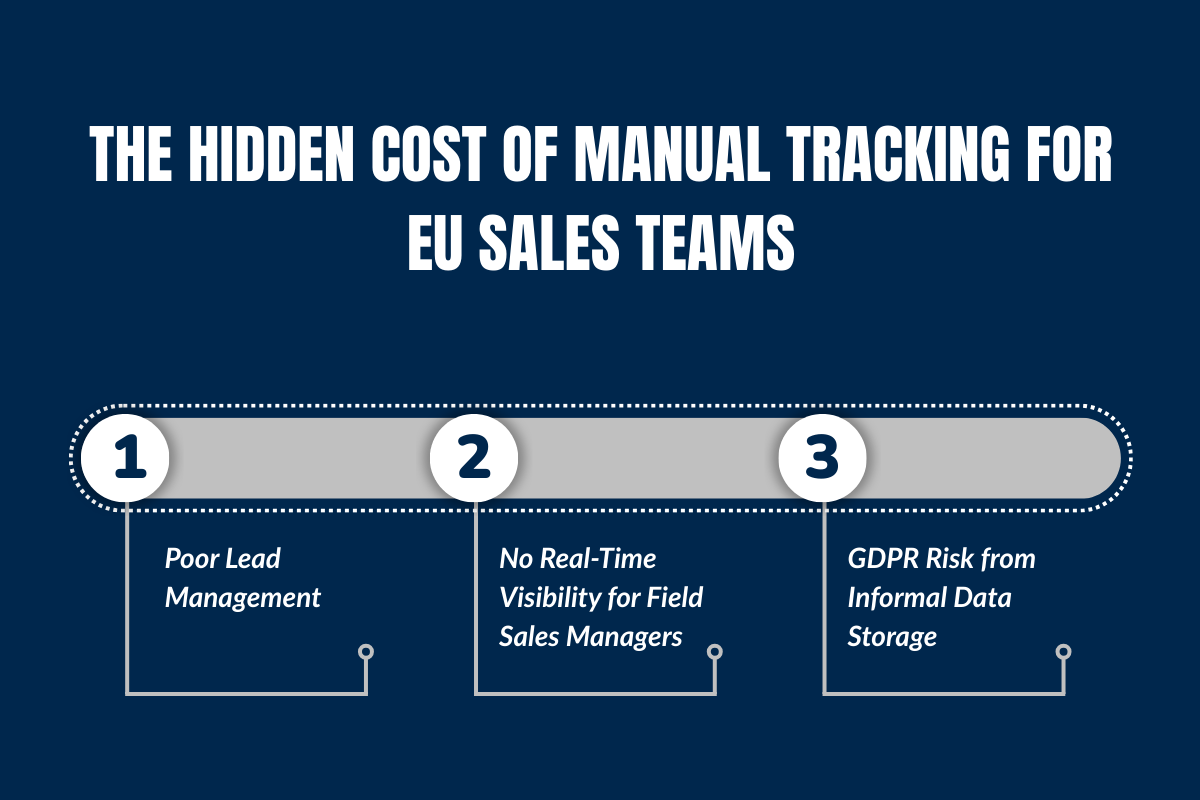
The Hidden Cost of Manual Tracking for EU Sales Teams
Many founders underestimate the financial and operational damage caused by manual tracking systems because the inefficiencies are often hidden inside daily routines.
The cost does not appear as a direct expense line item, but it shows up in lower close rates, inconsistent follow-ups, inaccurate forecasting, and management frustration.
1. Poor Lead Management
In many EU field sales operations, lead data sits in too many places. Sales representatives often capture conversations in personal notebooks, while Excel files may exist on a single office computer.
Follow-up reminders are sometimes sent through WhatsApp messages, while Google Sheets are updated inconsistently by different team members. In other cases, customer notes remain stored on individual phones without being shared across the team. There is no single source of truth, and managers cannot see the real pipeline clearly.
The result:
- Follow-ups get missed.
- Two reps knock on the same door or on the same sales routes.
- Customer details are incomplete.
- Nobody feels fully responsible for the next action.
Mini Case:
A twelve-person solar canvassing team in Southern Europe relied on spreadsheets and messaging apps to coordinate follow-ups after door-to-door visits. During an internal review, the company discovered that 80% of sales require an average of five follow-ups in order to close the deal.
Those prospects had expressed genuine interest, but their contact details were stored across multiple spreadsheets and private messages. Some reminders were missed, others were never recorded properly, and several leads simply disappeared between systems.
That 18 percent represented potential revenue that could never be recovered. This shows that manual tracking may feel manageable at first, but as teams grow, disconnected systems make it increasingly difficult to maintain a reliable pipeline.
2. No Real-Time Visibility for Field Sales Managers
Effective field sales management relies on timely, accurate data. Managers need clear visibility into daily activity in order to coach representatives, adjust territory strategies, and identify potential issues before they affect revenue.
With manual data entry, sales managers struggle to answer basic questions such as:
- How many doors were knocked on today?
- What is today’s direct sales rate?
- Which sales rep needs coaching and training modules this week?
- Which neighborhoods are already covered?
- How many leads sit in follow up stage?
When sales data is difficult to track, accountability begins to weaken. Teams operate with less clarity, coaching opportunities are missed, and overall performance becomes harder to improve.
3. GDPR Risk from Informal Data Storage
Within the European Union, manual lead tracking also introduces significant legal and compliance concerns. The General Data Protection Regulation (GDPR) requires companies to manage personal information responsibly and maintain clear records of how customer data is collected, stored, and processed.
Organizations handling personal data must ensure that information is stored securely, access is properly controlled, consent is recorded where required, and individuals have the ability to request deletion of their data.
Manual systems often involve:
- Writing phone numbers in paper notebooks.
- Emailing spreadsheets without protection.
- Storing data on personal devices.
- Missing documented consent.
- Lacking structured deletion workflows.
This means the client details or job details are either lost in notes or you completely forgot to note them down. For EU teams, digital transformation supports responsible data handling.
What a Digital-First Canvassing App Actually Solves?
A: Unified Lead Capture in the Field
Sales reps log customer information directly inside a mobile canvassing app while they are still at the door. The data is saved instantly in the system, so teams no longer need to transfer notes later or risk losing important details.
Benefits include:
- Structured fields that standardize data management.
- Geo-tagging to confirm territory coverage.
- Cloud-based CRM synchronization.
- Removal of double data entry.
With a unified system in place, teams can operate with far more confidence. Everyone works from the same information, and managers always have a clear view of what is happening in the field.
B: Automated Follow-Up Workflows
Manual follow-ups often depend on individual habits or memory. Some reps follow up consistently, while others forget or delay outreach, which causes promising leads to go cold.
A canvassing app introduces structure by automating the follow-up process and keeping every lead organized.
A canvassing app introduces structure:
- Task reminders and team messaging through user friendly interface.
- Automated emails with real-time tracking.
- SMS appointment reminders.
- Pipeline management's updates that move leads forward.
When follow-ups are structured and automated, consistency improves across the entire team. Every lead receives timely communication, which increases the chances of turning interest into a booked appointment or closed deal.
C: GDPR-Compliant Data Handling
For companies operating in the EU, data protection rules cannot be ignored. A modern campaign management platform ensures that every interaction and data record follows proper compliance standards.
Core capabilities often include:
- Encrypted cloud storage.
- Role-based access controls.
- Consent capture fields.
- Audit logs for data edits.
- Structured deletion workflows.
- EU-based hosting options.
When compliance is built directly into the platform, teams do not need to treat it as an extra task. It becomes a normal part of the workflow that protects both the company and the customer.
D: Performance Analytics for Field Teams
Digital canvassing systems provide managers with a clear view of how teams are performing in the field. Instead of relying on assumptions or rough estimates, performance data becomes visible in real time.
A sales enablement platform helps you track:
- Doors knocked per rep.
- Conversations logged.
- Appointments booked.
- Follow-up completion rates.
- Close rates by territory.
- Revenue per campaign.
With live dashboards in place, coaching shifts from guesswork to data-driven decisions. Managers can spot problems early, adjust strategy quickly, and help reps improve performance faster.
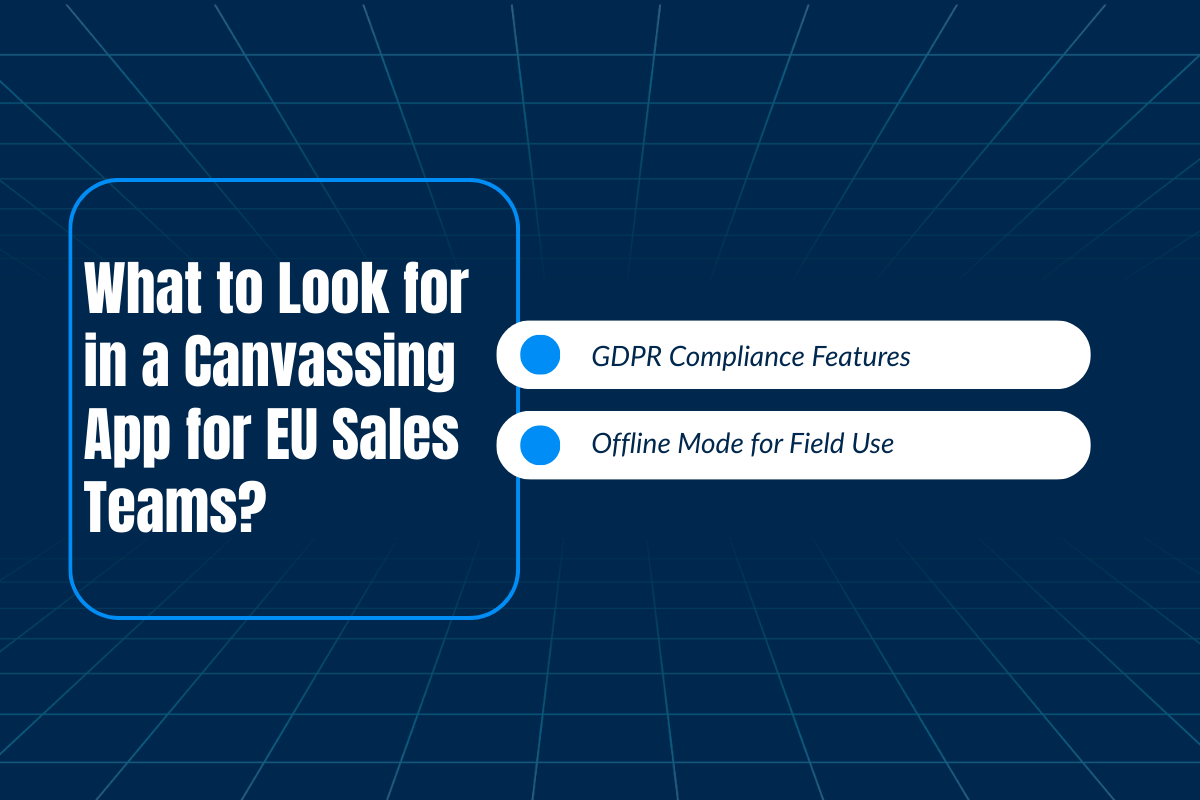
What to Look for in a Canvassing App for EU Sales Teams?
Feature 1: GDPR Compliance Features
For EU-based teams, GDPR compliance cannot be treated as an add-on or an afterthought. The platform you choose should include built-in consent tracking, strong data encryption standards, EU-based data hosting options, detailed audit logs, role-based permissions that control who can access specific information, and clearly defined data retention controls that allow structured deletion when required.
Feature 2: Offline Mode for Field Use
Across many European regions, especially rural areas or dense urban zones with unstable signals, connectivity gaps are the main issue.
A reliable canvassing app must support full offline data entry, secure local temporary storage on the device, have smart route planning, and automatic syncing once the internet connection is restored without any loss of information.
Feature 3: Territory & Mapping Tools
Territory control directly impacts revenue protection because, without structured mapping and visibility, teams risk duplicate visits, missed streets, and unevenly assigned work.
Feature 4: CRM & Automation Integration
No canvassing app should operate with disconnected tools, which is why the platform must integrate smoothly with existing CRM systems, email marketing tools, SMS automation providers, and sales reporting platforms.
Manual Tracking vs Canvassing App EU (Side-by-Side Comparison)
| Key Feature | Manual Tracking | Canvassing App EU |
|---|---|---|
| Lead Storage | Notebooks, Excel files | Secure cloud CRM |
| Real Time Sync | No | Yes |
| GDPR Compliance | High risk | Built-in controls |
| Follow-Up Reminders | Inconsistent | Automated workflows |
| Performance Tracking | Delayed reports | Live dashboards |
| Data Visibility | Fragmented | Unified |
| Audit Trail | None | Full tracking |
| Territory Control | Informal | Structured mapping |
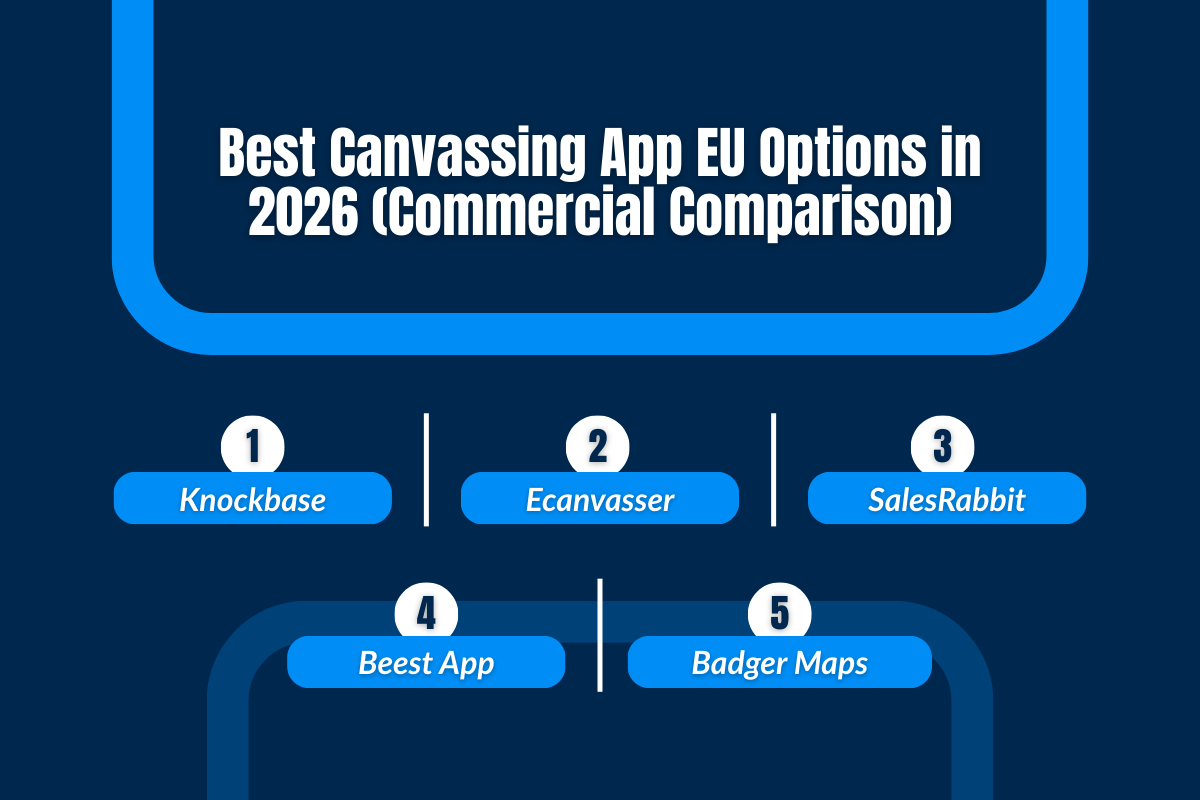
Best Canvassing App EU Options in 2026 (Commercial Comparison)
1. Knockbase
Knockbase is a mobile-first field sales tracking platform built to streamline operations with a structured digital workflow that centralizes lead data and activity in one place.
Team Fit:
Best suited for small to mid-sized organizations seeking clearer visibility of sales activities and a controlled shift from manual systems to structured digital tracking.
Essential Features:
- Centralized lead database– Every interaction at the door is stored in one cloud system, so teams no longer rely on scattered notes or spreadsheets. Managers can instantly review conversations, track lead status, and see the full sales pipeline in one place.
- Mobile lead capture– Sales reps record customer details, conversation notes, and next steps directly from their phone while still in the field. This keeps information fresh and eliminates the need to re-enter notes later.
- Offline mode– Field reps can continue logging leads even when working in areas with weak or no internet connectivity. Once the device reconnects, all information syncs automatically without interrupting their workflow.
- Structured data fields– The platform organizes information using predefined fields such as contact details, lead stage, and appointment dates. This keeps records consistent across the team and makes reporting far easier to analyze.
- Activity analytics– Managers get visibility into daily field activity, including doors knocked, leads captured, and appointments booked. These insights make it easier to spot performance trends and support reps with targeted coaching.
- CRM integrations– Knockbase connects with other sales systems, so customer data flows smoothly between platforms. Teams can maintain a single source of truth without juggling multiple tools.
Pricing:
Knockbase does not publicly list pricing on its website. Interested teams must contact the company directly to receive a custom quote based on team size and required features.
2. Ecanvasser
Ecanvasser is a canvassing CRM designed for teams that manage structured field campaigns. It is widely used in regulated environments where territory control, compliance, and large contact databases are important.
Team Fit:
Well-suited for campaign-driven teams operating in regulated EU markets where compliance, territory control, and CRM integration play a central role.
Key Features:
- Advanced territory mapping– Managers can visually divide cities into clear territories and assign them to specific reps. This keeps teams organized and ensures no neighborhood gets overlooked or duplicated.
- Route planning– Lead lists automatically turn into optimized routes for walking or driving. Reps spend less time navigating between streets and more time having meaningful conversations.
- Lead database management– The platform stores large contact lists and organizes them by campaign, lead status, or interaction history. Teams can easily filter prospects and prioritize the most promising opportunities.
- Real-time rep tracking– Managers can see where canvassers are working during the day and how territories are being covered. This visibility helps teams adjust plans quickly and support reps when needed.
- Offline canvassing mode– Reps can continue logging interactions even without internet access. All activity is stored locally and automatically synced to the system once connectivity returns.
- Workflow automation– Follow-ups, campaign actions, and reminders can run automatically in the background. This keeps leads moving through the pipeline without relying on manual tracking.
- Analytics dashboards– Campaign dashboards show door activity, conversations, and conversion patterns across territories. Managers can quickly identify what strategies are working and where improvements are needed.
Pricing:
- Starter: €99/month (up to 2,500 contacts)
- Standard: €199/month (up to 20,000 contacts)
- Pro: €599/month (up to 100,000 contacts + real-time tracking
3. SalesRabbit
SalesRabbit is one of the most widely used door-to-door sales platforms. It focuses on fast adoption, strong mobile usability, and practical tools that help teams manage territories and track leads efficiently.
Team Fit:
Ideal for fast-moving sales teams that want quick adoption, strong mobile usability, straightforward lead tracking, and help streamline workflows.
Key Features:
- Lead tracking on a map– Leads and prospects appear directly on a digital map so reps can see where opportunities are located. This helps teams plan visits strategically instead of knocking randomly.
- Territory management– Managers can assign neighborhoods or geographic zones to specific reps. This keeps teams organized and ensures everyone focuses on their designated area.
- Route planning– The platform generates efficient routes between prospects and customers. Reps can move through neighborhoods smoothly while covering more doors in a single day.
- Rep GPS tracking– Managers can view rep activity and location during the workday. This visibility helps confirm coverage and provides better support for field teams.
- Automation tools– Follow-up reminders and lead status updates are automated inside the platform. This keeps opportunities moving forward without relying on manual tracking.
- Sales materials library– Reps can access brochures, presentations, and product information directly inside the app. This helps them share accurate information with prospects during conversations.
- Analytics dashboards– Managers can monitor performance metrics such as appointments booked, close rates, and rep productivity. These insights make it easier to coach teams and improve results.
Pricing:
- Lite: Free for a single user
- Team Plan: $59/user/month (if paid monthly)
- Pro Plan: $75/user/month (billed monthly).
4. Beest App
Beest App is a lightweight field sales platform designed to simplify appointment booking and lead tracking for small teams. It focuses on ease of use rather than complex CRM functionality.
Team Fit:
Best for smaller teams with straightforward workflows that require basic structure without advanced CRM layers.
Key Features:
- Digital contracts and e-signatures– Reps can generate agreements and capture signatures directly from their mobile device. This allows deals to be closed immediately without paperwork delays.
- Appointment scheduling– Schedule meetings or follow-up visits instantly during conversations. This keeps momentum high while the customer is still interested.
- Mobile lead capture– Customer details and conversation notes can be recorded directly from the field. This prevents lost information and ensures accurate records.
- Activity visibility– Managers can see field activity and rep progress in real time. This helps teams stay accountable and organized throughout the day.
- Basic reporting– The platform provides simple reports on appointments, deals, and lead progress. Managers gain basic insights into sales performance without complex analytics.
Pricing
Beest App does not list pricing publicly. You must request a custom quote from the vendor based on team size and features.
5. Badger Maps
Badger Maps is a cloud and mobile-based route planning and territory management application for field sales reps, combining Google Maps, CRM data, route optimization, schedule planning, and lead generation features.
Team Fit:
Strong fit for route-heavy sales models where reducing travel time and maximizing daily visits significantly impacts revenue.
Key Features:
- Advanced route optimization– The platform calculates the most efficient routes for visiting multiple customers in a day. Reps can cover more locations while reducing unnecessary driving time.
- Interactive sales map– Customers and prospects appear visually on a geographic map. This helps reps quickly understand where opportunities are concentrated within their territory.
- CRM integrations– Badger Maps connects with systems like Salesforce and HubSpot. Customer information stays synchronized across platforms without manual updates.
- Lead generation tools– Reps can discover nearby prospects directly from the map interface. This makes it easier to expand coverage while working in high-potential areas.
- Activity tracking– The system records visit history, notes, and follow-up reminders for each location. Managers can review interactions and keep track of ongoing conversations.
- Mileage tracking– Travel distance and driving routes are automatically logged. This simplifies expense reporting and helps teams monitor travel efficiency.
Pricing:
- Business: $58 per user/month billed annually
- Enterprise: $95 per user/month Billed annually
Quick Look: Canvassing App EU Software Comparison
| Feature / App | Knockbase | Ecanvasser | SalesRabbit | Beest App | Badger Maps |
|---|---|---|---|---|---|
| Mobile Lead Capture | ✔ | ✔ | ✔ | ✔ | ✔ |
| Offline Mode | ✔ | ✔ | ✔ | Limited | ✔ |
| Automation | Basic | ✔ | ✔ | Basic | Basic |
| CRM Integration | Moderate | ✔ | ✔ | Limited | ✔ |
| Territory Mapping | Basic | Strong | Moderate | No | Strong |
| Route Optimization | No | ✔ | Moderate | No | ✔ |
| GDPR Support | Moderate | Strong | Config Required | Basic | Limited |
| Best For | Structured tracking | Compliance + territory | Fast teams | Small simple teams | Route heavy teams |
Which Canvassing App EU Fits Your Sales Model?
1. Small Field Teams (3–5 Reps)
You want speed, a simple pipeline, and basic reporting with real-time data.
Better fit:
- Knockbase – Structured and easy to adopt.
- Beest App – Lightweight and straightforward.
2. Growing Teams (5–15 Reps)
You need visibility across reps, territory management, and some automation to standardize work and improve maximum efficiency.
Better fit:
- Ecanvasser – Strong territory tools and CRM alignment.
- SalesRabbit – Automation and scalable lead tracking.
3. Larger Sales Organizations (15+ Reps)
You require analytics, CRM integration, and advanced automation to keep performance predictable and help make informed decisions.
Better fit:
- Ecanvasser – Deep analytics and compliance readiness.
- Badger Maps (paired with a CRM) – Excellent for route optimization and data visibility.
Why Digital-First Selling Is the Competitive Advantage in the EU?
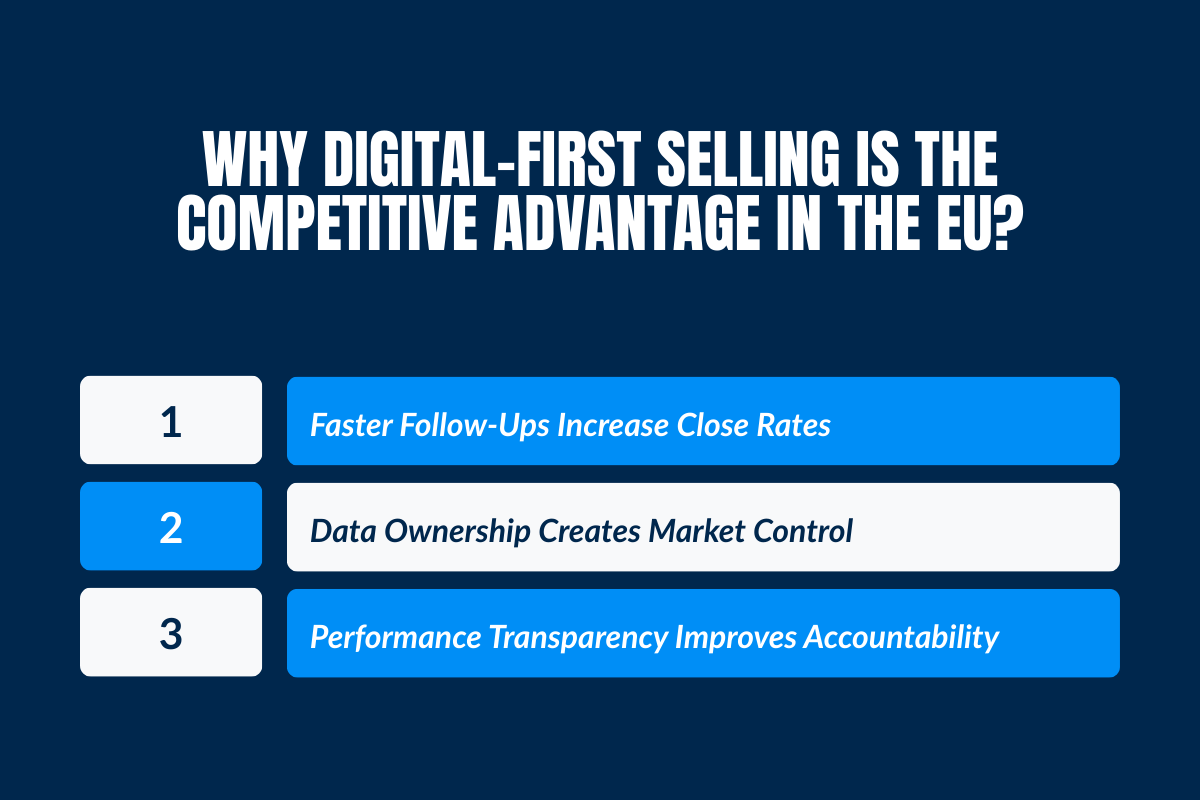
Door-to-door sales teams that still rely on manual tracking often struggle to respond quickly to leads, understand territory performance, and maintain consistent follow-up.
Digital canvassing systems change that dynamic by giving managers and representatives access to structured data and automated workflows.
I. Faster Follow-Ups Increase Close Rates
In field sales, timing often determines whether a lead converts or not. Prospects who show interest during a door conversation may speak with several providers within the same week. The team that follows up first usually has the advantage.
II. Data Ownership Creates Market Control
When sales data is scattered across notebooks, spreadsheets, and messaging apps, managers cannot easily understand which territories perform best. Important insights about customer behavior and neighborhood performance remain hidden.
But a structured tracking reveals which neighborhoods convert best. It prevents overlap and shows potential customers' satisfaction levels.
III. Performance Transparency Improves Accountability
When metrics related to field operations are visible daily, behavior changes. Digital systems also change how managers evaluate performance. Instead of relying on end-of-week reports or informal updates, activity metrics become visible throughout the day.
Mistakes to Avoid While Selecting a Canvassing App
Choosing a canvassing app may seem easy at first. Many teams simply compare features or pricing and make a quick decision. In reality, the wrong choice can create new operational problems, slow adoption, and limit long-term growth.
1. Choosing Based Only on Price
Cost is always an important factor, but selecting a canvassing app only because it is the cheapest option often leads to bigger problems later. Lower-priced tools may lack critical features such as automation, reporting, or compliance support.
When the platform cannot support daily workflows, teams end up using multiple tools again. This recreates the same errors that manual tracking caused in the first place.
2. Ignoring GDPR and Data Security
For EU sales teams, compliance is not optional. Many companies overlook how customer data is stored, who can access it, and how consent is recorded. A canvassing app should include secure data storage, clear consent tracking, and controlled user permissions. Without these protections, organizations risk both regulatory penalties and customer trust issues.
3. Overlooking Offline Capability
Field sales do not always happen in places with reliable internet access. If the app cannot function offline, representatives may struggle to capture leads in real time. This quickly leads to delayed data entry, lost notes, and incomplete records. A reliable canvassing platform must allow offline use and automatically sync data once the connection returns.
How to Transition from Manual Tracking to a Canvassing App (Without Disrupting Sales)?
Step 1: Start with one pilot team
Begin with a small group of representatives who can test the system in real field conditions. Their feedback helps identify workflow adjustments before introducing the platform to the entire sales team.
Step 2: Define required fields (GDPR-safe)
Decide exactly what information must be captured during each door conversation. Include consent tracking and standardized fields so every representative records leads consistently.
Step 3: Train reps on mobile-first workflows
Provide practical training sessions that show how to log conversations, update lead statuses, and schedule follow-ups directly from the mobile app. Hands-on practice ensures representatives feel comfortable using the system during real canvassing activity.
Step 4: Set weekly KPI benchmarks.
Define clear performance metrics such as doors knocked, leads captured, and follow-ups completed. Reviewing these metrics weekly helps managers monitor adoption while reinforcing accountability.
Step 5: Gradually phase out spreadsheets.
Once the new workflow becomes familiar, set a clear timeline to retire spreadsheets and manual notes. This ensures the canvassing platform becomes the single source of truth for lead tracking and sales activity.
Final Take: Manual Tracking Doesn’t Scale in the EU
Door-to-door sales still rely on strong conversations, but the teams that scale successfully treat canvassing as a structured system rather than a collection of individual notes and spreadsheets.
When every interaction, follow-up, and territory is tracked in one place, managers gain the visibility needed to guide performance and improve results over time.
For EU sales teams expanding across multiple territories, adopting a digital canvassing workflow is less about replacing tools and more about building a reliable sales operation.
Platforms like Knockbase help teams bring structure to lead tracking, territory management, and follow-ups so field activity translates into measurable growth.
A modern canvassing app, such as Knockbase, protects revenue, supports compliance, and gives leaders real control over performance. Book a call with Knockbase now.
FAQ’s
1. Is canvassing a sales job?
Yes! If your company offers products or services via in-person conversations (i.e., solar energy, telecommunication, and pest control service), then canvassers are definitely considered “salespeople.” They create interest in your company by identifying prospects that would be good candidates for your products and then positioning those individuals into your sales funnel.
2. Is canvassing illegal?
In general, canvassing is legal with only a few exceptions. If you are a canvasser operating within the United Kingdom and other European Union countries, then you are allowed to canvass throughout the EU without violating any law, provided you follow all applicable local soi-disant regulations or laws and GDPR.
3. What is the difference between prospecting and canvassing?
Prospecting is using multiple sections, such as telephone calls, cell phones, email, social media sites, and online research, to find new customers, while canvassing is a part of a prospecting strategy where potential customers are contacted personally through physical (door-to-door) or assigned territory (out-of-the-office) means.
4. What is the 70/30 rule in sales?
The 70-30 Rule in Selling refers to the concept of having a customer talk approximately 70% of the conversation, while the seller talks about 30%.

Canvassing Software ROI: How Sales Managers Should Calculate Cost-Per-Knock vs Cost-Per-Lead in 2026