Most door-to-door software has the same blind spot: it was built for reps, not managers. It tracks knocks and pins a few doors on a map. As the sales manager, you need more than activity logs. You need to know which reps are converting, where deals are stalling, and which territories are underperforming, all without making a round of phone calls to find out.
That gap between activity data and performance insight is exactly why so many home services teams hit a ceiling around the ten-rep mark. The tool stops scaling before the team does.
A newer category of purpose-built D2D platforms is closing that gap, giving sales leaders the visibility they have been asking for: live territory management, gamification that keeps reps engaged past week six, conversion analytics by rep, and integrations that move data without manual entry. This guide compares the leading options, explains what to look for, and helps you make the call faster.
Key Takeaways
- The best D2D sales software goes beyond activity tracking and helps managers improve conversion rates and team performance.
- Most tools break during scaling, when territory control, rep visibility, and follow-up systems become critical.
- A true D2D platform combines rep execution and manager oversight in a single system.
- Missing core features like territory enforcement or automated follow-ups tend to surface later as lost revenue.
- The right platform connects field activity to conversion outcomes, not just a log of what reps did.
Best D2D Sales Software 2026: A Practical Evaluation Guide for Sales Leaders
The best D2D sales software in 2026 is defined by its ability to improve sales team performance, not just track door activity. Modern D2D platforms provide live territory management, rep-level conversion analytics, automated follow-ups, and mobile-first workflows that support both field reps and sales managers.
For home services teams, software choice becomes critical during scaling, when manual tracking systems fail to provide visibility into performance, territory coverage, and pipeline movement. Purpose-built D2D platforms address this by combining real-time data, engagement systems like gamification, and direct integrations with operational tools.
This guide evaluates the top D2D sales software platforms, key features, pricing tiers, and implementation strategies to help teams choose a system that improves conversions, rep retention, and overall sales efficiency.
Why Home Services Companies Are Investing in D2D Sales
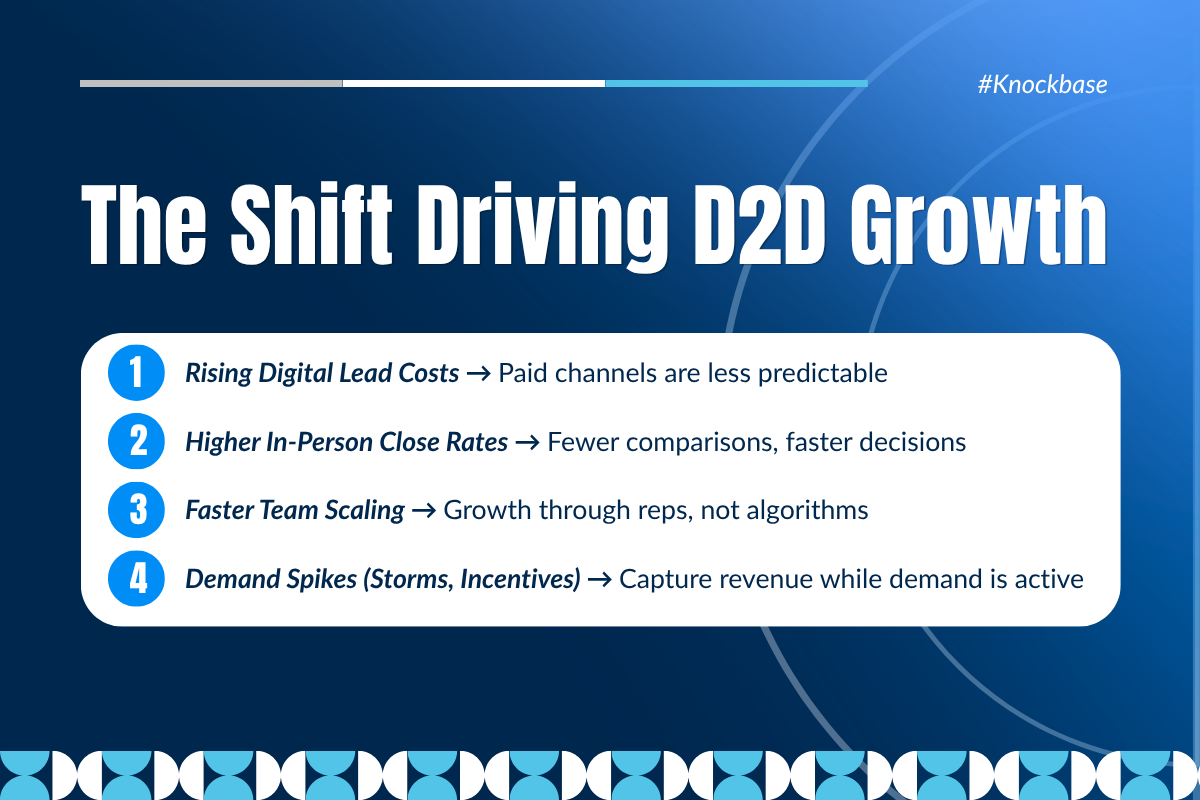
D2D growth is driven by shifts in acquisition costs, conversion dynamics, and the pace at which teams need to scale in competitive markets. That is why choosing the right door-knocking software has become a strategic decision rather than a tooling afterthought.
Rising digital lead costs. Paid acquisition keeps getting more expensive, with climbing cost-per-lead and inconsistent quality. For many teams, scaling through ads alone is no longer predictable or efficient.
Higher in-person close rates. At the door, reps engage homeowners directly without competing against multiple online quotes. A homeowner is not toggling between three browser tabs when someone is standing on their porch, which removes the comparison friction that kills a lot of inbound deals and often leads to faster decisions.
Faster team scaling. D2D scales through headcount, not campaign optimization. Teams can expand into new territories quickly without waiting for digital performance cycles to mature.
Demand spikes. Home services demand is often time-sensitive, driven by weather events or policy incentives. D2D teams can deploy into high-demand areas immediately, and the speed of deployment directly affects revenue during short demand windows.
At a small scale, manual tracking and basic tools can keep up. As team size grows, coordination gets harder, and visibility into territory coverage, follow-ups, and performance starts to break down. That is where purpose-built D2D software changes the economics of growth.
What D2D Sales Software Actually Is, and Why the Category Matters
The term "D2D sales software" gets used broadly, but not all products are built for the same purpose. For managers evaluating tools, the distinction matters because different categories solve different problems, and choosing the wrong one often leads to breakdowns during scaling.
The three products marketed as D2D sales software
1. The tracker (basic activity logging). Trackers record rep activity: doors knocked, routes taken, basic notes. They show what happened in the field but offer limited insight into outcomes. At scale, they fall short because they do not link activity to conversion or let managers act on the data.
2. The field CRM (general pipeline, limited D2D). Field CRMs extend traditional CRM systems into field operations, adding pipeline tracking and basic mobility. They are useful for managing leads and jobs, but they are not built for D2D-specific workflows like territory enforcement or rep-level performance tracking. As teams grow, gaps appear in territory control, real-time coordination, and rep engagement.
3. The D2D platform (rep plus manager system). Purpose-built canvassing and lead-tracking software combines rep execution and manager oversight in one system, with live territory mapping, conversion analytics, gamification, and automated follow-ups. These platforms manage both activity and outcomes, which is what scaling teams need. You can see how a purpose-built D2D platform differs from a tracker in practice.
The key distinction is simple. Trackers tell you what your reps did. D2D platforms tell you what is actually driving revenue. Once the goal shifts from logging activity to improving performance, that gap becomes the deciding factor.
The Seven Non-Negotiable Features of D2D Sales Software
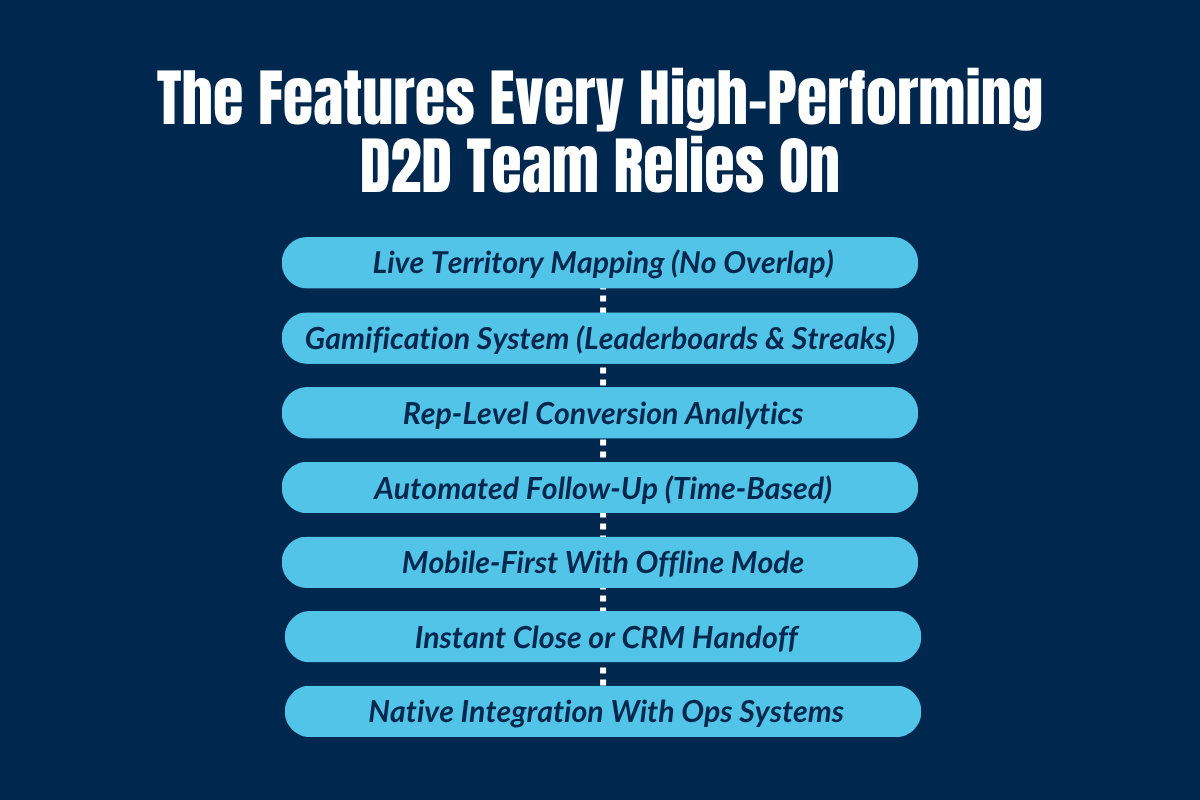
Use this list as a demo checklist when you evaluate vendors.
Feature 1: Live territory mapping with system-level enforcement. Territory overlap is one of the fastest ways to destroy rep trust and distort performance data. Effective territory mapping goes beyond visualization by actively preventing overlap, keeping assigned areas protected, and resolving conflicts in real time.
Feature 2: Gamification architecture. Gamification works best when it includes leaderboards, challenges, and streaks that keep reps engaged. A well-designed system that keeps evolving reinforces daily activity and sustains motivation well after onboarding ends. A gamified door-knocking app is built around that idea.
Feature 3: Conversion rate analytics by rep, not just activity totals. Activity alone does not show performance. Rep-level conversion analytics connect effort to outcomes, so managers can see which reps are actually closing and why. That shifts coaching from volume-based to performance-based.
Feature 4: Automated follow-up with timing precision. Most lost deals are not lost at the door. They are lost in the two days after. Follow-up systems should trigger automatically based on timing, not rely on a rep remembering to log a task.
Feature 5: Mobile-first offline functionality. Reps should be able to access and update the system without network connectivity, with data syncing automatically once the signal returns, so workflows are never interrupted in the field.
Feature 6: Instant proposal or CRM handoff at the door. The longer the gap between first contact and proposal, the lower the close rate. Reps should be able to close on the spot or hand off to the next stage instantly, without returning to the office or waiting on someone else.
Feature 7: Native integration with home services operational platforms. D2D software should connect directly to the systems you use for scheduling, job management, and customer tracking, so information flows across the business without manual re-entry.
In practice, missing any two of these, particularly territory enforcement, follow-up automation, or conversion analytics, creates compounding coordination failures as headcount grows. A gap in one area almost always surfaces as a problem in another.
The Management Visibility Gap: Why Most D2D Software Fails the Person Buying It
Most D2D tools are designed around rep activity, but the buyer is usually a sales manager responsible for outcomes. That creates a gap between what the system shows and what the manager actually needs to improve.
Activity versus performance
Activity data shows what happened in the field: doors knocked, routes covered, conversations logged. Performance data shows what needs fixing: which reps are converting, where drop-offs occur, and which actions drive revenue. Activity reflects effort. Performance reflects effectiveness.
Knowing a rep knocked 100 doors does not indicate success on its own. Without conversion data, there is no visibility into whether those interactions produced results. Teams optimized for activity often miss the underlying performance gaps that affect revenue.
The rep engagement cliff
Many D2D managers see rep engagement dip within the first couple of months, once onboarding energy fades and the novelty of a new tool wears off. The drop-off is usually a system-design problem, not a motivation problem. Static leaderboards, no individual progress tracking, and limited manager feedback leave reps with no view of their own growth. Platforms that use evolving challenges, streak tracking, and real-time recognition sustain engagement without constant manager intervention.
How We Evaluated These Platforms
Knockbase publishes this guide, and Knockbase is one of the platforms compared below, so here is exactly how the evaluation works. Each platform is assessed against the seven non-negotiable features defined above, plus pricing transparency and how the system holds up as a team scales past ten reps. Competitor pricing and capabilities are drawn from each vendor's published materials and third-party review data. Where a competitor is stronger on a given dimension, we say so. Treat this as a starting framework, then run the live-demo questions further down against your own shortlist before deciding.
Leading D2D Sales Platforms Compared
1. Knockbase
Knockbase is a purpose-built D2D platform designed to support both rep execution and manager-level visibility, with a focus on connecting field activity to performance outcomes.
Best for: Teams scaling beyond early-stage operations that need visibility into conversion rates, territory control, and rep performance.
Pros:
- Helps managers see which reps are converting and where deals are being lost
- Built-in gamification supports sustained engagement beyond initial onboarding.
- Real-time dashboards show pipeline, activity, and territory coverage
- Connects lead, follow-up, and close in a single workflow
Cons:
- As a newer, performance-focused platform, Knockbase has a smaller third-party integration ecosystem and a shorter public review history than long-established tools like SalesRabbit, so buyers who want a large marketplace of pre-built add-ons or a deep bank of independent reviews to read will find fewer of both today.
- The depth of reporting and territory control means initial setup and onboarding take more configuration than a basic tracker, so the absolute fastest day-one rollout is not the goal here.
Pricing: Quote-based rather than fixed tiers, aligned to team size and workflow needs rather than forcing upgrades through feature gates. Your quote is shaped mainly by rep count and which modules you need, so the practical step is to request a number for your specific team. Best suited to mid and growth-stage teams that prioritize performance visibility over basic activity tracking.
2. SalesRabbit
SalesRabbit is one of the more established D2D platforms, with a broad feature set spanning territory mapping, lead tracking, gamification, and integrations. It is also among the most-reviewed tools in the category, holding roughly 4.5 out of 5 across hundreds of G2 reviews, which gives cautious buyers a large body of independent feedback to read.
Best for: Teams with structured sales processes that want a mature platform and a wide ecosystem of add-ons.
Pros:
- Proven platform with widespread adoption across home services teams
- Strong territory mapping and lead management
- Flexible system with a wide range of add-ons and integrations
- Supports scaling teams with customizable workflows
Cons:
- Total cost climbs as add-ons are layered across the team
- Feature depth can add complexity for smaller or less structured teams
- Less emphasis on conversion-focused analytics than newer platforms
Pricing: Paid plans start around $49 per user per month on the entry tier, typically with a small user minimum. Real-world cost often lands closer to $60 to $80 or more per user once common add-ons (advanced data, digital contracts, gamification modules) are included, plus a one-time setup fee in the range of $399 to $4,999. Additional modules increase the total cost as teams scale. For a closer look, see the Knockbase vs SalesRabbit comparison.
3. SPOTIO
SPOTIO is a field sales engagement platform focused on activity tracking, territory management, and rep productivity.
Best for: Mid-sized teams that need structured field tracking and straightforward pipeline visibility without heavy system complexity.
Pros:
- Quick onboarding for teams moving off manual systems
- Clean, easy-to-use interface for activity tracking
- Strong territory mapping
- Good fit for teams that prioritize simplicity and speed of adoption
Cons:
- Limited ability to connect activity to conversion outcomes
- Less robust engagement systems than newer platforms
- Advanced reporting and automation sit in higher tiers
Pricing: SPOTIO publishes tiered per-user pricing that starts around $39 per user per month, with higher tiers required for deeper reporting, automation, and advanced functionality, and custom quotes for larger field-sales motions. Because per-user tools add up quickly at scale, confirm current rates for your team size before comparing.
Quick comparison
| Platform | Best for | Strength | Limitation |
|---|---|---|---|
| Knockbase | Scaling D2D teams (10+ reps) | Performance and manager visibility in one system | Newer in market; smaller add-on ecosystem |
| SalesRabbit | Established teams | Deep all-in-one feature maturity and a large review base | Cost climbs with add-ons; it can feel complex |
| SPOTIO | Mid-sized field sales teams | Territory and activity tracking, easy adoption | Limited conversion analytics depth |
A note on the wider market
These three are not the only credible options. Depending on your motion, you may also evaluate route- and territory-focused tools like Badger Maps, or broader field-CRM platforms that some teams adapt to D2D. We focused the detailed comparison on platforms purpose-built for door-to-door home services teams scaling past ten reps, which is where territory enforcement, conversion analytics, and engagement systems matter most. If your needs are lighter, such as a solo rep or a very small crew, a simpler tracker may be enough, and the three-products section above explains where that ceiling sits.
The right choice depends less on feature count and more on how well the system fits how your team operates today and what it needs to support as it grows.
How a Purpose-Built Platform Supports Both Managers and Reps
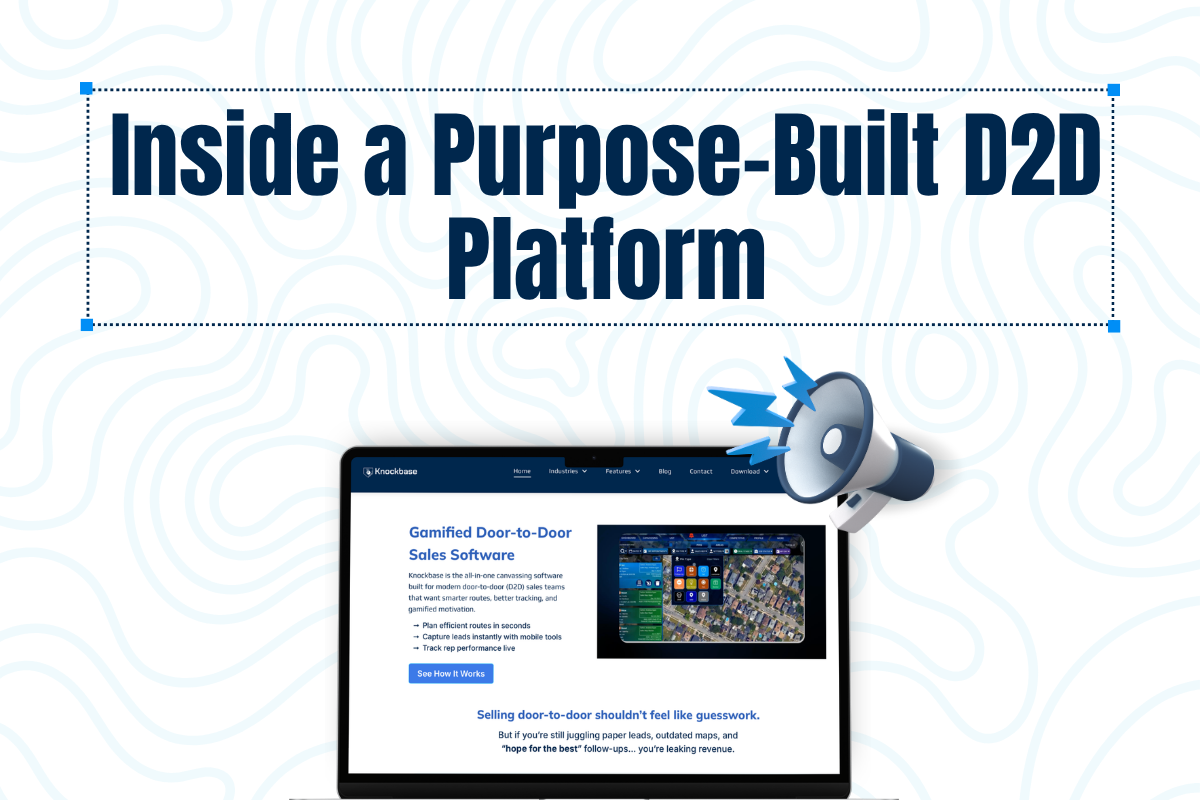
Purpose-built D2D platforms solve for both sides of the system: rep execution in the field and manager visibility across the team. That dual focus is what lets a team move from tracking activity to driving performance.
What a sales director sees every day
- A live dashboard of rep activity, pipeline movement, and territory coverage in real time, which removes the need for manual tracking and delayed reporting.
- Conversion insights showing which reps are converting, where drop-offs happen, and what actions drive results, so managers can focus on performance rather than raw effort.
- Action alerts that flag missed follow-ups, stalled leads, or inactivity, helping managers step in at the right moment instead of reacting late.
- Forecast visibility that connects field activity to expected outcomes, enabling planning based on actual performance trends rather than assumptions.
When activity and conversion data are connected, managers move from observing performance to actively improving it.
What keeps reps using it at day 90
- Leaderboards and challenges that reset and evolve, keeping reps engaged beyond the onboarding window.
- Personal streaks that build a daily habit without relying on external motivation.
- Real-time recognition that creates fast feedback loops and reinforces the resilience and self-improvement that strong D2D reps rely on.
- A simple mobile workflow that lets reps update activity, manage leads, and move deals forward without friction in the field.
This is what separates purpose-built platforms from basic tools. The system is not just a supporting activity. It is actively shaping how the team performs at scale.
D2D Sales Software Pricing: What Each Tier Costs and Delivers
Pricing varies widely based on team size, feature depth, and how much the platform focuses on performance rather than basic tracking. Base pricing rarely reflects actual cost, because add-ons, integrations, and scaling needs increase total spend.
| Tier | Cost per user (monthly) | Best for |
|---|---|---|
| Entry | $30 to $45 | Small teams (1 to 5 reps) |
| Mid | $45 to $70 | Growing teams (5 to 15 reps) |
| Growth | $70 to $120 | Scaling teams (15 to 50 reps) |
| Enterprise | $120+ | Large, multi-region operations |
Most platforms start in the mid-tier, with costs rising as teams need better visibility, automation, and performance tracking. In practice, actual cost often exceeds base pricing because of add-ons for advanced features, integration requirements, and onboarding or setup fees. Those differences become more visible as teams scale.
The ROI calculation that reframes the pricing decision
Software pricing is usually evaluated as cost per user. The more useful metric is how the platform affects revenue per rep.
- Better follow-up systems convert leads that would otherwise go cold.
- Conversion visibility lets managers coach to outcomes, not activity.
- Higher rep engagement reduces turnover and lowers recruiting costs.
If one rep closes a single additional deal per month because follow-up is automated and territory is clear, the revenue impact typically outweighs the software cost at almost any tier. You can sanity-check this for your own team with a commission and payback calculation. That is why the pricing decision is less about the lowest cost per user and more about selecting a system that improves how the team performs.
Questions to Ask Every D2D Sales Software Vendor Before You Sign
Most demos show what a product can do, not how it performs in real scenarios. Use these questions to move the conversation from features to actual workflows.
Territory and management:
- Show me the real-time dashboard with live rep activity, pipeline, and territory coverage.
- How does the system prevent territory overlap between reps, and can you demonstrate it live?
- Show how a manager identifies underperforming reps using conversion data.
- What triggers an alert for a missed follow-up or stalled lead, and what does that workflow look like?
Gamification and engagement:
- What does the rep experience look like at day 45, not just during onboarding?
- Demonstrate how challenges are created, updated, and reset over time.
- How is individual rep progress, such as streaks or goals, tracked inside the system?
- Walk through how real-time recognition or rewards are triggered.
Integration and automation:
- Show a live integration with an operational platform or CRM.
- How does follow-up automation trigger after a door interaction, and what is the actual sequence?
- Where does data go after a rep logs field activity, and how does it move into the pipeline without manual entry?
- Walk through how a lead moves from rep interaction to proposal or next step.
Red flags to watch for:
- "It's on the roadmap" when you ask for core features like territory enforcement or automation
- An inability to show features live during the demo
- Reliance on static screenshots instead of real workflows
If a vendor cannot demonstrate these capabilities in a live environment, the system is not ready to support a scaling D2D team.
How to Implement D2D Sales Software Without Losing Momentum
Implementation fails when teams layer a new system onto old workflows instead of replacing them. The goal is not just to set up. It is an adoption without slowing active sales.
Week 1: Setup. Define territories, import a small set of leads, and configure core workflows like follow-ups and pipeline stages. Build a working system that reflects how your team actually operates, not a perfect one.
Week 2: Pilot. Run the platform with two or three reps in a controlled territory. Find workflow gaps, fix friction points, and confirm that data flows correctly from field activity into the pipeline.
Week 3: Team onboarding. Roll out to the full team with clear expectations on daily usage. Train on essential actions only: logging activity, updating leads, and moving deals forward. Do not try to teach every feature this week.
Week 4: Full switch. Move all active operations into the new platform so it becomes the single source of truth. Running parallel systems at this stage creates inconsistent data and kills adoption.
Week 5: Performance review. Analyze rep activity, conversion data, and pipeline movement to spot early patterns, then adjust workflows, coaching, and territory assignments based on actual performance.
Adoption is not really a training problem. It is a system design and rollout problem, and how you implement it determines whether the platform improves performance or becomes another unused tool.
The Bottom Line
Choosing D2D sales software is about selecting a system that can support how your team operates as it grows. Most tools can track activity. Far fewer connect that activity to performance, sustain rep engagement over time, and give managers the visibility to improve outcomes.
Teams that choose on price or surface-level features tend to run into the same issues: missed follow-ups, unclear performance, and declining engagement. Teams that choose workflow alignment and performance visibility build systems that improve with every additional rep. The gap between those two approaches becomes obvious when you are managing 15 or more reps across multiple territories and need to know, without making calls, which areas are underperforming and why.
You now have the taxonomy, the seven non-negotiable features, the vendor questions, and a rollout plan. The honest next step is to run those questions against your shortlist in a live demo, not a slide deck. Book a Knockbase demo and walk through your real workflow, from territory assignment to follow-up logic to rep performance tracking, to see where the gaps are before you commit.
FAQs
How many reps do I need before D2D software pays for itself?
Most teams see clear ROI around eight to ten reps, the point where manual coordination starts creating visible revenue leakage through missed follow-ups, territory disputes, and inconsistent close rates. Below that, simpler tools often suffice.
What does Knockbase cost?
Knockbase uses quote-based pricing aligned to your team size and the modules you need, rather than fixed feature tiers. The fastest way to get an accurate number is a short demo that maps the platform to your workflow, where you can also confirm what is included in your rep count.
What other D2D platforms should I consider?
Beyond the three compared here, route- and territory-focused tools like Badger Maps and broader field CRMs adapted for D2D can fit certain motions. The right shortlist depends on your team size, your industry, and whether you need conversion analytics or mainly activity tracking.
What should I ask about pricing before signing?
Get the all-in cost for your expected team size, including integrations, onboarding fees, and mid-contract scaling. Ask specifically what happens to your rate if you grow from 15 to 30 reps. Base pricing rarely reflects what you actually pay at month six.
Will switching platforms disrupt active sales?
It depends on the rollout. A phased approach, starting with two or three reps in a single territory, usually keeps disruption minimal. Teams that migrate everything at once tend to experience a few weeks of data inconsistency and often partially revert to old tools.
How does D2D software improve rep performance?
It gives visibility into both activity and outcomes, so reps see what is working and where to improve, and managers can coach more effectively using real conversion data rather than effort alone.
How is D2D software different from general field sales tools?
General field sales tools cover broader use cases. D2D platforms are more specialized, focusing on territory enforcement, rep engagement, and conversion tracking for door-to-door motions.
Can D2D software be used on mobile in the field?
Yes. Most platforms are built mobile-first, letting reps log activity, update leads, and move deals forward without needing desktop access, including offline in low-signal areas.

Canvassing Software ROI: How Sales Managers Should Calculate Cost-Per-Knock vs Cost-Per-Lead in 2026