Here's the pattern every field sales manager knows. A new rep starts on fire, energized, knocking hard, chasing every lead. Three months in, the fire's gone out. Same rep, same territory, half the doors.
Nothing dramatic happened; the daily grind of hearing "no" just slowly drained the tank, and a monthly commission check that lands weeks away does nothing to refill it on a tough Tuesday afternoon.
That slow fade is one of the most expensive problems in door-to-door sales, and you can't fix it with a quarterly contest that only the top closer ever wins. What actually moves the needle is making progress visible and rewarding every single day, which is exactly what gamification does when it's built into the work itself.
This guide skips the game-design theory. The real question isn't "what is gamification," it's "how do I keep my field team motivated and productive day after day?" Gamification is the answer; here's how it works, what it changes, and how to run it without the common mistakes.
Key Takeaways:
- Productivity fades slowly, worn down by rejection, invisible effort, slow feedback, and distant rewards, not by a single failure.
- Traditional incentives fall short because they reward outcomes too late and only motivate top performers.
- Gamification changes behavior through immediate feedback, visible progress, healthy competition, small-win recognition, and habit reinforcement.
- It produces measurable outcomes: more doors knocked, more appointments, better follow-up, cleaner data, higher territory completion, and faster onboarding.
- Features must map to behaviors, leaderboards drive activity, streaks drive consistency, team challenges protect collaboration.
- Avoid the classic mistakes: rewarding only top sellers, unfair contests, all-individual competition, metric overload, and gimmicky design.
- Software makes it scalable by automating leaderboards, goals, and recognition from real field data.
Why Gamification Is Changing Door-to-Door Sales Performance
Door-to-door sales productivity rarely collapses all at once; it erodes as repetition, rejection, and delayed rewards wear reps down. Gamification counters that erosion by building motivation into the daily process: it makes progress visible, recognizes effort in real time, and turns routine activity into momentum.
This guide explains why field teams lose steam, why traditional incentives fall short, how gamification changes rep behavior, the measurable outcomes it produces, the features that matter most, the mistakes to avoid, and how software makes it practical to run at scale.
Your Best Sales Manager Might Be a Leaderboard!
Recognition doesn't have to wait until Friday's meeting. Celebrate wins the moment they happen with built-in gamification that keeps reps motivated every day.
Book a demo to see how Knockbase keeps the momentum going.
Why Field Teams Quietly Lose Steam After the First Few Months
Motivation in field sales doesn't disappear in a crash; it leaks. And because it leaks slowly, managers often miss it until the numbers are already down.
- Rejection compounds. A door-to-door salesperson hears "no" dozens of times a day. Without small wins to balance it, that steady stream of rejection wears down even strong reps until they ease off the gas.
- Effort feels invisible. A rep can knock a hundred doors and have nothing, no sale, no recognition, no sign it mattered. When hard work goes unseen, people stop pushing.
- Feedback comes too late. Reps often find out how they're doing at a monthly review, long after they could have adjusted. Slow feedback means slow improvement and fading drive.
- Goals feel like mountains. A big quarterly target with no visible daily steps reads as an obstacle, not a goal, so reps disengage from it entirely.
- New reps wash out fast. Without early wins and momentum, new hires hit the rejection wall before they ever build confidence, and turnover spikes.
The consequences stack up into real money. Fewer door knocks shrink the top of the funnel. Inconsistent follow-up lets warm leads die. And the costliest leak of all is turnover, every burned-out rep who quits takes their ramp-up investment with them and forces you to recruit and retrain from scratch.
None of this shows up as "our incentives are broken." It shows up as a team that's simply running slower than it did in month one. That's the exact erosion gamification is designed to stop.
Why Traditional Incentives Aren't Enough
Most teams try to solve motivation with the same three tools: monthly bonuses, commission, and the occasional end-of-quarter contest. They help, but they share a fatal flaw for daily field work.
The reward is too far away. A commission check weeks out does nothing to pull a rep through a brutal Tuesday. Human motivation responds to immediate feedback, and these incentives are anything but.
They only move the top. A single big contest prize is realistically winnable by your best two or three reps. Everyone else checks out early, which means the incentive demotivates the exact middle-of-the-pack reps you most need to lift.
They reward outcomes, not effort. Commission pays the close, but in D2D, the close is mostly luck layered on top of consistent activity. If you only reward results, you ignore the daily behaviors that actually produce them.
What field teams need isn't a bigger annual prize. It's a system that recognizes consistent effort every day and gives every rep, not just the stars, a reason to push on the next door. That's the gap gamification fills.
What Gamification Means in a Door-to-Door Sales Environment
Gamification in D2D sales isn't about turning work into a video game or handing out novelty badges. It's the practical application of game mechanics: points, levels, challenges, leaderboards, and streaks to real sales activity, so that everyday effort produces immediate, visible, rewarding feedback.
In plain terms: instead of a rep knocking in a vacuum, every door, conversation, and follow-up registers as points on a live leaderboard, progress toward a daily goal, or a streak worth protecting. The work doesn't change. What changes is that the rep can see their progress and gets recognized for it in real time, rather than waiting weeks to find out if any of it counted.
That's the whole idea, and the reason it works has everything to do with behavior, not novelty.
Gamification in D2D sales applies game mechanics: leaderboards, points, challenges, streaks, and goal tracking, to everyday field activity. It gives sales reps immediate feedback and recognition for effort, making progress visible and motivating consistent daily performance rather than relying on delayed rewards like monthly commission.
Why Gamification Actually Changes Sales Rep Behavior
The reason gamification drives productivity isn't the points themselves; it's what they do to behavior. Five mechanisms are at work.
- Immediate feedback. A rep sees the result of their effort the moment it happens, closing the gap between action and reward that traditional incentives leave wide open.
- Visible progress. Watching a number climb or a goal bar fill turns abstract effort into tangible momentum — and momentum is self-sustaining.
- Healthy competition. A live leaderboard taps reps' natural competitive drive, pushing the whole team to match the pace of the front-runners rather than coast.
- Recognition of small wins. Celebrating a good conversation or a booked appointment, not just a closed deal, keeps motivation alive through the long stretches between sales.
- Habit reinforcement. Streaks and daily challenges reward showing up and doing the productive thing consistently, which is how good sales habits get built and locked in.
Put together, these mechanisms attack the exact leaks from the first section. Rejection stings less when small wins are constantly recognized. Effort stops feeling invisible when it's on a board. Feedback arrives instantly instead of monthly. That's behavioral change, and behavioral change is what shows up in the numbers.
How Gamification Improves Productivity, Outcome by Outcome
Concepts are nice; managers care about results. Here's how the behavioral shifts above translate into measurable field sales outcomes.
- More doors knocked per day. When activity is tracked and rewarded, reps push for more, the single rawest input to revenue.
- More conversations and appointments. Daily challenges aimed at conversations or bookings lift the metrics that actually fill the pipeline, not just vanity activity.
- Better follow-up consistency. Points and streaks tied to follow-up make sure the second and third touches, where many deals close, actually happen.
- Cleaner data entry. When logging activity earns points, reps actually do it, giving managers accurate data to coach from instead of guesses.
- Higher territory completion. Goal tracking turns "cover this area" into a visible target reps want to finish.
- Greater accountability. A transparent leaderboard means effort is visible to everyone, which naturally lifts the floor without a manager hovering.
- Faster onboarding. New reps chasing achievable early wins build confidence fast, ramp up quicker, and survive the rejection wall that washes so many out.
The throughline is consistency. Gamification doesn't create a single heroic day; it raises the baseline of daily effort across the whole team, and a higher baseline, sustained over a quarter, compounds into serious revenue gains.
Which Gamification Features Matter Most
Not every game mechanic earns its place. These are the ones that map to a real business outcome, and what each is actually for.
| Gamification feature | What it does | Business outcome |
|---|---|---|
| Live leaderboards | Surface real-time rankings | Healthy competition, visible effort |
| Points and rewards | Recognize every win, big or small | Sustained motivation between sales |
| Daily challenges | Set fresh, achievable targets | Breaks routine, maintains momentum |
| Performance streaks | Reward consistency | Builds productive daily habits |
| Team competitions | Pit squads, not just individuals | Collaboration, lifts the whole team |
| Goal tracking | Make progress toward targets visible | Turns big goals into daily steps |
| Instant recognition | Celebrate wins as they happen | Reinforces the behaviors you want |
The strategic point: a feature only matters if it reinforces a behavior you actually want more of. Leaderboards drive activity; streaks drive consistency; team competitions protect against the "only the top rep wins" trap.
Choose the mechanics that target your team's specific leak rather than switching on everything at once. For a deeper look at the mechanics, see gamification techniques to motivate your sales reps.
What Mistakes Undermine a Gamification Program
Done badly, gamification backfires; it demotivates the middle and breeds resentment. These are the errors that wreck it, and how to avoid each.
- Rewarding only top sellers. If the same rep wins every time, everyone else disengages. Fix it by also rewarding effort, improvement, and streaks- metrics any rep can win on a given day.
- Creating unfair contests. Pitting a veteran against a first-week rep on raw closes is demoralizing. Tier competitions or use personal-best targets to keep the playing field fair.
- Ignoring team-based wins. All-individual competition can erode collaboration and company culture. Balance it with squad challenges so reps still help each other.
- Tracking too many metrics. Gamifying everything dilutes focus. Pick the two or three behaviors that matter most this month and reward those.
- Letting it feel forced or childish. Experienced reps tune out anything that feels like a gimmick. Tie rewards to things they genuinely value: recognition, real prizes, status, and it lands for veterans as much as new reps.
The principle behind all five: gamification should reinforce meaningful sales behaviors, not just sprinkle points on top of the work. Get that right, and it elevates the whole team; get it wrong, and it becomes noise.
How Software Makes Gamification Practical at Scale
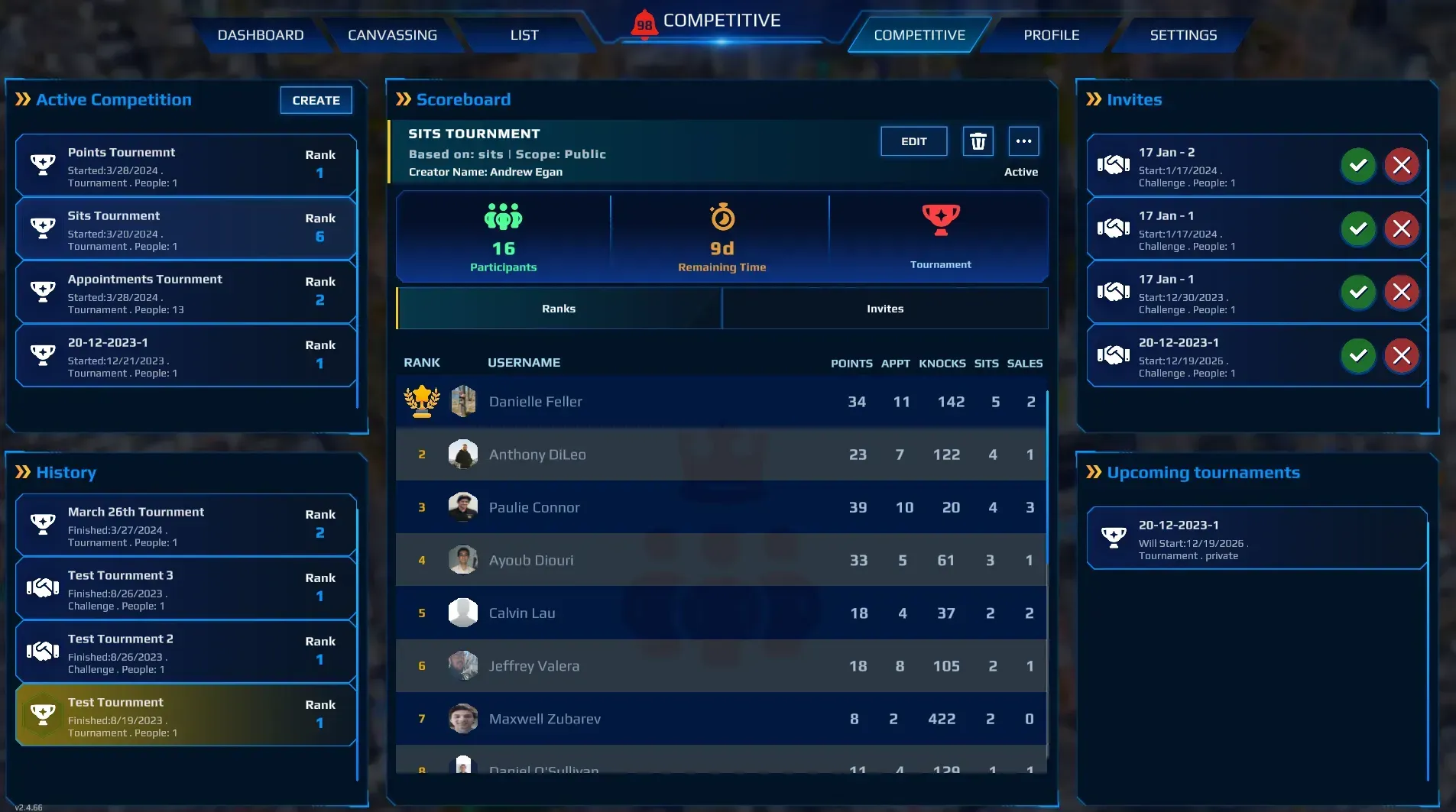
Plenty of managers grasp the concept but stall in execution because running gamification by hand is a full-time job in itself. Manually tallying points, updating a whiteboard leaderboard, and verifying who hit which goal is impossible to sustain across a real field team spread over multiple territories.
This is where dedicated D2D sales software earns its keep. The right platform automates the entire program: live leaderboards update themselves from real field activity, goals and streaks track automatically, achievement notifications fire in real time, and managers get performance dashboards without touching a spreadsheet.
The gamification runs on its own, fed by the same data reps are already capturing at the door. A few capabilities make it work in practice:
- A purpose-built door knocking app with built-in leaderboards and challenges, so the game lives where reps already work.
- Sales rep management software that ties recognition to real performance metrics.
- Canvassing software and territory mapping software that feed accurate activity data into the scoring automatically.
- Appointment management software so follow-up streaks and booked-meeting challenges track without manual entry.
This is exactly where Knockbase fits: its gamified leaderboards, points, challenges, and goal tracking are built directly into the field workflow, turning everyday activity into visible, rewarded progress, and turning motivation from a manual chore into an automatic system.
Conclusion
Gamification works in door-to-door sales because it fixes the real reason productivity fades: the gap between daily effort and any sign that it mattered. By making progress visible and rewarding consistency in real time, it keeps reps pushing through rejection, lifts the whole team's baseline instead of just the top closer, and helps new hires survive long enough to succeed.
But it only works when it reinforces meaningful behaviors, more doors, better follow-up, real consistency, rather than just adding points for their own sake. Run it that way, automate it with the right software, and gamification stops being a gimmick and becomes one of the most reliable levers you have for sustained field sales performance.
In a profession defined by repetition and rejection, that daily spark is what separates teams that fade from teams that finish.
Motivation Fades! Momentum Wins!
The most successful D2D teams don't rely on occasional incentives; they build a culture where progress is visible, achievements are recognized, and every rep knows what success looks like.
A little competition goes a long way. Give your reps real-time goals, rewards, and recognition, all without adding extra work for managers. See how Knockbase gamifies field sales the right way.
Schedule a personalized Knockbase demo today.
FAQ's
How does gamification improve D2D sales productivity?
Gamification makes the sales process more engaging by rewarding consistent actions such as knocking on doors, booking appointments, and completing follow-ups. Features such as leaderboards, points, and challenges provide instant feedback, motivating reps to stay productive throughout the day.
Does gamification actually work for experienced reps?
Yes. Experienced sales representatives are often motivated by recognition, competition, and measurable progress. When rewards are meaningful and performance-based, gamification keeps even seasoned reps engaged without feeling gimmicky.
Won't gamification just reward the top performers?
Not if it's implemented correctly. Recognizing improvement, consistency, and effort, not just closed deals, motivates field sales teams at every performance level and encourages broader participation.
What gamification features matter most in D2D sales?
Live leaderboards, points, daily challenges, streaks, team competitions, and goal tracking are most effective when they reinforce the right sales techniques and encourage behaviors that lead to better performance.
Is gamification suitable for small sales teams?
Absolutely. Small teams can benefit from friendly competition and real-time recognition without adding administrative work. It also helps improve overall sales efforts by keeping everyone focused on shared goals.
Can gamification help reps handle objections during door-to-door selling?
Yes. In the sales industry, gamification can reinforce effective objection handling by rewarding reps for completing training, practicing responses, and applying proven techniques during door-to-door selling, helping them build confidence with every conversation.
Can gamification improve customer interactions in face-to-face sales?
Yes. Gamification encourages reps to consistently apply best practices during direct sales, making conversations with potential customers more engaging and increasing the likelihood of building relationships that support future sales.

Canvassing Software ROI: How Sales Managers Should Calculate Cost-Per-Knock vs Cost-Per-Lead in 2026