Ask a door-to-door sales manager what they dread most, and it is rarely the knocking, the weather, or even the rejection at the door.
It is Friday. Specifically, it is the two or three hours hunched over a spreadsheet reconciling deals, chargebacks, tiers, and bonuses, hoping the formulas still hold, and bracing for the message from a rep who is certain they were shorted forty dollars.
Commissions are supposed to be the reward at the heart of this business. Too often they become its biggest source of error, delay, and quiet distrust. It does not have to be that way, and fixing it is far more of a systems problem than a math problem.
Key Takeaways
- Commission errors are rarely about bad arithmetic; they come from manual tracking, unclear rules, and missed adjustments.
- Pay accuracy is a trust issue: reps who doubt their payouts disengage or leave.
- Structures range from flat and percentage to tiered, team, and residual, and each adds calculation complexity.
- Spreadsheets fail quietly, not loudly, usually somewhere between twenty and fifty reps.
- Automation pays for itself in recovered hours, fewer disputes, and faster payroll.
How to Calculate Door-to-Door Sales Commissions Accurately?
Commission calculation is one of the most error-prone and dispute-heavy tasks in D2D sales, and it only gets harder as a sales team grows. This guide breaks down why payouts go wrong, the commission structures field teams actually use, and how to calculate them step by step, including the messy parts like cancellations and chargebacks.
It then explains why manual spreadsheets stop scaling and what an automated commission calculator should handle instead. The goal is accurate, transparent, on-time pay that reps trust, without surrendering every Friday afternoon to reconciliation and arguments.
What This Guide Covers
- Why commission day turns into a weekly headache
- Why accurate payouts matter more than the formula suggests
- The commission structures door-to-door teams actually use
- How to calculate commissions step by step
- Why spreadsheets break down as you grow
- What to automate, and how Knockbase handles it
Why Payday Math Becomes the Worst Part of Your Week
The knocking is the visible work. The invisible work is what happens afterward, and commission day is where it all collides.
- The Friday spreadsheet grind. A manager exports the week's deals, cross-references them against a pay plan, and manually keys in rates, overrides, and bonuses. One mistyped cell and someone gets paid wrong. Multiply that across a full sales team and errors stop being a risk and become a certainty.
- The disputes. When a rep cannot see how their number was built, they assume the worst. Two reps compare checks, the math looks off, and now the manager is refereeing an argument instead of coaching. Trust erodes one contested payout at a time.
- The chargeback tangle. A deal cancels three weeks after it was paid. Now you are clawing back commission, adjusting the next check, and explaining why. Handled by hand, this is where most pay errors quietly hide.
- The delay. Complex plans take time to compute, so payouts slip. For reps living on commission, a late or wrong check is not an annoyance; it is a reason to answer a recruiter's call.
The hidden cost is bigger than the lost hours. Inaccurate, opaque pay is one of the fastest ways to lose good sales reps, and replacing them costs far more than the software that would have prevented the problem. Getting this right is not administrative hygiene. It is retention strategy, which is why it deserves real attention before your next pay cycle.
Why Getting Commissions Right Matters More Than the Math Suggests
Let's find out:
1. Every Commission Represents More Than a Closed Deal
It is tempting to treat commission calculation as pure arithmetic. In practice, the payout is the single clearest signal a company sends about whether effort is valued.
Consider what a door-to-door rep actually does to earn one commission. They push through constant rejection, refine their sales pitch, and deliver the opening line that decides whether a door opens or closes.
When the door opens, they run an in person conversation built on active listening, real product knowledge, and the ability to explain product benefits and answer questions on the spot.
2. Every Sale Is Built on Trust, Not Just Technique
They read the customer, make a positive impression, and use objection handling to turn a hesitation into interest.
They leave a business card, schedule a follow up for a later date, and keep building relationships on a consistent basis until the deal closes. Every dollar of commission sits on top of that entire sales process.
3. Why Door-to-Door Sales Demand Fair Compensation
Door-to-door selling is outside sales in its purest form. Unlike inside sales run over the phone, or the reach of digital marketing, digital advertising, and other digital channels, it lives on direct interaction and a personal touch at the doorstep.
A rep's first impressions, their read of the target audience on a given street, and the informal market research they gather block by block all shape whether they sell products to new customers at all.
There is no algorithm doing the work here, just a person earning trust face to face, which is precisely why the pay behind that work has to be right.
4. Transparent Commissions Build Long-Term Motivation
When pay honors that effort accurately and transparently, reps trust the system and lean in; when it does not, even the sharpest sales techniques cannot offset the feeling of being shortchanged.
5. Accurate Payouts Help Retain Top Performers
Commission clarity also shapes the longer arc of a sales role. Reps weighing whether to stay look at their earning trajectory and the career paths ahead of them, and a company that rewards a proven track record, invests in ongoing training, and pays for genuine sales efforts keeps its best people.
Clear pay even drives the small daily choices, like whether a rep keeps knocking through slow business hours, because they can see each successful door and every step toward future sales translate directly into income. Fair, legible pay is also central to retention, a theme in reducing sales rep turnover.
Accurate commissions protect your sales goals by rewarding the behaviors that matter rather than drowning them in payroll noise, and over time, they lift the team's overall success rate.
What Commission Structures Do Door-to-Door Teams Actually Use?
Before you can calculate anything, you need to know which model you are running.
To calculate door-to-door sales commissions accurately, define the structure (flat, percentage, tiered, or team-based), apply it consistently to verified sales data, and adjust for real-world factors like cancellations, chargebacks, and split deals.
Most door sales organizations use one or a blend of these.
1. Flat-Rate Commission
A fixed dollar amount per sale, regardless of deal size. Simple to compute and popular where products are standardized, like some pest control or home security systems plans. Easy to run, but it ignores deal value entirely.
2. Percentage Commission
A set percentage of each sale's revenue. This is the backbone of direct sales pay and scales naturally with deal size, which keeps reps focused on higher-value potential customers.
3. Tiered Commission
Rates rise as reps cross thresholds: for example, 5% up to a target, then 8% beyond it. Tiered plans are strong motivators because they reward reps for pushing past their comfort zone, but they add real calculation complexity.
4. Bonuses and Performance Incentives
One-time rewards for milestones, like a fast-start bonus or a monthly volume target. Great for energy, and easy to forget in a manual spreadsheet.
5. Team Commissions and Overrides
Managers or team leads earn a percentage of their team's production. Essential for building a leadership layer, and a frequent source of double-counting errors when tracked by hand.
6. Residual Commissions
Recurring payouts on subscription products, common in security systems and some home services, where a rep earns a smaller ongoing cut for as long as the customer stays. Powerful for income stability, and brutal to track manually over time.
The right structure depends on your product, margins, and the behavior you want to reward. Many teams across various industries, from home improvement to telecom, layer several of these together, which is exactly where manual calculation starts to strain.
Manual spreadsheets can manage a handful of reps, but automated commission software removes the math errors, disputes, and payroll delays that surface the moment a team scales.
How Do You Calculate Sales Commissions Step by Step?
Here is a repeatable process that works regardless of structure.
- Confirm the qualified sale. Only count deals that meet your definition of "closed," verified against real sales data rather than a rep's optimistic memory.
- Apply the base rate or tier. Multiply the deal value by the correct percentage, or apply the flat rate. For tiered plans, check which threshold the rep crossed this period.
- Add eligible bonuses. Layer in any milestone or performance incentives earned.
- Subtract adjustments. Deduct for cancellations, chargebacks, or returns. This is the step manual systems most often miss.
- Account for splits and overrides. If two reps shared a deal, or a manager earns an override, distribute accordingly.
- Document the result. Produce a clear breakdown the rep can read, so the number is self-explaining rather than something they have to trust blindly.
A quick worked example. Say a rep sells $18,000 under a tiered plan: 5% on the first $10,000 and 8% above it. That is $500 plus $640, or $1,140. Then a $3,000 deal from earlier cancels, clawing back 5%, or $150. Add a $100 fast-start bonus. Final payout: $1,090.
| Component | Amount |
|---|---|
| Tier 1 (5% of $10,000) | $500 |
| Tier 2 (8% of $8,000) | $640 |
| Chargeback (−5% of $3,000) | −$150 |
| Fast-start bonus | #ERROR! |
| Total | $1,090 |
That table is trivial for one rep. Now run it for forty reps, each with different tiers, splits, and chargebacks, every single week. One of the most underrated sales tips for managers is that predictable pay motivates more than a high rate paid late, and predictability is the first thing manual math sacrifices at scale.
What Are the Most Common Commission Mistakes?
Even teams with a solid pay plan lose money and trust to a handful of repeatable errors:
- Paying before deals are verified. Advancing commission on unconfirmed sales guarantees painful clawbacks later.
- Forgetting adjustments. Cancellations and returns that never make it back into the ledger quietly overpay some reps and underpay others.
- Inconsistent rules. When rates are applied differently from one week to the next, reps notice, and fairness turns into an argument.
- No audit trail. Without a record of how each payout was built, a single challenged check can take hours to reconstruct.
- Opaque logic. If a rep cannot see the reasoning behind their number, they will not trust it, no matter how correct it actually is.
Each of these is a byproduct of manual process, not bad intent. The fix is the same in every case: consistent rules applied automatically, with a transparent record attached to every payout.
Why Do Manual Spreadsheets Break Down as You Scale?
Spreadsheets are the natural starting point because they are free and familiar. The trouble is they do not scale with a growing team.
At five reps, a spreadsheet is manageable. At twenty, version control slips, formulas break when someone inserts a row, and reconciliation eats a full afternoon. At a hundred reps across multiple plans and regions, manual tracking is not just slow; it becomes a liability that produces wrong checks and open disputes.
The failure is quiet: nothing crashes, the numbers just drift, and you only notice when a rep flags an error or an audit cannot reconcile a payout.
| Factor | Manual Spreadsheets | Automated Commission Software |
|---|---|---|
| Error rate | Rises with every rep and rule | Consistent regardless of scale |
| Payout speed | Hours per cycle | Near-instant |
| Transparency | Opaque to reps | Self-serve breakdowns |
| Chargebacks and splits | Easily missed | Handled by rule |
| Audit trail | Fragile | Automatic |
The pattern is the same one that drives teams off manual tracking across the board, which we cover in managing large sales teams. Growth exposes the cracks a small operation could paper over.
Commission Day Shouldn't Feel Like Damage Control!
If your team is spending more time fixing formulas than coaching reps, you've already outgrown manual commission tracking. Knockbase's Commission Calculator automates payouts, handles tiers and chargebacks, and gives every rep complete visibility into their earnings—all from one platform.
Take a quick walkthrough and see how Knockbase turns commission day into just another completed task.
What Should a Commission Calculator Actually Automate?
When you evaluate a solution, look past the feature list and focus on the outcomes that matter:
- Automatic calculations the moment a deal is verified, so no sale goes unpaid or miscounted.
- Custom rules that match your real plans, including the tiers, overrides, splits, and residuals that field sales teams actually run, without workarounds.
- Bonus automation so milestones trigger themselves instead of relying on memory.
- Chargeback handling that adjusts future payouts cleanly when deals cancel.
- Transparent, self-serve breakdowns so reps see exactly how each number was built.
- Payroll-ready exports that hand clean figures straight to your payroll system.
- Real-time earnings visibility so sales representatives can track progress toward their targets any day of the week.
These are benefits, not bells and whistles. Each one removes a specific way that manual pay goes wrong, and together they turn commission day from a dreaded chore into a background process. Choosing well here is part of a larger platform decision, which our D2D software buyer's guide walks through in detail.
How Does Knockbase Simplify Commission Management?
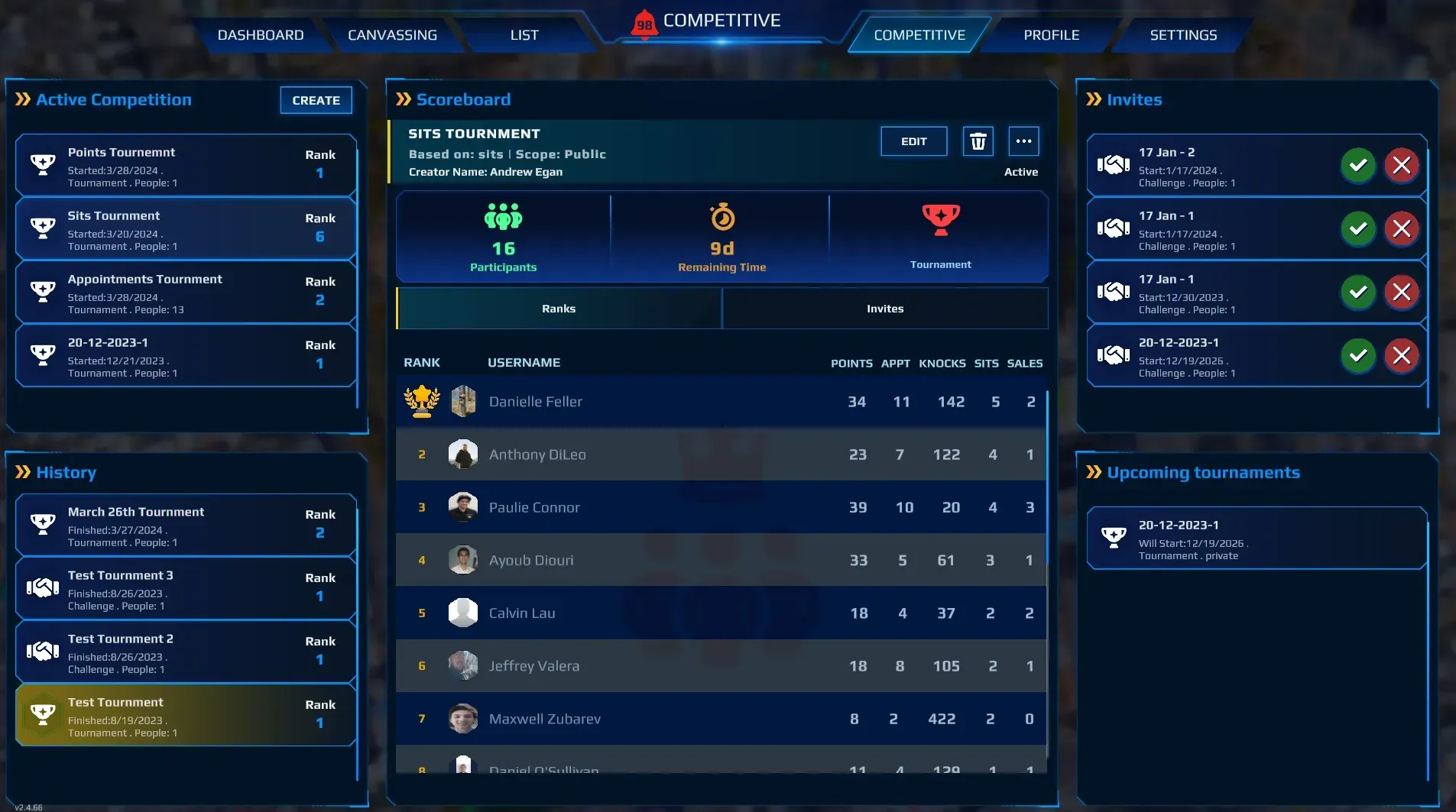
Knockbase was built so field teams never have to choose between accurate pay and a free Friday. Its sales commission calculator computes payouts automatically from verified activity, applies your custom rules including tiers and overrides, and adjusts for chargebacks without a manager rebuilding a spreadsheet.
- Because it pulls directly from field activity captured in the door-to-door sales software, there is no double entry and no gap between what was sold and what gets paid.
- Reps see transparent, real-time breakdowns of their earnings, which heads off disputes before they start and keeps motivation high.
- Managers get their time back to coach through the sales rep management software rather than refereeing arithmetic, while gamified standings in the gamified door knocking app channel competitive energy into more sales.
- Activity logged in the canvassing software feeds the whole system, so the numbers always reflect reality on the ground.
The result is what every commission plan promises, but few deliver: pay that reps trust, delivered on time, with the manager free to focus on the business instead of the math.
Conclusion
Calculating commissions isn't just about getting the numbers right, it's about creating a compensation system your team trusts. Every accurate payout reinforces confidence, rewards performance, and keeps reps focused on selling rather than questioning their paychecks.
As your team grows, the complexity of commission plans grows with it. What starts as a manageable spreadsheet eventually becomes a weekly source of errors, disputes, and lost productivity. The teams that scale successfully don't spend more time calculating commissions, they automate the process, apply rules consistently, and give every rep complete transparency into how they're paid.
If commission day has become one of the busiest days of your week, it's probably time to replace manual calculations with a system built for modern door-to-door sales.
Great Sales Teams Earn Trust Twice: At the Door and on Payday.
Winning a customer takes effort. Keeping great reps takes confidence that every sale will be rewarded accurately. Knockbase's Commission Calculator automates payouts, eliminates manual errors, and gives managers and reps complete visibility into every commission.
Schedule a personalized demo today and discover how Knockbase makes commission day faster, fairer, and stress-free.
FAQ's
How do you calculate door-to-door sales commissions?
Multiply each qualified sale by its commission rate or tier, add any earned bonuses, then subtract adjustments for cancellations and chargebacks. Account for splits and overrides, and document the breakdown. For every door-to-door salesman, a clear and accurate calculation builds trust and reduces payout disputes.
What is the best commission structure for door-to-door selling?
There is no universal answer. Flat rates suit standardized products, percentages reward higher-value deals, and tiered plans push top performers. Most teams blend structures, choosing based on margins and the behaviors they want to encourage.
How do I avoid commission disputes?
Transparency. When reps can see exactly how each payout was calculated in real time, disputes largely disappear. Automated, self-serve breakdowns do this far better than a manager explaining a spreadsheet after the fact.
When should I switch from spreadsheets to commission software?
When errors, disputes, or payroll time start climbing, usually somewhere past twenty reps or once you run multiple plans. If reconciliation regularly costs you hours, or you have paid someone wrong, you have already outgrown manual tracking. This becomes especially important as the number of door-to-door salespeople and commission plans increases.
Does commission software integrate with sales tracking?
Good platforms calculate directly from verified field activity, so there is no separate data entry. That single source of truth is what makes payouts both accurate and instant.

Canvassing Software ROI: How Sales Managers Should Calculate Cost-Per-Knock vs Cost-Per-Lead in 2026